
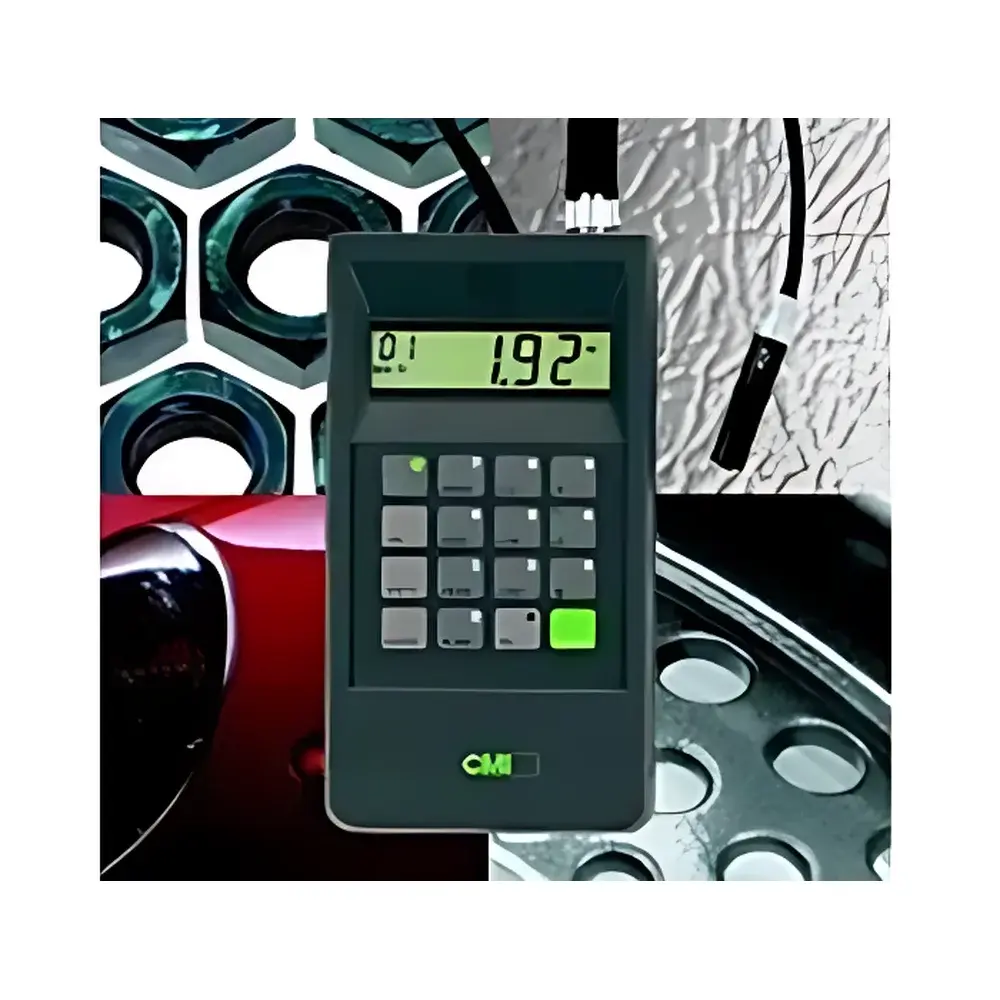
Oxford Instruments CMI233 Electromagnetic Eddy Current & Magnetic Induction Coating Thickness Gauge
| Brand | Oxford Instruments |
|---|---|
| Origin | USA |
| Model | CMI233 |
| Measurement Principle | Magnetic Induction (for non-magnetic coatings on ferrous substrates) & Eddy Current (for non-conductive coatings on non-ferrous conductive substrates) |
| Accuracy | ±1% or ±0.1 µm (per certified reference standards) |
| Measurement Range | Magnetic Induction: 0–3.05 mm (0–120 mils) |
| Eddy Current | 0–1.52 mm (0–60 mils) |
| Resolution | 0.1 µm |
| Minimum Substrate Thickness | 0.35 mm |
| Minimum Curvature Radius | 5 mm (convex), 25 mm (concave) |
| Minimum Measured Area | Ø20 mm |
| Compliance | ASTM B499, B530, B244, B259 |
| Data Storage Capacity | 12,400 readings |
| Display | 1/2-inch backlit LCD |
| Interface | RS-232 serial port |
| Power | 9 V alkaline or rechargeable battery |
| Weight | 260 g (including battery) |
| Units | Dual metric/imperial with toggle switch |
| Statistical Functions | Mean, Std Dev, Min/Max, Histogram, CPK, Count |
| Scan Mode | Time-based automatic averaging with optional min/max capture |
| Keypad | Sealed membrane, 9-key basic / 16-key enhanced layout |
Overview
The Oxford Instruments CMI233 is a dual-mode, handheld coating thickness gauge engineered for precision and reliability in industrial quality control environments. It operates on two complementary physical principles: magnetic induction for measuring non-magnetic coatings (e.g., Zn, Cr, paint, epoxy) on ferromagnetic substrates (steel, iron), and eddy current for measuring non-conductive coatings (e.g., anodized layers, enamel, powder coatings, plastics) on non-ferrous conductive substrates (aluminum, copper, brass). This dual-sensor architecture eliminates the need for separate instruments in mixed-material production lines—common in automotive body shops, aerospace component finishing, pipeline corrosion protection, and electronics plating facilities. The device complies with internationally recognized metrological standards including ASTM B499/B530 (magnetic) and ASTM B244/B259 (eddy current), ensuring traceable, auditable measurements suitable for ISO 9001-certified processes and third-party inspection protocols.
Key Features
- Dual-principle measurement engine supporting both magnetic induction and eddy current modes without hardware switching—calibration and mode selection are software-controlled and context-aware.
- High-resolution 0.1 µm display resolution with ±1% or ±0.1 µm accuracy (whichever is greater), validated against NIST-traceable certified reference standards per ISO/IEC 17025 laboratory practices.
- Rugged, sealed-membrane keypad (IP54-rated ingress protection) and compact ergonomic housing (149 × 79.4 × 30.2 mm) optimized for one-handed operation in oily, dusty, or high-vibration settings such as shipyard decks or electroplating bath lines.
- Onboard statistical analysis suite: real-time calculation of mean, standard deviation, min/max values, histogram generation, and process capability index (CPK) — all exportable via RS-232 to SPC software or LIMS platforms.
- Adaptive scan mode enables time-synchronized averaging across variable surface topographies—critical for curved components like exhaust manifolds or turbine blades where single-point repeatability is compromised by geometry.
- Configurable unit system (µm/mils) with instant toggle, eliminating manual conversion errors during cross-functional reporting between US-based OEMs and Asian Tier-1 suppliers.
Sample Compatibility & Compliance
The CMI233 is validated for use on flat, curved, and irregular surfaces meeting minimum geometric constraints: convex radii ≥5 mm and concave radii ≥25 mm. Minimum substrate thickness is 0.35 mm to prevent signal interference from underlying support structures. It supports measurement on coated fasteners, welded joints, and heat-treated castings without requiring substrate-specific calibration offsets—enabled by auto-compensated lift-off correction algorithms. Regulatory alignment includes full adherence to ASTM, ISO, DIN, and BS standards referenced in global manufacturing specifications (e.g., Ford WSS-M2P177-A2, GMW14872, Boeing D6-17487). For regulated industries, the instrument’s deterministic firmware behavior, immutable audit log timestamps, and RS-232 data integrity support FDA 21 CFR Part 11-compliant electronic record workflows when integrated with validated data acquisition systems.
Software & Data Management
Data handling is designed for integration into enterprise quality ecosystems. All 12,400 stored readings include timestamp, measurement mode, substrate type flag, and operator ID (assignable via keypad). Export formats include ASCII CSV and fixed-field binary streams compatible with Minitab, JMP, and custom SQL-based dashboards. The RS-232 interface supports hardware handshaking (RTS/CTS) and configurable baud rates (up to 115.2 kbps), enabling direct connection to PLC-controlled test stations or automated pass/fail gating logic. Firmware updates are delivered via serial load—no proprietary dongles or cloud dependencies—ensuring long-term maintainability in air-gapped production networks.
Applications
- Automotive: Verification of e-coat thickness on chassis frames, zinc-nickel plating on brake calipers, and ceramic thermal barrier coatings on exhaust valves.
- Aerospace: In-process monitoring of anodized Al 7075-T6 thickness per AMS-A-8625 Type II/III, and nickel-phosphorus electroless deposits on turbine housings.
- Energy Infrastructure: Field verification of fusion-bonded epoxy (FBE) lining thickness on API 5L X70 pipeline spools prior to hydrostatic testing.
- Electronics: Quantitative assessment of solder mask uniformity on PCB panels and gold flash thickness on connector contacts.
- General Manufacturing: Routine QC of powder-coated enclosures (RAL/BS EN 13438 compliance), galvanized steel sheet (ISO 1461), and enamel-coated cookware (ISO 27926).
FAQ
Does the CMI233 require annual recalibration?
Yes—Oxford Instruments recommends annual recalibration against certified reference standards traceable to national metrology institutes (e.g., NPL, NIST) to maintain compliance with ISO/IEC 17025 and internal QA procedures.
Can it measure coatings on stainless steel substrates?
Yes, but only if the stainless steel is ferritic or martensitic (magnetically permeable). Austenitic grades (e.g., 304, 316) require eddy current mode and must be conductive—surface passivation or oxide layers may reduce accuracy and necessitate substrate-specific verification.
Is the RS-232 interface compatible with modern Windows 10/11 systems?
Yes, using a certified USB-to-serial adapter with WHQL-signed drivers; native COM port enumeration is supported without additional middleware.
What is the warranty coverage for the probe assembly?
The CMI233 probe is covered under Oxford Instruments’ standard 2-year limited warranty, excluding wear-related degradation of the wear-resistant ceramic tip under normal industrial use.
Does the device support GLP/GMP audit trails?
While the standalone unit does not generate electronic signatures, its deterministic timestamping, immutable read-only memory storage, and RS-232 data integrity enable compliant audit trail reconstruction when paired with validated external data management software meeting 21 CFR Part 11 requirements.



