
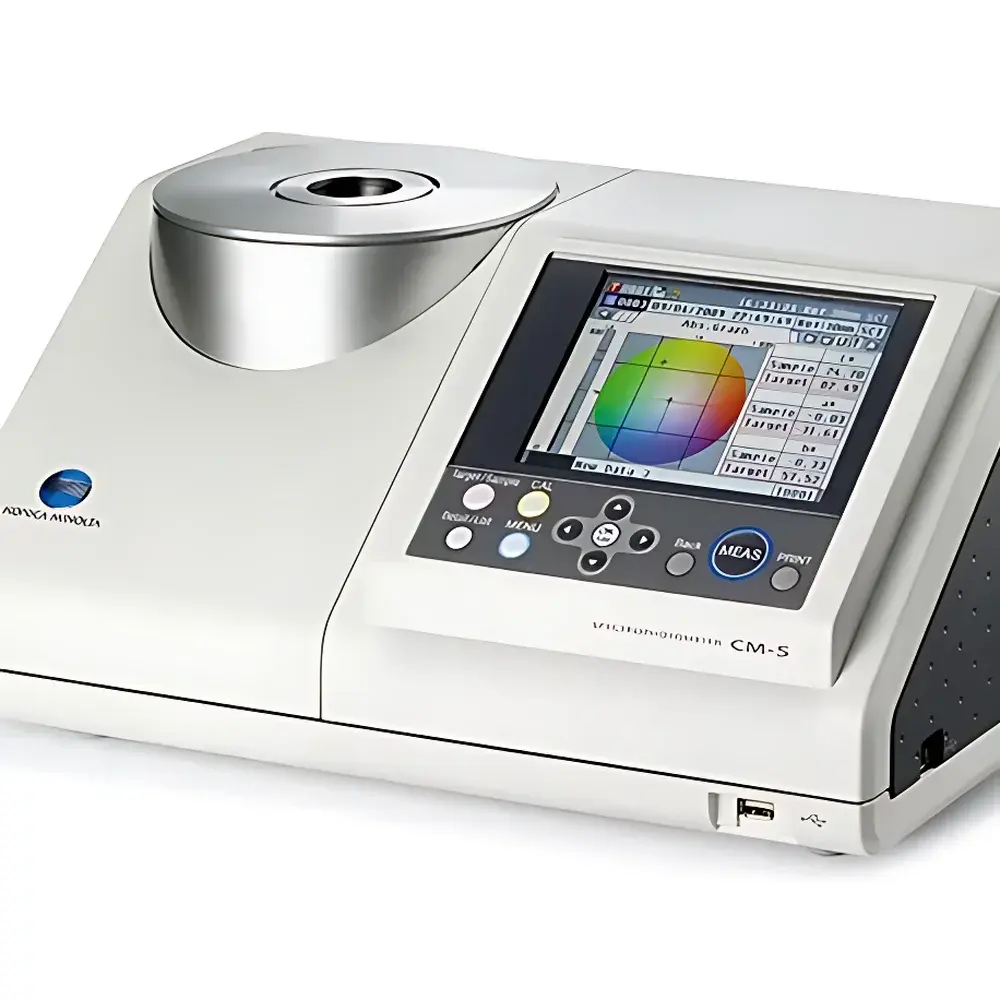
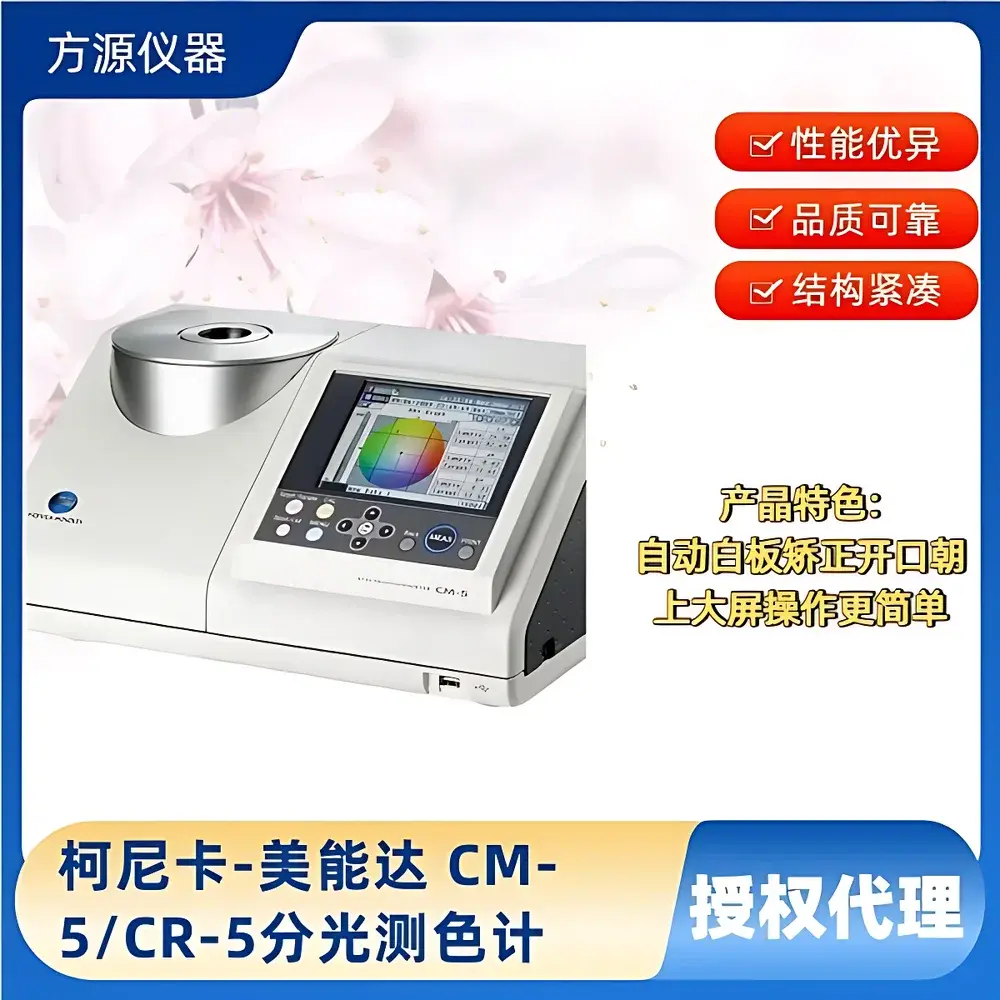
Konica Minolta CM-5 / CR-5 Desktop Spectrophotometer with Top Port
| Brand | Konica Minolta |
|---|---|
| Origin | Japan |
| Instrument Type | Benchtop |
| Measurement Principle | Diffuse Illumination / 8° Viewing (d/8°) for Reflectance |
| Compliance | CIE No.15, ISO 7724-1, ASTM E1164, DIN 5033-7, JIS Z 8722 (Condition C) |
| Spectral Range | 360–740 nm |
| Spectral Interval | 10 nm |
| FWHM | ~10 nm |
| Integrating Sphere Diameter | Ø152 mm |
| Detector | Dual-row 40-element silicon photodiode array |
| Grating | Plane diffraction grating |
| Light Source | Pulsed xenon lamp with UV filter |
| Measurement Time | ~1 s (data output) |
| Minimum interval | ~3 s |
| Repeatability | ΔE*ab ≤ 0.04 (after white calibration, 30 measurements at 10 s intervals) |
| Inter-instrument Agreement | ΔE*ab ≤ 0.15 (typical, BCRA Series II, 23°C) |
| Reflectance Range | 0–170% |
| Resolution | 0.01% |
| Illumination/Aperture Options | LAV (Ø30/Ø36 mm), MAV (Ø8/Ø11 mm, optional), SAV (Ø3/Ø6 mm, optional) |
| Transmittance Aperture | Ø20 mm |
| Transmittance Chamber Max Thickness | 60 mm |
| Display | 5.7″ TFT color LCD |
| Languages | English, Simplified Chinese, Japanese, German, French, Italian, Spanish |
| Observer Angles | 2° and 10° standard observers |
| Illuminants | A, C, D50, D65, F2, F6, F7, F8, F10, F11, F12, ID50, ID65 (dual-illuminant display supported) |
| Color Spaces | CIE L*a*b*, L*C*h*, Hunter Lab, Yxy, XYZ, Munsell (color difference only in non-Munsell spaces) |
| Color Difference Formulas | ΔE*ab (CIE 1976), ΔE94 (CIE 1994), ΔE00 (CIE 2000), ΔE(Hunter), CMC (l:c) |
| Indices | MI, WI (ASTM E313-73/96), YI (ASTM E313-73/96, ASTM D1925), ISO Brightness, B (ASTM E313-73), Gardner, Iodine, Hazen/APHA, EP, USP |
| Tolerance Setting | For color values (except Munsell), color differences, or reflectance indices |
| Data Storage | 4,000 sample measurements + 1,000 standards internally |
| Interface | USB 1.1 (PC & USB memory), RS-232C (printer) |
| Power | AC 100–240 V, 50/60 Hz (with supplied adapter) |
| Dimensions (closed) | 385 × 192 × 261 mm (W × H × D) |
| (open) | 475 × 192 × 261 mm |
| Weight | ~5.8 kg |
| Operating Environment | 13–33°C, ≤80% RH (non-condensing at ≤35°C) |
| Storage Environment | 0–40°C, ≤80% RH (non-condensing at ≤35°C) |
Overview
The Konica Minolta CM-5 and CR-5 are benchtop spectrophotometers engineered for high-precision color measurement in quality control, R&D, and regulatory-compliant production environments. Designed with a top-port optical architecture, these instruments employ dual-beam diffuse illumination geometry—d/8° for reflectance and d/0° for transmittance—to ensure metrological consistency across diverse material classes. The core optical system integrates a 152 mm integrating sphere, a pulsed xenon lamp with integrated UV filtering, and a plane diffraction grating coupled to a dual-row 40-element silicon photodiode array. This configuration delivers spectral data from 360 nm to 740 nm at 10 nm intervals, with a full-width half-maximum (FWHM) of approximately 10 nm—meeting the spectral resolution requirements defined in ISO 7724-1 and ASTM E1164. The instrument supports both SCI (Specular Component Included) and SCE (Specular Component Excluded) modes via software-selectable optical path routing, enabling accurate characterization of textured, glossy, and metallic surfaces without mechanical reconfiguration.
Key Features
- Top-port optical design optimized for ergonomic sample placement and unobstructed access to large or irregularly shaped specimens—including rolled goods, molded parts, and rigid panels.
- Dual-standard observer capability (2° and 10°) and comprehensive illuminant library (A, C, D50, D65, F-series, ID50/ID65) supporting multi-condition color evaluation per ISO/CIE guidelines.
- Three interchangeable aperture sizes for reflectance (LAV: Ø30/Ø36 mm; MAV and SAV optional) and fixed Ø20 mm aperture for transmittance, ensuring geometric conformity with ASTM D2244 and ISO 11664-4.
- Automated white calibration (reflectance) and 100% transmittance calibration using built-in reference tiles—reducing operator dependency and minimizing drift-related uncertainty.
- High repeatability: spectral reflectance standard deviation ≤0.1% (400–740 nm); chromaticity repeatability ΔE*ab ≤0.04 under controlled conditions after white calibration.
- Inter-instrument agreement of ΔE*ab ≤0.15 (typical) validated against BCRA Series II reference tiles—critical for multi-site color matching and supply chain traceability.
- Transmittance chamber accommodates samples up to 60 mm thick with no lateral width restriction, compatible with cuvettes, films, liquids, and translucent polymers.
Sample Compatibility & Compliance
The CM-5/CR-5 accommodates opaque, translucent, and transparent materials—including plastics, paints, textiles, ceramics, pharmaceutical tablets, food packaging, and optical filters. Its d/8° reflectance geometry complies with ISO 7724-1, ASTM E1164, and JIS Z 8722 (Condition C), while its d/0° transmittance mode aligns with ISO 11664-4 and ASTM D1003. The instrument supports GLP/GMP-aligned workflows through audit-trail-capable software (e.g., SpectraMagic NX), enabling user authentication, parameter logging, and electronic signature support per FDA 21 CFR Part 11 when deployed with compliant IT infrastructure. All colorimetric calculations adhere to CIE 15:2018 and ISO 11664 series standards, and derived indices—including WI (ASTM E313), YI (ASTM D1925), APHA/Hazen, and European Pharmacopoeia specifications—are computed using standardized coefficients and weighting functions.
Software & Data Management
SpectraMagic NX software (included) provides full instrument control, spectral visualization, tolerance mapping, and report generation in PDF, CSV, or XML formats. It supports multi-illuminant comparison, pass/fail evaluation with configurable ΔE thresholds, and custom index formulation using user-defined mathematical expressions. Internal memory stores up to 4,000 sample measurements and 1,000 standard references. USB 1.1 interface enables direct transfer to PCs or encrypted-free USB memory devices for offline analysis. RS-232C port supports legacy label printers for shop-floor documentation. Data export includes full spectral curves, tristimulus values, color differences, and metadata (operator ID, timestamp, instrument serial number)—facilitating integration into LIMS and MES platforms.
Applications
The CM-5/CR-5 serves as a primary color measurement platform in industries requiring strict conformance to international color standards. In automotive OEM and Tier-1 supply chains, it validates paint gloss, interior trim, and exterior plastic components against OEM color standards (e.g., BMW GS95024, Ford WSS-M2P195-A). In pharmaceutical manufacturing, it quantifies tablet film coating uniformity and excipient batch-to-batch consistency per USP <1061> and EP 2.2.57. In food and beverage packaging, it verifies ink consistency on flexible laminates and monitors yellowing of PET bottles via ASTM D1925 YI. In academic and industrial pigment research, its high-resolution spectral data supports Kubelka-Munk modeling and metamerism analysis under multiple illuminants.
FAQ
Does the CM-5/CR-5 support FDA 21 CFR Part 11 compliance?
Yes—when used with SpectraMagic NX v3.6 or later and configured with role-based user accounts, electronic signatures, and audit-trail logging enabled, the system meets foundational requirements for Part 11 compliance in regulated environments.
Can the instrument measure small or curved samples?
Yes—the top-port design and optional SAV (Ø3 mm) aperture enable precise measurement of small-area features, printed dots, or localized surface defects. Curved samples may be measured using the LAV aperture with appropriate fixturing to maintain consistent geometry.
Is UV calibration required for fluorescence measurement?
The built-in UV filter is fixed and non-removable; therefore, the instrument does not support UV-excited fluorescence measurement. For fluorescent whitening agent (FWA) assessment, users must rely on UV-included (SCI) mode with D65 or D50 illuminants calibrated to include typical UV energy profiles.
What is the maximum sample thickness for transmittance measurement?
The transmittance chamber accepts samples up to 60 mm in thickness, with no lateral width limitation—suitable for thick glass, acrylic blocks, or stacked polymer sheets.
Are calibration standards traceable to NIST or other national metrology institutes?
Konica Minolta certifies its white calibration tile and BCRA reference tiles with traceability to NMIJ (National Metrology Institute of Japan), which maintains mutual recognition agreements (CIPM MRA) with NIST, PTB, and NPL for spectral reflectance.




