
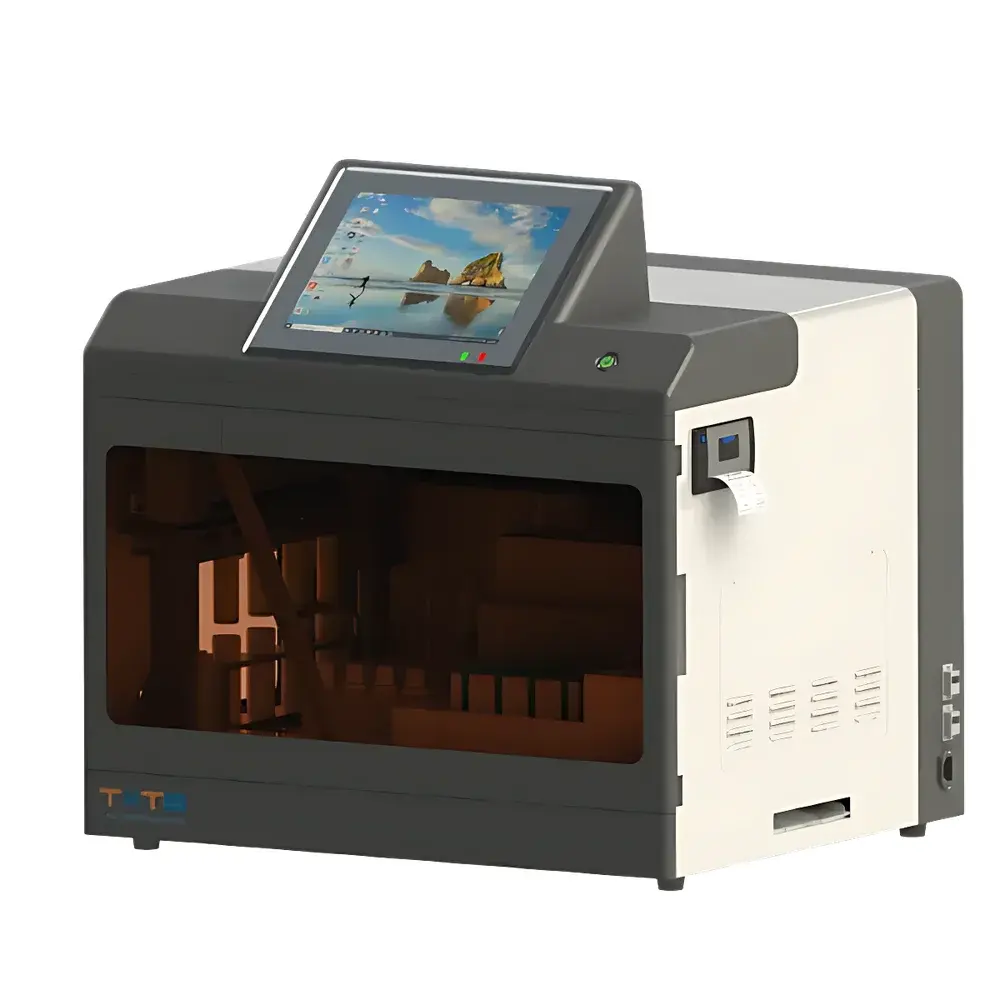
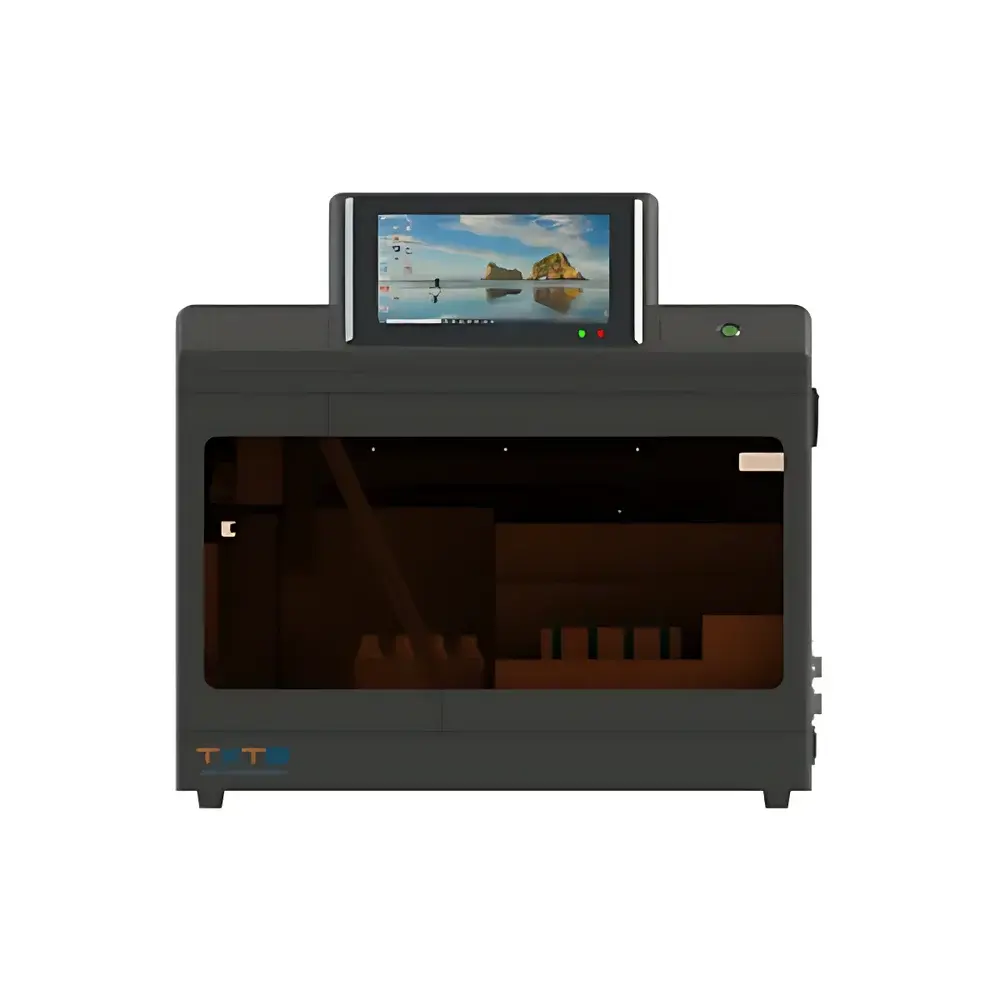
Tongxintianbo TON-IV Automated Mycotoxin Quantitative Analyzer
| Brand | Tongxintianbo |
|---|---|
| Origin | Beijing, China |
| Model | TON-IV |
| Instrument Category | Aflatoxin Analyzers |
| Detection Principle | Fluorescent Quantitative Immunoassay (Lateral Flow Immunochromatography) |
| Target Analytes | Aflatoxin B1 & M1, Zearalenone, Deoxynivalenol (DON), Fumonisin, Ochratoxin A, T-2 Toxin |
| Detection Range | 0.1 ppb – 10 ppm (for AFB1 and DON) |
| Limit of Detection (LOD) | 0.1 ppb (for AFB1 and DON) |
| Coefficient of Variation (CV) | ≤0.8% |
| Throughput | 4 parallel channels |
| Sample Processing | Fully automated extraction, vortexing, transfer, and assay incubation |
| System Architecture | Sealed XYZ robotic platform with integrated cleaning station |
| Compliance | Designed for GLP-compliant environments |
Overview
The Tongxintianbo TON-IV Automated Mycotoxin Quantitative Analyzer is an integrated benchtop instrument engineered for high-throughput, regulatory-grade quantification of major mycotoxins in food and feed matrices. It operates on the principle of fluorescent quantitative lateral flow immunoassay — a validated, antibody-based detection method where analyte-specific capture antibodies immobilized on nitrocellulose strips bind target mycotoxins in sample extracts, followed by fluorescently labeled detection antibodies. The intensity of emitted fluorescence at the test line is measured via calibrated photodiode detection and converted into concentration values using preloaded, matrix-matched calibration curves. Unlike manual strip readers or semi-automated platforms, the TON-IV embeds full sample preparation — including solvent-assisted extraction, vortex-assisted homogenization, centrifugation (via external centrifuge integration or optional on-board mini-centrifuge module), supernatant transfer, dilution, and strip incubation — within a single, closed robotic workflow. This eliminates operator-dependent variability in pipetting, timing, and environmental exposure, thereby enhancing measurement reproducibility and reducing inter-laboratory discrepancies.
Key Features
- Fully automated 4-channel parallel processing: Simultaneous analysis of up to four independent samples, each configurable for single- or multi-analyte testing (e.g., AFB1 + DON + ZEN in one run), cutting total assay cycle time by ≥65% versus sequential single-channel systems.
- Integrated XYZ robotic platform: Precision stepper-motor-driven arm performs extraction, mixing, phase separation (with optional centrifuge handshake), liquid handling, and lateral flow strip loading without manual intervention.
- Hermetically sealed processing chamber: Prevents solvent vapor release (e.g., acetonitrile, methanol, chloroform) and cross-contamination between runs; maintains consistent ambient humidity and temperature during incubation phases.
- Programmable ultrasonic-coupled cleaning station: Dedicated wash reservoir and disposable tip management system execute customizable cleaning cycles (number, volume, dwell time) between samples, validated to achieve <0.001% carryover for high-concentration standards.
- Embedded 10.1-inch industrial touchscreen HMI: Runs real-time status monitoring, method selection, QC flagging, and result review without requiring external PCs — minimizing lab footprint and cybersecurity surface area.
- Pre-validated assay cartridge interface: Compatible with CE-IVD–marked and AOAC-RI–certified fluorescent immunochromatographic test kits for all six regulated mycotoxins (AFB1/M1, DON, ZEN, OTA, FB1, T-2).
Sample Compatibility & Compliance
The TON-IV accepts raw and processed agricultural commodities including corn, wheat, barley, rice, soybean meal, peanut paste, dairy powder, and finished pet food. Sample input formats include ground grains (≤0.5 mm particle size), liquid milk, and extracted supernatants from QuEChERS or immunoaffinity column clean-up workflows. All onboard protocols are aligned with ISO/IEC 17025:2017 documentation requirements and support compliance with EU Commission Regulation (EC) No 1881/2006, FDA Action Levels (21 CFR §109.18), and Codex Alimentarius GSCTM-2023 guidelines. The system architecture enables full electronic record retention — including raw fluorescence counts, calibration logs, maintenance timestamps, and user authentication events — satisfying FDA 21 CFR Part 11 Annex 11 and EU GMP Annex 11 data integrity expectations when deployed with version-controlled firmware and access-controlled user roles.
Software & Data Management
The embedded operating system features a role-based access control (RBAC) framework with three tiers: Operator (run-only), Supervisor (method edit + QC review), and Administrator (system configuration + audit log export). Data output includes PDF analytical reports with embedded chromatogram-like fluorescence profiles, CSV exports compliant with LIMS ingestion schemas (ASTM E1482, ASTM E2500), and encrypted SQLite databases supporting 10-year retention. Optional cloud synchronization (via TLS 1.3–secured API) enables remote QC dashboarding and multi-site method harmonization. All software modules undergo annual revalidation per ICH Q2(R2) guidance, with version history archived and change logs retained for regulatory inspection.
Applications
- Grain elevator and silo intake screening: Rapid triage of inbound corn and wheat lots against AFB1 and DON action thresholds prior to storage or milling.
- Feed mill quality assurance: In-line verification of premixes and compound feeds for OTA and fumonisins to meet EU Directive 2002/32/EC limits.
- Third-party contract laboratories: High-volume batch testing for certification bodies requiring ISO/IEC 17025 accreditation evidence of automation-driven uncertainty reduction.
- National food safety surveillance programs: Deployment in regional labs conducting annual mycotoxin monitoring across staple crops, with built-in reporting templates aligned with WHO/FAO Global Environment Monitoring System–Food Contamination (GEMS/Food) data submission formats.
- R&D applications: Method development support for novel toxin analogs (e.g., AFB2, AFG1) via custom curve fitting and open calibration file import.
FAQ
Does the TON-IV require external centrifugation?
Yes — standard configuration assumes integration with a compatible benchtop centrifuge (≥3,000 × g, 15 mL tube capacity); optional add-on mini-centrifuge module is available for fully self-contained operation.
Can the system validate multi-toxin panels in a single run?
Yes — each channel independently supports up to three analytes per sample using multiplexed lateral flow strips; method files define analyte-specific calibrations and decision logic per channel.
Is method transfer supported between instruments?
Yes — calibration files, QC templates, and assay protocols are exportable/importable via USB or network share in standardized .tonpkg format, enabling consistent performance across distributed lab networks.
What maintenance intervals are recommended?
Daily: Tip rack replacement and waste bin emptying. Weekly: Optical path cleaning and fluidic line priming. Quarterly: Robotic arm calibration and seal integrity verification per manufacturer’s SOP-MAINT-04.
How is data integrity ensured during power failure?
The system incorporates non-volatile memory buffers and automatic resume-on-reboot functionality; all active assays retain state metadata and continue from last validated step upon recovery.




