
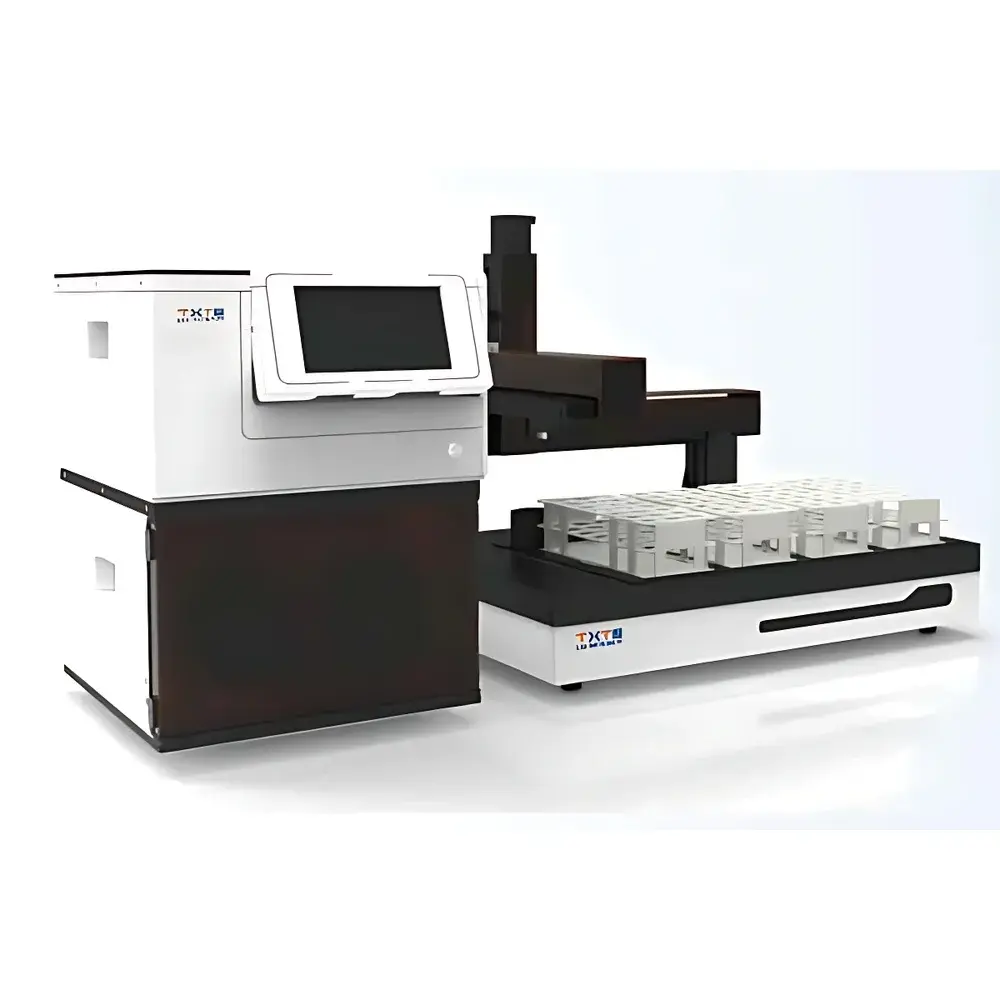
Tongxintianbo AVP-40/40A Fully Automated Liquid Dispenser
| Brand | Tongxintianbo |
|---|---|
| Origin | Beijing, China |
| Model | AVP-40/40A |
| Dimensions (Main Unit) | 780 × 570 × 380 mm |
| Dimensions (Auxiliary Unit) | 350 × 390 × 480 mm |
| Power Supply | 220 V / 50 Hz |
| Power Consumption | 500 W |
| Operating Temperature | −10–45 °C |
| Dispensing Volume Range | 1–1000 mL per cycle |
| Minimum Dispense Volume | 1 mL per cycle |
| Pump Configuration | Standard 1 peristaltic pump |
| Fluid Path | Standard single-channel |
| Compatible Vessel Sizes | 10, 15, 40, 50, and 100 mL tubes |
| Display | 7.0-inch high-sensitivity color touchscreen |
| Cleaning Protocol | Automatic pre- and post-dispense rinse |
| Tubing Material | Acid-/alkali-resistant silicone |
| Housing Material | ABS plastic |
| Sample Rack Material | Polypropylene (PP) or polycarbonate (PC), chemical-resistant |
| Dispense Modes | Single-point, multi-point, and segmented dispensing with user-defined time intervals |
| Compatible Liquids | Deionized water, aqueous buffers, cell culture media, organic solvents (e.g., methanol, acetonitrile), weak acids (≤1 M HCl, HNO₃), weak bases (≤1 M NaOH, NH₄OH) |
Overview
The Tongxintianbo AVP-40/40A Fully Automated Liquid Dispenser is a precision-engineered sample preparation workstation designed for high-throughput, repeatable liquid handling in regulated and research laboratory environments. Built upon a dual-chamber modular architecture—comprising a main control unit and an auxiliary fluid management module—the system implements peristaltic pumping technology to deliver volumetrically accurate, contamination-minimized liquid transfers without contact between the drive mechanism and the fluid path. This non-invasive actuation principle ensures compatibility with a broad spectrum of chemically diverse reagents while eliminating risk of cross-contamination from internal valves or seals. The AVP-40/40A operates under programmable dispense logic, supporting single-target, multi-target, and segmented distribution protocols across heterogeneous vessel arrays. Its design prioritizes operational robustness, ease of validation, and seamless integration into routine QC/QA workflows—including those governed by ISO/IEC 17025, CLIA, or GLP-compliant sample preparation pipelines.
Key Features
- Modular dual-unit configuration enables flexible benchtop deployment and scalable fluid routing
- Peristaltic pump architecture with chemically resistant silicone tubing (standard) and optional fluoropolymer-lined alternatives for aggressive solvents
- Seven-inch capacitive touchscreen interface with intuitive icon-driven navigation and real-time status feedback
- Programmable dispense sequencing: single-point (same destination), multi-point (identical volume to multiple vessels), and segmented (variable volumes across positions)
- Automated pre- and post-dispense tubing rinsing using dedicated wash solvent reservoirs to prevent carryover and ensure inter-sample integrity
- Expandable fluid handling capacity: base configuration supports one pump channel; upgradable to four independent pumps for parallel reagent delivery
- Wide vessel compatibility—from 10 mL centrifuge tubes to 100 mL wide-mouth bottles—via adjustable rack fixtures and height calibration
- Temperature-stable operation across −10 °C to 45 °C ambient range, suitable for cold-room or warm-hold applications
Sample Compatibility & Compliance
The AVP-40/40A accommodates aqueous, organic, and mildly corrosive liquids commonly encountered in analytical, environmental, pharmaceutical, and food safety laboratories. Validated compatibility includes phosphate-buffered saline (PBS), nutrient broths (e.g., LB, Mueller-Hinton), methanol/acetonitrile mixtures for HPLC mobile phase preparation, dilute nitric acid (≤1 M) for trace metal digestion, and ammonium hydroxide solutions used in pesticide residue extraction. All wetted materials conform to USP Class VI biocompatibility standards and FDA 21 CFR 177.2600 for indirect food contact. System firmware supports audit trail generation with timestamped event logging (dispense start/stop, error codes, cleaning cycles), fulfilling core requirements for ALCOA+ data integrity principles. While not pre-certified to IEC 61000-6-3 or UL 61010-1, the instrument meets CE marking criteria for electromagnetic compatibility and low-voltage safety when operated within specified environmental conditions.
Software & Data Management
The embedded control software provides full local operation without dependency on external PCs. Users define methods via graphical workflow editors—specifying volume per target, dwell time, rinse volume, and pump rotation speed (RPM). Method files are stored internally with version tagging and exportable via USB 2.0 port in CSV or XML format for LIMS integration. Audit trails record operator ID (optional PIN login), method name, start/end timestamps, total dispensed volume per cycle, and any system alerts (e.g., tubing occlusion, low wash solvent). No cloud connectivity or remote access capabilities are implemented, preserving data sovereignty—a critical consideration for labs operating under GDPR, HIPAA, or national cybersecurity frameworks.
Applications
- Preparation of standardized microbial growth media across microbiology and fermentation labs
- Accurate proportioning of acid mixtures (e.g., HNO₃/HF) into digestion tubes for ICP-MS sample prep
- Dilution series generation for pesticide residue analysis (AOAC 2007.01, EN 15662)
- Volumetric dosing of internal standards into LC-MS/MS sample vials prior to derivatization
- Automated filling of UV-Vis cuvettes or microplate wells for spectral calibration
- Batch-wise addition of catalysts or quenching agents in kinetic assay development
- Consistent solvent blending for GC-FID carrier gas humidification or HPLC gradient optimization
FAQ
What regulatory standards does the AVP-40/40A support for data integrity?
It generates time-stamped, immutable audit trails compliant with ALCOA+ principles and supports 21 CFR Part 11–aligned procedural controls when paired with documented SOPs and access restriction policies.
Can the system handle viscous solutions such as glycerol or polymer stock solutions?
Yes—viscosity tolerance depends on tubing inner diameter and pump RPM; recommended upper limit is ~200 cP at 25 °C using 3.2 mm ID tubing.
Is third-party calibration documentation available?
Factory calibration certificates (volumetric accuracy ±1.5% RSD at 10 mL and 100 mL) are provided; users may perform periodic verification using gravimetric or photometric reference methods per ISO 8655-6.
How is tubing wear managed during long-term operation?
The system logs cumulative pump revolutions; maintenance alerts trigger at user-configurable thresholds (default: 10,000 rotations), prompting tubing replacement to maintain volumetric fidelity.
Does the AVP-40/40A support barcode-triggered dispensing?
No native barcode reader is integrated; however, external scanners may be used to populate sample IDs via USB HID emulation if custom scripting is deployed on connected hosts.



