
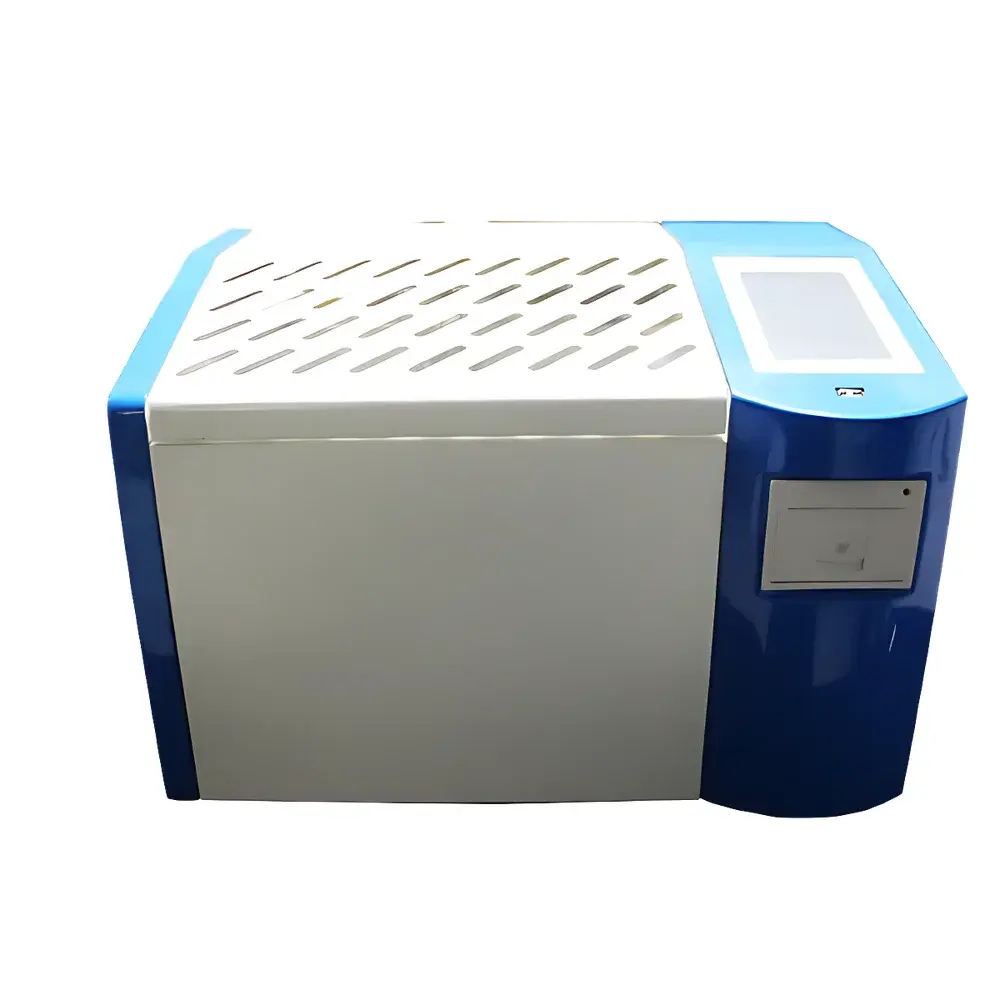
FlanD FDT-0531 Insulating Oil Dielectric Strength Tester
| Brand | FlanD / csfriend |
|---|---|
| Origin | Hunan, China |
| Manufacturer Type | Authorized Distributor |
| Country of Manufacture | China |
| Model | FDT-0531 |
| Test Voltage Range | 0–80 kV |
| Voltage Distortion Rate | <3% |
| Rising Rate | 2.0–3.5 kV/s |
| Standby Time | 15 min (adjustable) |
| Interval Between Steps | 15 min (adjustable) |
| Number of Breakdown Tests per Sample | 1–6 |
| Transformer Capacity | 1.5 kVA |
| Measurement Accuracy | ±(2% + 2 digits) |
| Power Supply | AC 220 V / 50 Hz |
| Rated Power | 500 W |
| Operating Temperature | 10–45 °C |
| Operating Humidity | 30–85% RH |
| Data Storage | 100 test records with ambient temperature & humidity logging |
| Safety Protections | Overvoltage, overcurrent, and mechanical limit interlocks |
| Display | Large LCD with Chinese menu interface |
| Output | Thermal printer for breakdown voltage values (per trial), cycle count, and mean value |
Overview
The FlanD FDT-0531 Insulating Oil Dielectric Strength Tester is a microprocessor-controlled, triple-cup dielectric withstand testing system engineered for precise and repeatable determination of the dielectric breakdown voltage (BDV) of transformer oils, turbine oils, and other insulating liquids used in high-voltage electrical equipment. It operates on the principle of stepwise AC voltage application—per ASTM D877 and IEC 60156—where a controlled sinusoidal 50 Hz voltage is applied across two standardized spherical electrodes immersed in the oil sample until electrical breakdown occurs. The instrument automatically executes the full test sequence—including oil stirring, static settling, voltage ramping, arc detection, post-breakdown pause, and statistical averaging—ensuring compliance with international standard protocols for insulation integrity assessment in power generation, transmission, and distribution infrastructure.
Key Features
- Triple-cup design enables sequential or parallel testing of up to three independent oil samples without manual electrode repositioning or chamber draining.
- Microcontroller-driven voltage regulation ensures stable 50 Hz output frequency and linear ramp rates adjustable between 2.0–3.5 kV/s—meeting the tolerance requirements of IEC 60156 Clause 6.2 and ASTM D877 Section 7.3.
- Integrated environmental monitoring logs ambient temperature and relative humidity during each test cycle—critical for BDV correction per IEEE Std C57.106 Annex B and ISO 6292.
- Thermal line printer provides traceable hardcopy output of individual breakdown voltages, number of breakdown events per sample, arithmetic mean BDV, and timestamped test metadata.
- Non-volatile memory retains up to 100 complete test records—including all raw breakdown values, cycle counts, operator ID (if configured), and environmental conditions—supporting internal audit trails and GLP-aligned documentation practices.
- Comprehensive hardware safety architecture includes dual-redundant overvoltage cutoff, current-limiting circuitry, mechanical travel limits on the high-voltage actuator, and automatic discharge sequencing post-test.
Sample Compatibility & Compliance
The FDT-0531 accommodates standard 400 mL oil specimens per cup, conforming to electrode geometry and spacing defined in IEC 60156 (spherical electrodes, 2.5 mm gap) and ASTM D877 (disk electrodes, 0.1 inch gap). It supports routine quality control of mineral-based, synthetic ester, and silicone insulating oils. The system meets electromagnetic compatibility (EMC) requirements per IEC 61000-6-3 and electrical safety standards under IEC 61010-1 for laboratory measurement equipment. Its operational parameters align with calibration traceability frameworks supporting ISO/IEC 17025 accredited laboratories when paired with NIST-traceable high-voltage reference dividers and certified oil standards.
Software & Data Management
While the FDT-0531 operates as a standalone embedded system without PC connectivity, its firmware implements deterministic real-time control logic compliant with IEC 62443-1-1 security principles for industrial control devices. All test data are stored in immutable format within onboard EEPROM, with no user-editable fields—ensuring data integrity for regulatory review. Timestamps adhere to UTC synchronization via internal RTC (real-time clock), and environmental readings are sampled concurrently with voltage acquisition. For laboratories requiring electronic data interchange, optional RS-232 or USB-to-serial adapters (sold separately) enable ASCII-formatted export compatible with LIMS platforms that accept delimited text ingestion. Audit trail functionality satisfies FDA 21 CFR Part 11 predicate rule expectations when combined with documented procedural controls.
Applications
- Routine acceptance testing of new insulating oil prior to transformer filling (per IEEE C57.106).
- Periodic condition monitoring of in-service transformer oil in substation maintenance programs.
- Quality assurance in oil reclamation and regeneration facilities.
- Research-grade comparative evaluation of oxidation stability and moisture sensitivity across oil formulations.
- Training and certification labs conducting personnel competency assessments per EN 50587 or national grid operator specifications.
FAQ
What standards does the FDT-0531 comply with for dielectric strength testing?
It implements core test methodology from IEC 60156 and ASTM D877, with configurable timing and ramp parameters to satisfy regional variants such as GB/T 507 (China), JIS C 2101 (Japan), and DIN 51375 (Germany).
Can the instrument perform tests at non-standard electrode gaps or geometries?
No—the hardware is fixed for standard 2.5 mm spherical electrode spacing per IEC 60156; alternative configurations require separate electrode kits not supported by this model.
Is calibration certificate included with shipment?
A factory calibration report is provided; however, field recalibration must be performed annually using a certified high-voltage divider and reference oil per ISO/IEC 17025 procedures.
Does the thermal printer support barcode or QR code output?
No—it prints only alphanumeric test summaries; barcode generation requires external software integration via serial data export.
How is data integrity ensured during power interruption?
The EEPROM storage retains all completed test records and system settings; volatile registers are backed by capacitor-hold circuitry sufficient for graceful shutdown and state recovery.




