
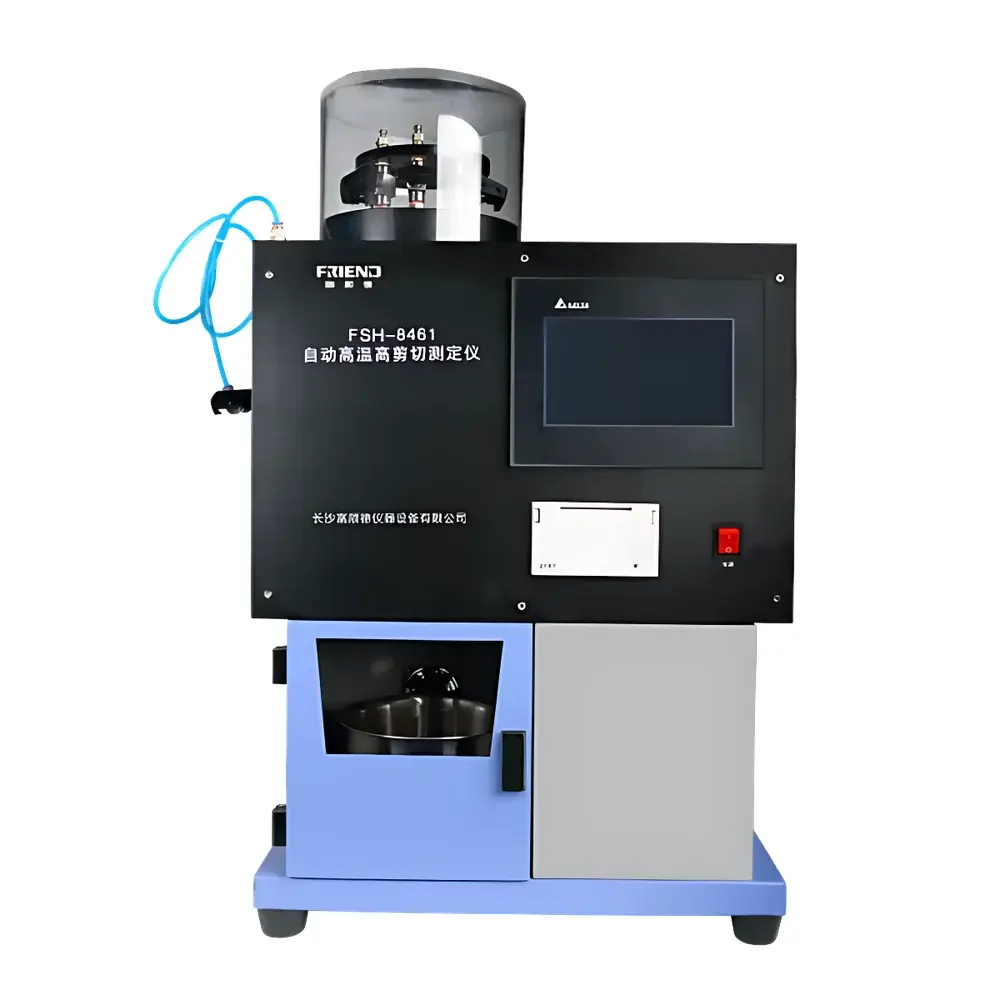
Brookfield FDH-8401 Fully Automated High-Temperature, High-Shear Viscometer
| Brand | Brookfield (csfriend OEM) |
|---|---|
| Origin | Hunan, China |
| Model | FDH-8401 |
| Compliance | ASTM D5481, SH/T 0703 |
| Temperature Range | Ambient to 260 °C ±0.1 °C |
| Shear Rate Range | Up to 1×10⁶ s⁻¹ (calculated) |
| Capillary Diameter | 0.15 mm |
| Pressure Rating | 20 MPa |
| Sample Volume | 7 mL ±1 mL |
| Display | Industrial Touchscreen (Bilingual UI) |
| Power Supply | AC 220 V, 50 Hz |
| Safety Standards | EN 61010-1, Integrated FTC Circuit Protection, Pneumatic Pressure-Limiting Valve, Dynamic Honeycomb Data Acquisition Architecture |
Overview
The Brookfield FDH-8401 is a fully automated high-temperature, high-shear viscometer engineered for precise dynamic viscosity measurement of lubricants, base oils, and engine oil formulations under simulated in-service conditions. It operates on the principle of capillary flow rheometry—applying controlled pressure across a precision-bore capillary (0.15 mm ID) to generate shear rates up to 1×10⁶ s⁻¹ at temperatures ranging from ambient to 260 °C ±0.1 °C. This enables direct correlation with ASTM D5481 (Standard Test Method for Measuring Viscosity of Used and Unused Engine Oils at High Shear Rate and High Temperature) and SH/T 0703 (Chinese national standard for high-temperature, high-shear viscosity of lubricating oils). The instrument’s core architecture integrates infrared variable-frequency heating, closed-loop PID temperature control, and real-time pressure regulation—ensuring thermally stable, reproducible shear fields essential for evaluating shear stability, polymer degradation, and VI improver performance.
Key Features
- Fully automated workflow: integrated auto-sampling, pneumatic sample aspiration, pressure-driven capillary flow, real-time viscosity calculation, and thermal-stable data logging—minimizing operator intervention and inter-run variability.
- High-integrity thermal management: IR-based variable-frequency heating system coupled with dual-zone thermal insulation ensures uniform axial temperature distribution along the capillary and eliminates cold spots that compromise shear rate accuracy.
- Pressure-rated mechanical design: EN 61010-1–compliant construction with 20 MPa rated pressure containment; includes redundant safety layers—pneumatic pressure-limiting valve, FTC (Fast Thermal Cut-off) circuit protection, and automatic power cutoff upon thermal excursion.
- Dynamic honeycomb data acquisition system: multi-channel synchronized sampling (pressure, temperature, flow time, ambient drift) at ≥1 kHz resolution, enabling statistical filtering and outlier rejection during post-processing to enhance measurement reproducibility.
- Bilingual touchscreen HMI: intuitive interface supporting English and Chinese navigation, real-time diagnostic feedback, calibration status monitoring, and embedded help context—designed for multi-regional laboratory environments.
- OEM software platform: csfriend-branded viscosity control software with proprietary algorithms for shear rate derivation, non-Newtonian correction (where applicable), and ASTM D5481-compliant reporting templates—including raw timing data, viscosity values (cP or mPa·s), and pass/fail flags against specification limits.
Sample Compatibility & Compliance
The FDH-8401 accommodates 7 mL ±1 mL sample volumes and is validated for use with mineral oils, synthetic esters, polyalphaolefins (PAO), and formulated engine oils containing viscosity index improvers, dispersants, and anti-wear additives. Its single-capillary configuration meets the geometric requirements of ASTM D5481 and SH/T 0703, ensuring regulatory traceability for OEM approvals and quality assurance programs. All electrical and mechanical subsystems comply with EN 61010-1 for laboratory equipment safety. While not FDA 21 CFR Part 11–certified out-of-the-box, audit trails, electronic signatures, and user-access controls can be implemented via optional software modules for GLP/GMP-aligned laboratories.
Software & Data Management
The dedicated csfriend viscosity control software provides full instrument control, method storage (up to 99 preconfigured protocols), real-time curve visualization (ΔP vs. t, η vs. T), and export-ready reports in CSV, PDF, and XLSX formats. Raw acquisition data—including millisecond-level flow timing, absolute temperature readings, and applied pressure—is stored with timestamped metadata. USB 2.0 interface supports offline data transfer and firmware updates. For enterprise integration, the software exposes a COM/ActiveX API enabling bidirectional communication with LIMS platforms and MES systems—supporting automated result ingestion, QC flagging, and batch-level statistical process control (SPC) charting.
Applications
- Quality control of finished engine oils per OEM specifications (e.g., GM dexos1™, Ford WSS-M2C945-A, API SP/CK-4).
- Evaluation of shear stability of viscosity index improvers during accelerated aging studies.
- R&D screening of novel base stock blends and additive packages under high-temperature, high-shear stress.
- Regulatory compliance testing for SAE J300 low-temperature pumpability and HTHS viscosity classification.
- Failure analysis of field-used oils exhibiting viscosity loss or thickening due to mechanical shearing or thermal oxidation.
FAQ
What standards does the FDH-8401 directly support?
ASTM D5481 and SH/T 0703 are natively implemented in method templates and reporting logic.
Is calibration traceable to NIST or other national metrology institutes?
Yes—capillary geometry is certified by third-party metrology lab; temperature sensors are calibrated against ITS-90 reference standards; pressure transducers are traceable to ISO/IEC 17025-accredited providers.
Can the instrument operate unattended overnight?
Yes—auto-shutdown, thermal watchdog, and sample-level detection enable secure unattended operation for sequential multi-sample runs.
What maintenance intervals are recommended?
Capillary cleaning after every 10 samples; annual verification of temperature uniformity and pressure line integrity; biannual recalibration of pressure and timing modules.
Does the system support remote diagnostics or firmware updates?
Yes—via USB-connected service port and authenticated cloud-assisted update protocol (optional subscription required).






