
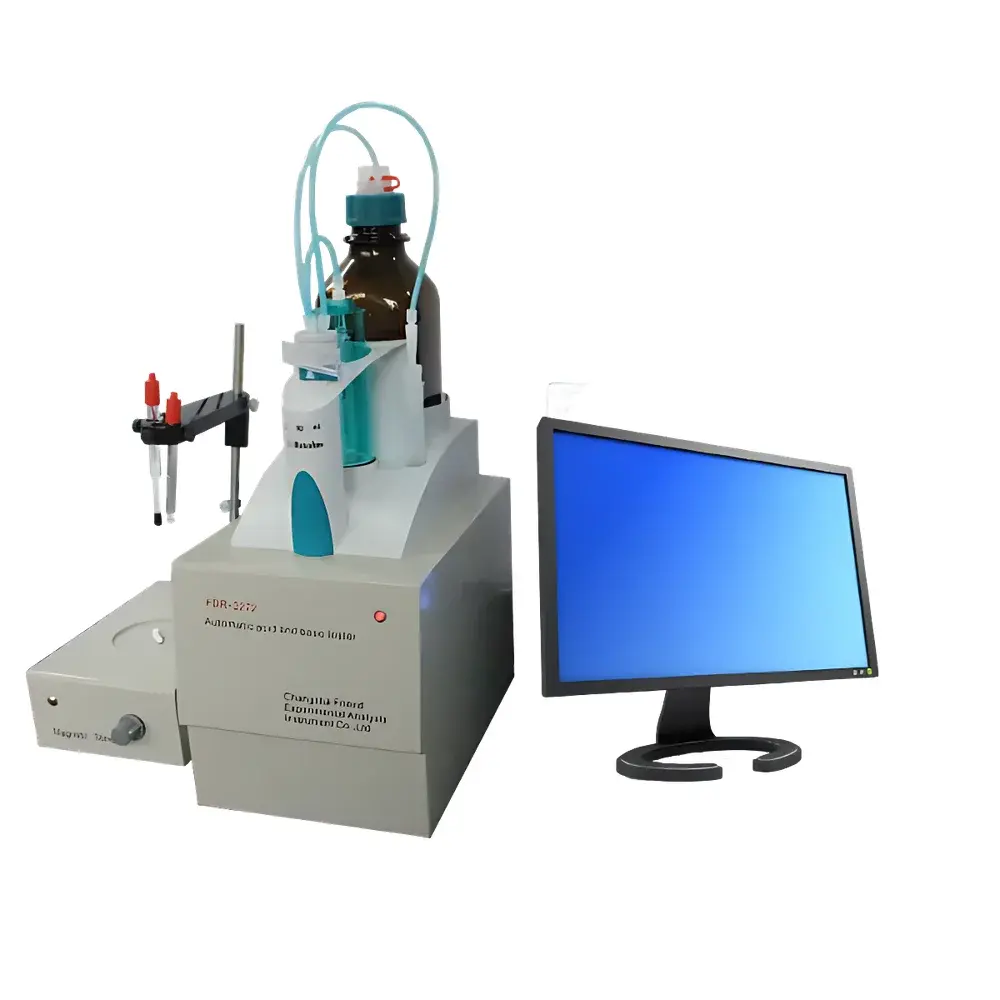
Flanders FDR-2272 Automated Acid Number Analyzer for Dark Petroleum Products
| Brand | Flanders (csfriend) |
|---|---|
| Origin | Hunan, China |
| Manufacturer Type | Authorized Distributor |
| Country of Origin | China |
| Model | FDR-2272 |
| Power Supply | 0–±2000 mV |
| Burette Accuracy | ±0.1% F/S |
| Burette Volume | 10 mL (configurable) |
| Minimum Dispensing Volume | 0.001 mL |
| Burette Resolution | 1/20000 |
| Titration Time (Full Scale) | 60 ± 20 s |
| Potential Measurement Error | ±0.03% F/S ± 1 digit |
| Electrode Compatibility | pH, redox, ion-selective, non-aqueous electrodes |
Overview
The Flanders FDR-2272 Automated Acid Number Analyzer is a dedicated potentiometric titration system engineered for precise, repeatable determination of total acid number (TAN) in dark petroleum products—including lubricating oils, residual fuels, crude oil blends, and aged transformer oils—per ASTM D664, ASTM D974, ISO 6618, and IP 177. It operates on the principle of potentiometric endpoint detection, where a pH or composite electrode monitors the electromotive force (EMF) change during titration with alcoholic potassium hydroxide (KOH). The instrument employs a high-resolution burette drive mechanism and real-time derivative analysis (dE/dV) to identify inflection points with sub-microliter precision, eliminating subjective visual endpoint interpretation and minimizing operator-induced variability. Its robust architecture supports unattended operation across multi-sample batches, making it suitable for QC laboratories operating under ISO/IEC 17025-accredited workflows.
Key Features
- Computer-controlled automation with Flanders proprietary bilingual (English/Chinese) software interface, supporting intuitive method setup, real-time visualization, and audit-ready data logging.
- Simultaneous display of potentiometric titration curve (E vs. V), first-derivative plot (dE/dV), measured electrode potential (E), delivered titrant volume (V), and final TAN result (mg KOH/g).
- Integrated autosampler with programmable sample positioning, automatic syringe-based aspiration, solvent addition, and electrode immersion control.
- Corrosion-resistant fluidic path constructed from PTFE, ETFE, and sapphire components; compatible with alcoholic KOH, perchloric acid, silver nitrate, and other aggressive titrants used in non-aqueous and redox titrations.
- Self-contained maintenance cycle: automated electrode rinsing with inert solvent, reagent replenishment, blank calibration, and tip purging prior to each titration sequence.
- Imported high-precision burette module featuring diffusion-inhibiting titration tip, 10 mL capacity (optional 5 mL or 25 mL), 0.001 mL minimum dispensing increment, and 1/20000 step resolution.
Sample Compatibility & Compliance
The FDR-2272 accommodates viscous, opaque, and thermally unstable samples without pre-dilution or filtration—critical for heavy fuel oils, bitumen extracts, and oxidized lubricants. Sample vials (25–100 mL) are heated and stirred during titration to ensure homogeneity and accelerate reaction kinetics. The system complies with regulatory data integrity requirements: all method parameters, raw EMF traces, derivative calculations, and manual overrides are timestamped and stored with immutable digital signatures. Audit trails meet FDA 21 CFR Part 11 expectations for electronic records, while reporting templates support GLP/GMP documentation standards. Optional LIMS integration enables direct result export to laboratory information management systems.
Software & Data Management
The embedded Flanders Titration Suite provides ISO 17025-aligned data handling: automatic calculation of TAN per ASTM D664 Annex A1 (potentiometric method), statistical summary across batches (mean, SD, RSD, confidence intervals), and customizable certificate generation. Raw E-V datasets are saved in .CSV and native .FDR binary formats; derivative peak detection algorithms apply Savitzky-Golay smoothing and cubic spline interpolation to suppress noise without distorting inflection geometry. User access levels (Operator, Supervisor, Administrator) enforce role-based permissions for method editing, calibration, and data deletion. All changes trigger an electronic log with user ID, timestamp, and parameter delta.
Applications
- Quality control of base oils and finished lubricants during refining and blending operations.
- Condition monitoring of in-service turbine, hydraulic, and engine oils to assess oxidation degradation.
- Acid number trending in transformer oil per IEEE C57.104 for predictive maintenance of power infrastructure.
- Research-grade quantification of naphthenic acids in crude assay workflows.
- Support for alternative titration modes: chloride content (Mohr method), water content (Karl Fischer coulometric), and mercaptan sulfur (potentiometric iodometry).
FAQ
What standards does the FDR-2272 validate against for acid number testing?
ASTM D664 (potentiometric), ASTM D974 (color-indicator), ISO 6618, IP 177, and GB/T 258—method selection is configurable within the software.
Can the system perform non-aqueous titrations such as perchloric acid in glacial acetic acid?
Yes—the fluidic system is chemically inert to anhydrous solvents, and electrode compatibility includes glass pH, platinum redox, and silver/silver chloride reference electrodes.
Is the software compliant with FDA 21 CFR Part 11 for electronic signatures and audit trails?
Yes: full electronic signature workflow, biometric or password-based authentication, and immutable, time-stamped audit logs are enabled by default.
What maintenance routines are automated?
Electrode cleaning, burette tip purging, reagent reservoir refilling, blank titration verification, and stirring speed calibration—all scheduled or triggered per batch.
Does the FDR-2272 support remote diagnostics or service access?
Remote desktop support is available via secure TLS-encrypted connection with customer consent; no persistent external ports or cloud dependencies are implemented.




