
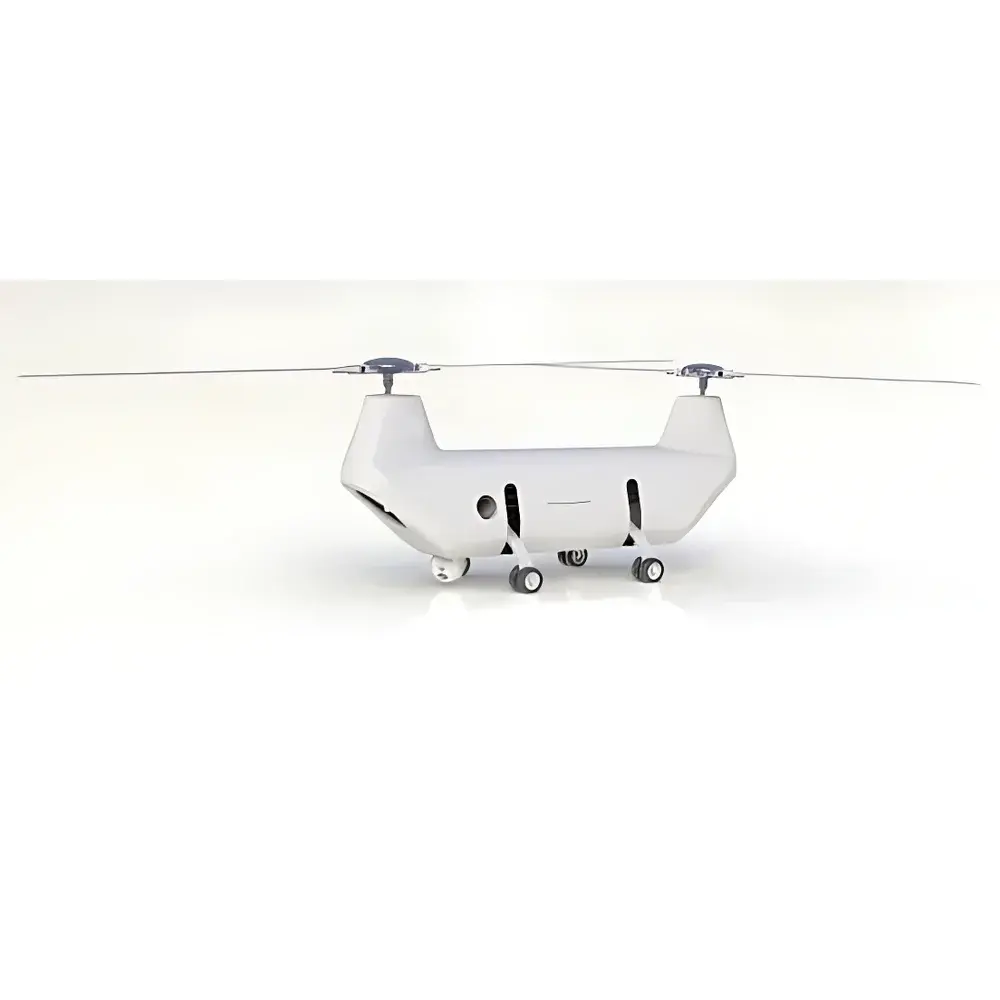
AZUP AZ-90 Medium-Altitude Long-Endurance (MALE) Tandem-Rotor Unmanned Aerial System
| Origin | Beijing, China |
|---|---|
| Manufacturer Type | Authorized Distributor |
| Origin Category | Domestic (PRC) |
| Model | AZ-90 |
| Pricing | Upon Technical Evaluation & Configuration |
Overview
The AZUP AZ-90 is a medium-altitude, long-endurance (MALE) unmanned aerial system engineered for persistent environmental remote sensing and telemetry operations in complex terrain and variable meteorological conditions. Its tandem-rotor configuration—featuring two counter-rotating main rotors mounted in longitudinal alignment—eliminates torque reaction without requiring a tail rotor, thereby optimizing engine power allocation exclusively to lift and forward thrust generation. This aerodynamic architecture delivers superior lift-to-weight efficiency: with a rotor disk area significantly larger than conventional single-main-rotor UAVs of comparable airframe mass, the AZ-90 achieves a maximum takeoff weight (MTOW) of 90 kg while maintaining a compact folded transport volume of only 500 L. The system operates on aviation-grade kerosene (Jet-A1), powered by a certified turboshaft engine, enabling sustained flight at altitudes up to 5,000 m AMSL under wind conditions up to Beaufort Scale 8 (≤ 20.7 m/s gusts). Designed explicitly for ecological and atmospheric monitoring missions, the AZ-90 serves as a stable, high-payload airborne platform compatible with multispectral imagers, gas analyzers, particulate samplers, LiDAR scanners, and real-time telemetry transceivers.
Key Features
- Tandem-rotor aerodynamic layout ensuring inherent yaw stability, eliminating mechanical anti-torque systems and reducing drivetrain complexity.
- High structural integrity with simplified load-path design, extending service life by approximately 10× compared to conventional composite UAV airframes.
- 60 kg maximum payload capacity distributed across standardized hardpoints and modular payload bays, supporting simultaneous multi-sensor integration.
- Rapid field deployment: fully foldable airframe requiring no disassembly; stowable in standard off-road utility vehicles without specialized crating.
- Optimized cruise performance: 110 km/h true airspeed at optimal lift coefficient, with 4-hour endurance at 75% MTOW and 3-hour mission endurance at 20 kg operational payload.
- Robust environmental resilience: IP54-rated avionics enclosure, -25°C to +55°C operational temperature range, and ice-resistant rotor blade coating option.
Sample Compatibility & Compliance
The AZ-90 platform is certified for operation under China’s CAAC Part 92 regulations for civil unmanned aircraft systems (UAS) and conforms to ICAO Annex 10 Vol II (Aeronautical Telecommunications) for command-and-control data link interoperability. Payload interfaces comply with STANAG 4609 (VMTI) and MISB ST 0601.7 (motion imagery metadata) standards. When integrated with EPA Method TO-15-compliant canister-based VOC samplers or ISO 14644-1 Class 5 airborne particle counters, the system supports GLP-aligned environmental data acquisition workflows. All flight control firmware and telemetry logs are timestamped with GPS-derived UTC and support audit-trail export per ISO/IEC 17025:2017 clause 7.10.3 for traceable environmental reporting.
Software & Data Management
Ground control is executed via AZUP’s proprietary Aegis-GCS v3.2 software suite, compliant with DO-178C Level C for safety-critical flight management logic. Mission planning supports KML/KMZ import, dynamic no-fly zone overlay (including real-time NOTAM ingestion), and automated sensor trigger sequencing based on geofence crossing or altitude thresholds. Telemetry streams—including IMU, GNSS, engine parameters, and payload health status—are recorded in binary .azlog format with embedded SHA-256 checksums for data integrity verification. Raw sensor outputs are time-synchronized to within ±10 ms using IEEE 1588 PTPv2 over Ethernet, enabling post-mission fusion of hyperspectral, thermal, and atmospheric chemistry datasets. Export modules generate CF-NetCDF 4.0 files compliant with NASA’s Earth Observing System Data and Information System (EOSDIS) metadata schema.
Applications
- Long-range atmospheric boundary layer profiling using integrated differential absorption LiDAR (DIAL) and ozone photometers.
- Wetland and forest canopy change detection via synchronized multispectral + SAR imaging at ≤ 15 cm GSD.
- Industrial emission source attribution through coordinated SO₂/NOₓ/CH₄ plume mapping with wind-field modeling integration.
- Post-wildfire ash dispersion monitoring and PM₂.₅ vertical column density estimation.
- Coastal eutrophication assessment via chlorophyll-a fluorescence and CDOM spectral analysis.
- Permafrost thaw monitoring using ground-penetrating radar (GPR) and thermal infrared anomaly detection.
FAQ
What regulatory certifications does the AZ-90 hold for international deployment?
The platform holds CAAC Type Certificate TC-2023-AZ90 and EASA SC-VTOL-001 Special Condition compliance documentation; export requires individual end-user license approval under Wassenaar Arrangement Category 9.A.1.a.
Is the turboshaft engine maintenance schedule aligned with ISO 21781:2019 standards?
Yes—engine overhaul intervals follow ISO 21781 Annex B recommendations, with condition-based monitoring supported via embedded HUMS (Health and Usage Monitoring System) telemetry.
Can the AZ-90 operate beyond visual line of sight (BVLOS) in unsegregated airspace?
BVLOS operations require national ANSP authorization and integration with UTM infrastructure; the system includes ADS-B Out (DO-260B) and remote ID (ASTM F3411-22a) modules as standard.
Does the payload interface support hot-swappable sensor modules during ground turnaround?
Yes—payload bays feature MIL-DTL-38999 Series III connectors with automatic electrical and mechanical mating verification; full reconfiguration takes ≤ 8 minutes.
How is data security ensured during RF transmission?
All C2 and payload downlinks employ AES-256-GCM encryption with TLS 1.3 handshake; key rotation follows NIST SP 800-57 Part 1 Rev. 5 guidelines.
Related Products







