
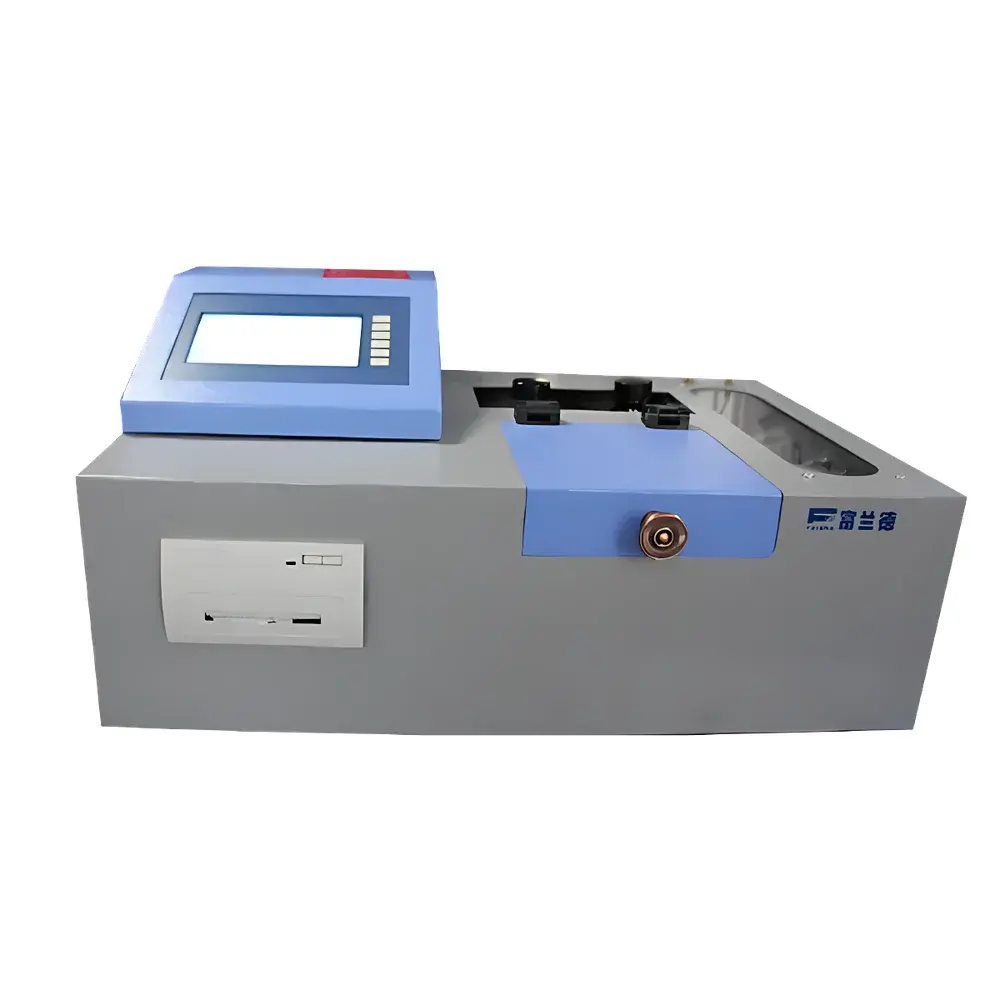
Flanders FDT-0931 Automated Acid Number Analyzer (Extraction Method)
| Brand | Flanders |
|---|---|
| Origin | Hunan, China |
| Manufacturer Type | Authorized Distributor |
| Country of Manufacture | China |
| Model | FDT-0931 |
| Power Supply | AC 220 V ±10%, 50 Hz |
| Max. Power Consumption | <100 W |
| Acid Number Range | 0.001–0.999 mg KOH/g |
| Minimum Resolution | 0.001 mg KOH/g |
| Accuracy | ±0.02 mg KOH/g for AN < 0.1 |
| Repeatability | 0.004 mg KOH/g |
| Sample Capacity | 6 positions |
| Data Processor | XECOM (USA) embedded signal processing IC |
| Liquid Handling System | VERDER (Netherlands) precision peristaltic dosing module |
| Display | Backlit LCD with Chinese GUI |
| Interface | Integrated thermal printer, non-labeled tactile keypad |
Overview
The Flanders FDT-0931 Automated Acid Number Analyzer is a benchtop analytical instrument engineered for precise, high-throughput determination of acid number in petroleum-based insulating oils, turbine oils, and other hydrocarbon lubricants using the standardized solvent extraction titration method (ASTM D974, ASTM D664, ISO 6618, and GB/T 258). It operates on the principle of potentiometric endpoint detection during automated titration of acidic components extracted into isopropanol–toluene–water solvent mixture with standardized alcoholic potassium hydroxide solution. The system integrates electrochemical sensing, gravimetric reagent delivery, and real-time stoichiometric calculation to deliver trace-level quantification without manual endpoint interpretation. Designed for routine QC laboratories in power generation, transformer maintenance, and oil reclamation facilities, the FDT-0931 eliminates operator bias, reduces assay time per sample to under 5 minutes, and supports unattended batch processing of up to six samples.
Key Features
- Automated sequential sample handling: Robotic cup carousel enables automatic vial positioning, solvent addition, extraction agitation, phase separation, titrant delivery, and endpoint recognition—no manual transfer or pipetting required.
- Potentiometric titration architecture: Uses a dual-junction Ag/AgCl reference electrode and pH-sensitive glass indicator electrode calibrated per IUPAC guidelines; dynamic slope compensation corrects for temperature drift and junction potential variation.
- VERDER precision fluidics: Imported peristaltic pump system with PTFE-lined tubing and calibrated volumetric dispensing (±0.2% RSD at 1 mL), ensuring reproducible reagent metering across extended operation cycles.
- XECOM digital signal processor: High-speed 32-bit embedded IC performs real-time derivative analysis of titration curves (dE/dV vs. V), enabling robust first-derivative peak detection for objective endpoint identification—even in turbid or colored extracts.
- Full audit trail compliance: All measurement parameters—including electrode calibration history, blank subtraction values, titration curve metadata, and user login timestamps—are timestamped and stored in non-volatile memory.
- Integrated thermal printer and intuitive interface: 5.7-inch backlit LCD displays live titration curves, intermediate calculations, and final results in SI units; menu navigation uses context-sensitive soft keys with no ambiguous labeling.
Sample Compatibility & Compliance
The FDT-0931 accepts standard 50-mL glass extraction vials and accommodates viscosity ranges from 2 cSt to 150 cSt (at 40 °C), including aged mineral oils, synthetic esters, and phosphate ester fire-resistant fluids. It meets essential requirements for GLP-compliant environments: electronic records adhere to ALCOA+ principles (Attributable, Legible, Contemporaneous, Original, Accurate, Complete, Consistent, Enduring, Available); data export supports CSV and PDF formats for LIMS integration. While not certified to FDA 21 CFR Part 11 out-of-the-box, its firmware architecture supports optional digital signature modules and role-based access control upgrades for regulated pharmaceutical or nuclear-grade lubricant testing.
Software & Data Management
Instrument control and data reduction are executed via embedded firmware (v3.2.1), eliminating dependency on external PCs. Each analysis generates a structured dataset containing raw electrode potential readings (10 Hz sampling), second-derivative plots, equivalence point coordinates, acid number (mg KOH/g), blank correction factor, and uncertainty estimation based on NIST-traceable calibration standards. Data archives are retained for ≥10,000 assays with automatic overwrite protection; USB port enables encrypted backup to FAT32-formatted drives. Optional Flanders LabLink™ software (Windows 10/11 compatible) provides advanced statistical reporting (Shewhart X-bar/R charts, trend analysis over time), multi-instrument fleet monitoring, and customizable certificate-of-analysis templates aligned with ISO/IEC 17025 documentation frameworks.
Applications
- Condition monitoring of transformer insulating oil per IEEE C57.106 and IEC 60296: trending acid number increase (>0.10 mg KOH/g) indicates oxidation byproduct accumulation requiring filtration or replacement.
- Acceptance testing of new turbine oils prior to commissioning, verifying conformance to OEM specifications (e.g., GEK 32568, Siemens TLV 9013).
- Research-scale evaluation of antioxidant package efficacy under accelerated aging (ASTM D2440) by correlating acid number growth rate with RPVOT induction time.
- Regulatory reporting for EPA SPCC compliance audits where acid number serves as proxy for organic acid corrosion potential in stored hydrocarbon inventories.
- Third-party certification labs performing accredited testing to ASTM D974 (color-indicator) and ASTM D664 (potentiometric) methods within same platform—method selection configurable per test sequence.
FAQ
What extraction solvents are compatible with the FDT-0931?
The system is pre-configured for ASTM D664-compliant isopropanol–toluene–water (1:1:1 v/v/v) mixture; alternative solvent blends (e.g., chloroform–isopropanol) may be used with method validation and manual parameter adjustment.
Does the instrument support automatic blank correction?
Yes—integrated blank titration mode executes solvent-only runs before each batch; measured blank values are subtracted algorithmically from sample results with uncertainty propagation.
Can electrode calibration be performed internally?
Yes—built-in calibration routine accepts standard buffer solutions (pH 4.01, 7.00, 10.01) and verifies electrode slope (≥95% theoretical) and asymmetry potential (<±30 mV) prior to analysis.
Is remote diagnostics available?
Firmware v3.2.1 supports Ethernet-connected diagnostic mode; authorized service engineers can initiate secure SSH sessions for log retrieval and sensor health assessment—no cloud dependency or vendor telemetry.
What maintenance intervals are recommended?
Electrode cleaning every 50 assays; VERDER pump tubing replacement every 6 months or 2,000 cycles; annual verification against NIST SRM 2490c (acid number reference material) using in-house calibration protocol.





