
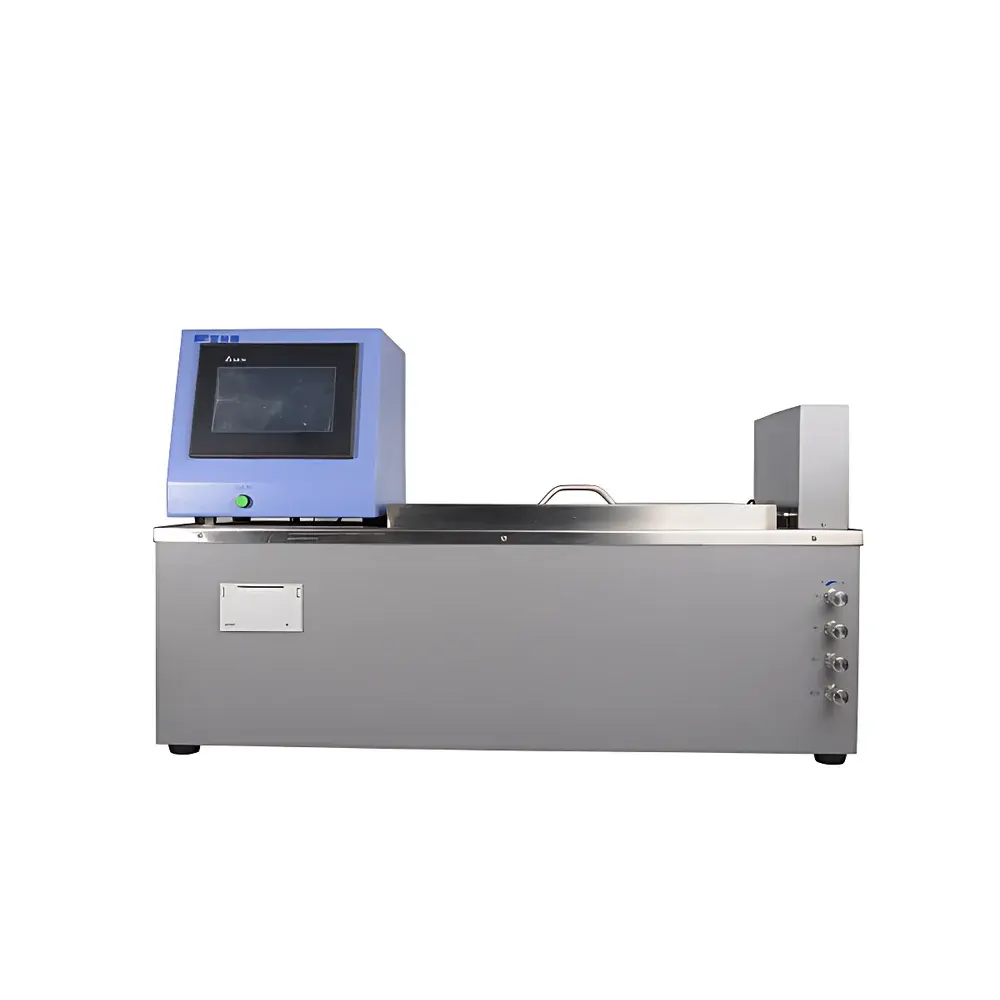


Fland FDR-0271 Automated Reid Vapor Pressure (RVP) Analyzer
| Brand | Fland |
|---|---|
| Origin | Hunan, China |
| Model | FDR-0271 |
| Analysis Method | ASTM D323 (Reid Method) |
| Pressure Range | 0–200 kPa (0–29 psi) |
| Temperature Control | 37.8 ± 0.1 °C |
| Sample Capacity | 3 bomb units |
| Power Consumption | 1.5 kW |
| Compliance | ASTM D323, IP 121, GB/T 8017, ISO 3016 |
Overview
The Fland FDR-0271 Automated Reid Vapor Pressure (RVP) Analyzer is a dedicated petroleum testing instrument engineered for precise, repeatable determination of the vapor pressure of gasoline, volatile crude oils, and other light distillates according to the standardized Reid method (ASTM D323, IP 121, GB/T 8017). RVP is a critical specification in fuel formulation, storage safety assessment, and regulatory compliance—directly influencing evaporative emissions, engine startability, and summer/winter blend adjustments. The FDR-0271 implements a closed-loop, microprocessor-controlled thermodynamic equilibrium system wherein a fixed-volume air-saturated sample is equilibrated at 37.8 °C in a calibrated vapor pressure chamber (Reid bomb), and the resulting equilibrium vapor pressure is measured under strictly defined atmospheric conditions. Its design adheres to the mechanical and procedural requirements of the Reid test, including mandatory horizontal oscillation to ensure uniform vapor–liquid phase contact and thermal homogeneity.
Key Features
- Triple-bomb configuration enabling parallel or sequential analysis of up to three samples per cycle—improving laboratory throughput without compromising inter-bomb reproducibility.
- Microcomputer-based temperature regulation with PID control logic, maintaining bath stability at 37.8 ± 0.1 °C across all operational cycles—meeting ASTM D323’s thermal tolerance requirement.
- Automated horizontal oscillation mechanism integrated into each bomb holder, eliminating manual agitation and ensuring consistent vapor saturation kinetics and phase equilibration.
- Digital pressure transduction system with zero-drift compensation, delivering direct kPa/psi readout on an integrated LCD interface with English-language menu navigation and alphanumeric keypad input.
- Self-contained pressure detection circuitry built around a high-stability piezoresistive sensor, calibrated traceably to NIST-traceable references and validated per ISO/IEC 17025 internal verification protocols.
- Robust stainless-steel construction of all wetted parts—including bomb bodies, caps, and connecting hardware—resistant to hydrocarbon corrosion and compatible with repeated cleaning per refinery lab SOPs.
Sample Compatibility & Compliance
The FDR-0271 is validated for use with gasoline, reformulated gasoline (RFG), oxygenated blends (e.g., ethanol-gasoline mixtures), naphthas, and light distillate fractions meeting the volatility range specified in ASTM D323 (typically RVP ≤ 150 kPa). It supports both single-point and multi-point calibration using certified reference materials (CRMs) traceable to national metrology institutes. Instrument operation complies with ASTM D323 Section 7 (Apparatus Requirements), Section 8 (Sampling and Handling), and Section 9 (Test Procedure), as well as equivalent clauses in IP 121 and GB/T 8017. Data integrity is reinforced through non-volatile memory logging of test timestamps, ambient barometric pressure inputs, and final RVP values—supporting GLP-aligned record retention for audit readiness.
Software & Data Management
While the FDR-0271 operates as a standalone benchtop analyzer with embedded firmware, it provides RS-232 serial output for integration with laboratory information management systems (LIMS) or custom data acquisition platforms. Exported records include test ID, sample ID, start/end time, bath temperature deviation, measured pressure, barometric correction factor (if applied), and final reported RVP value (uncorrected and corrected per ASTM D323 Annex A1). Firmware supports configurable pass/fail thresholds based on product specifications (e.g., ASTM D4814 limits), enabling automated flagging of out-of-spec results. All stored data are retained for ≥90 days and can be retrieved via terminal command or exported to CSV format—facilitating FDA 21 CFR Part 11–compliant environments when paired with validated third-party software.
Applications
- Quality control laboratories in refineries performing incoming crude assay and finished gasoline release testing.
- Fuel blending facilities verifying RVP compliance prior to pipeline injection or tanker loading.
- Regulatory testing labs supporting EPA Tier 3, CARB, or CNPC specification enforcement.
- Research institutions studying volatility–composition relationships in alternative fuels (e.g., bioethanol blends, synthetic hydrocarbons).
- Contract testing organizations accredited to ISO/IEC 17025 conducting proficiency testing for RVP interlaboratory studies.
FAQ
What standards does the FDR-0271 comply with?
ASTM D323, IP 121, GB/T 8017, and ISO 3016—covering apparatus design, test procedure, and reporting requirements for Reid vapor pressure measurement.
Is barometric pressure correction applied automatically?
No—the instrument reports raw equilibrium pressure; users must apply the standard barometric correction (per ASTM D323 Annex A1) manually or via external calculation software unless integrated with a LIMS that performs real-time correction.
Can the FDR-0271 be used for liquefied petroleum gas (LPG) testing?
No—LPG requires specialized high-pressure apparatus per ASTM D1267 or D6897; the FDR-0271 is designed exclusively for low-boiling liquid fuels within the Reid method’s scope.
How often does the pressure sensor require recalibration?
Annual calibration is recommended using NIST-traceable deadweight testers or certified pressure calibrators; verification checks should be performed daily using zero and span points before routine analysis.
Does the system support remote monitoring or network connectivity?
It features RS-232 only; Ethernet or Wi-Fi connectivity is not built-in but can be added via industrial protocol converters compatible with Modbus RTU or ASCII serial framing.





