
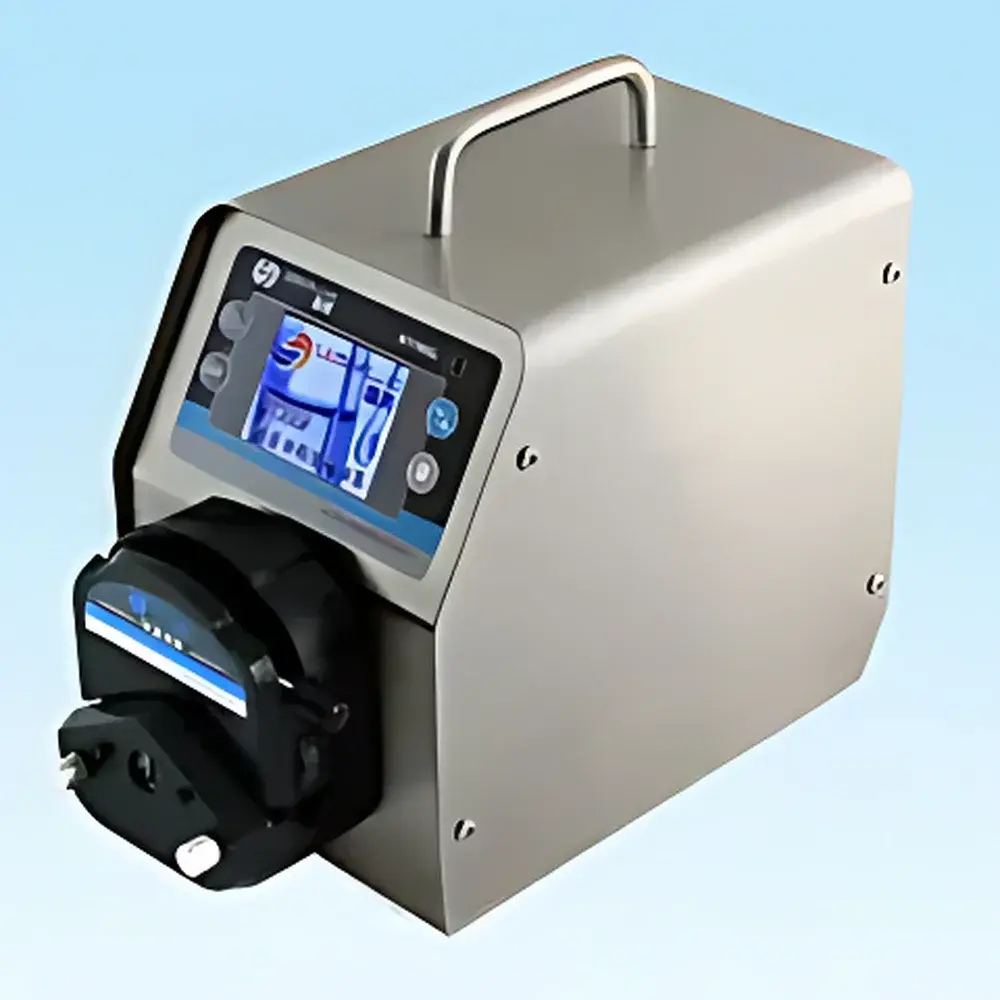
LeFever BT100L Flow-Mode Peristaltic Pump
| Brand | LeFever |
|---|---|
| Origin | Hebei, China |
| Model | BT100L (YZ15-compatible) |
| Flow Rate Range | 0.006–420 mL/min |
| Speed Range | 0.1–150 rpm |
| Speed Resolution | 0.1 rpm |
| Speed Accuracy | ±0.2% |
| Display | 65,535-color TFT LCD with capacitive touch interface |
| External Control | Isolated TTL-level start/stop & direction (5V/12V/24V), analog speed control (0–5V / 0–10V / 4–20 mA), frequency input (0–10 kHz), RS485 with MODBUS RTU protocol |
| Power Supply | AC 220 V ±10%, 50/60 Hz |
| Power Consumption | <40 W |
| Operating Environment | 0–40 °C, RH <80% |
| Dimensions (L×W×H) | 223 × 150 × 195 mm |
| Weight | 4.8 kg |
| Enclosure Material | Stainless steel dust-resistant chassis |
| Compatible Pump Heads | YZ15, YZ25, DG1, DG2, DG4, DG8 |
| Minimum Flow Resolution | 0.00016 mL/min |
| Maximum Flow Capacity | 575 mL/min |
Overview
The LeFever BT100L is a precision-engineered flow-mode peristaltic pump designed for laboratory-scale fluid handling where contamination-free, pulseless, and repeatable delivery is critical. Based on the well-established roller-compression principle—where rotating rollers sequentially compress flexible tubing to displace fluid—the BT100L delivers accurate volumetric transfer without internal valves, seals, or wetted metal parts. This design ensures complete fluid isolation, eliminating cross-contamination risks and enabling safe handling of aggressive solvents, biological media, cell suspensions, and shear-sensitive reagents. The pump is particularly suited for applications requiring programmable flow profiles, intermittent dispensing, or integration into automated workflows via industrial communication protocols.
Key Features
- Capacitive touchscreen interface with 65,535-color TFT display provides intuitive navigation, real-time parameter visualization, and contextual feedback—reducing operator training time and minimizing misconfiguration.
- Intelligent expert mode guides users through setup, calibration, and operation sequences using context-aware prompts, ensuring consistent performance even among infrequent or novice operators.
- Adaptive thermal management system modulates fan speed based on internal temperature, achieving acoustic noise reduction (<45 dB(A) at 1 m) and extending component service life while maintaining stable motor torque across ambient conditions (0–40 °C).
- Direct flow-rate entry (mL/min) eliminates manual rpm-to-flow conversion; the embedded algorithm dynamically calculates optimal rotational speed based on selected tubing ID, wall thickness, and pump head geometry.
- Dedicated “Simple Dispensing” mode enables rapid multi-step volume distribution with user-defined intervals, pause durations, and repeat counts—ideal for routine sample preparation, buffer aliquoting, or reagent addition in QC/QA labs.
- Infrared remote control supports hands-free operation in biosafety cabinets, gloveboxes, or laminar flow hoods where physical contact must be minimized.
- Stainless steel enclosure meets IP54-rated dust resistance, supporting deployment in shared instrument rooms, pilot-scale process labs, and light industrial environments where particulate exposure or incidental splashes are common.
Sample Compatibility & Compliance
The BT100L accommodates a broad range of peristaltic tubing materials—including silicone, Viton®, Tygon® LFL, PharMed® BPT, and C-Flex®—enabling compatibility with organic solvents, aqueous buffers, acidic/basic solutions, and sterile biologics. Its modular pump head architecture supports six interchangeable head types (YZ15, YZ25, DG1–DG8), each optimized for specific tubing inner diameters (0.1–6.4 mm) and pressure ratings (up to 2.5 bar). While not certified to ISO 8573 or FDA 21 CFR Part 11 out-of-the-box, the pump’s audit-ready RS485/MODBUS interface supports traceable command logging when integrated with compliant SCADA or LIMS platforms. It complies with IEC 61000-6-3 (EMI emission) and IEC 61000-6-2 (immunity) standards, and its power supply conforms to GB 4943.1–2022 (China national safety standard equivalent to IEC 62368-1).
Software & Data Management
The BT100L operates as a standalone instrument but is fully programmable via external controllers using standardized industrial protocols. RS485 serial communication implements MODBUS RTU register mapping for real-time read/write access to operational status (e.g., running state, current rpm, totalized volume, error codes), setpoint parameters, and I/O configuration. Analog inputs (0–5 V, 0–10 V, 4–20 mA) allow seamless integration with PLCs, DAQ systems, or custom LabVIEW-based automation suites. All external control signals feature galvanic isolation (>1500 VRMS) to prevent ground-loop interference in multi-instrument setups. No proprietary software is required; configuration and monitoring can be performed using generic MODBUS masters or terminal emulators.
Applications
- Automated sample introduction in HPLC, IC, and flow injection analysis (FIA) systems.
- Controlled reagent dosing in titration, enzymatic assays, and kinetic studies.
- Cell culture media perfusion and waste removal in bioreactor auxiliary loops.
- Calibration standard delivery in environmental water testing (e.g., EPA Method 300.0).
- Low-shear transfer of fragile nanoparticles, liposomes, or exosome suspensions.
- Continuous feed in small-scale chemical synthesis reactors and microfluidic platform priming.
- Dispensing of viscous polymer solutions (e.g., PVA, alginate) in biomaterial fabrication workflows.
FAQ
What tubing sizes are supported by the BT100L?
The pump is compatible with tubing inner diameters from 0.1 mm to 6.4 mm, depending on the installed pump head (YZ15: 0.1–3.2 mm; YZ25: 0.5–6.4 mm; DG-series heads support specialized high-pressure or low-pulse configurations).
Does the BT100L support flow calibration against gravimetric or volumetric standards?
Yes—users may perform manual calibration by measuring dispensed mass/volume over time and entering correction factors into the pump’s flow compensation table, improving long-term accuracy to ±0.5% of setpoint under stable conditions.
Can the pump be integrated into a GLP-compliant workflow?
When connected to a validated MODBUS master system with electronic audit trail functionality, the BT100L can contribute to data integrity requirements for GLP/GMP environments; however, it does not natively generate 21 CFR Part 11-compliant electronic signatures or user authentication logs.
Is firmware upgradable in the field?
Firmware updates are available via USB-to-serial adapter and require LeFever’s official configuration utility; version history and release notes are published on the manufacturer’s technical support portal.
What maintenance intervals are recommended for continuous operation?
Roller and tubing wear should be inspected every 500 operating hours; tubing replacement frequency depends on chemical compatibility and pressure load—typical service life ranges from 100 to 1,000 hours under moderate conditions.



