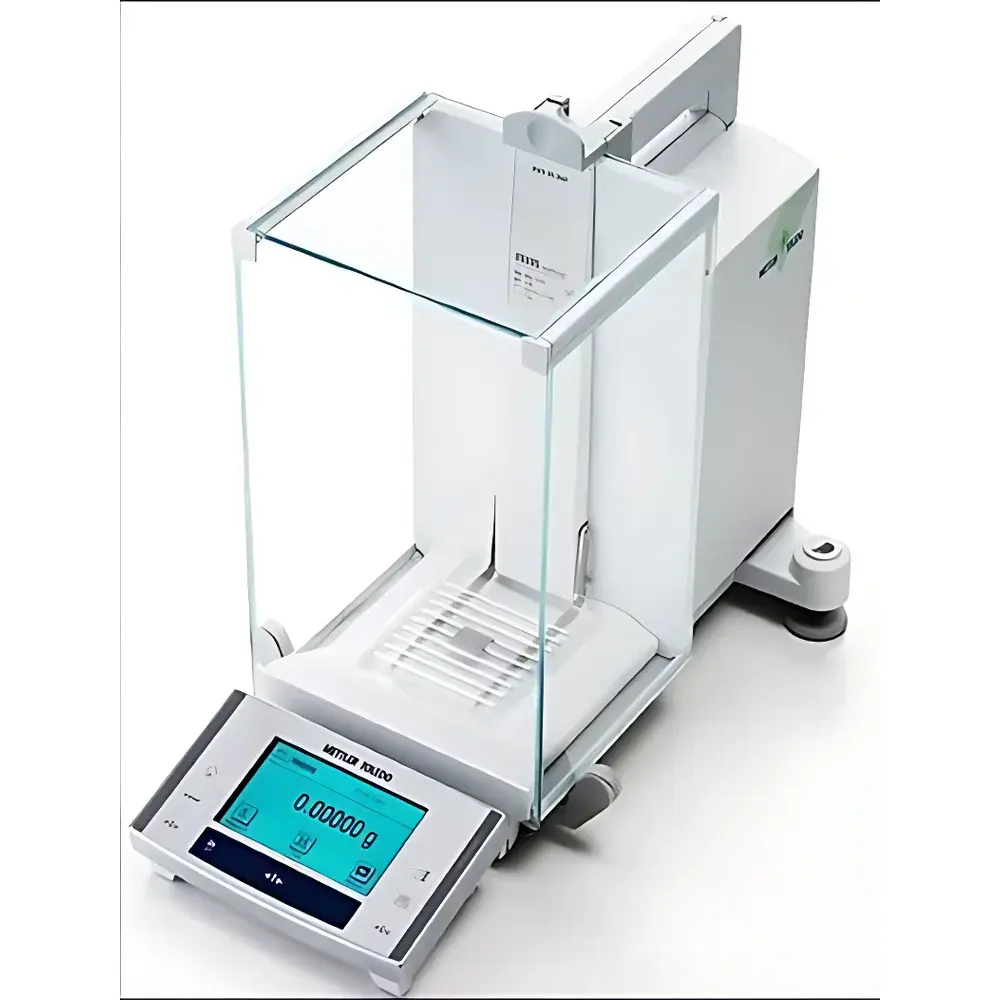
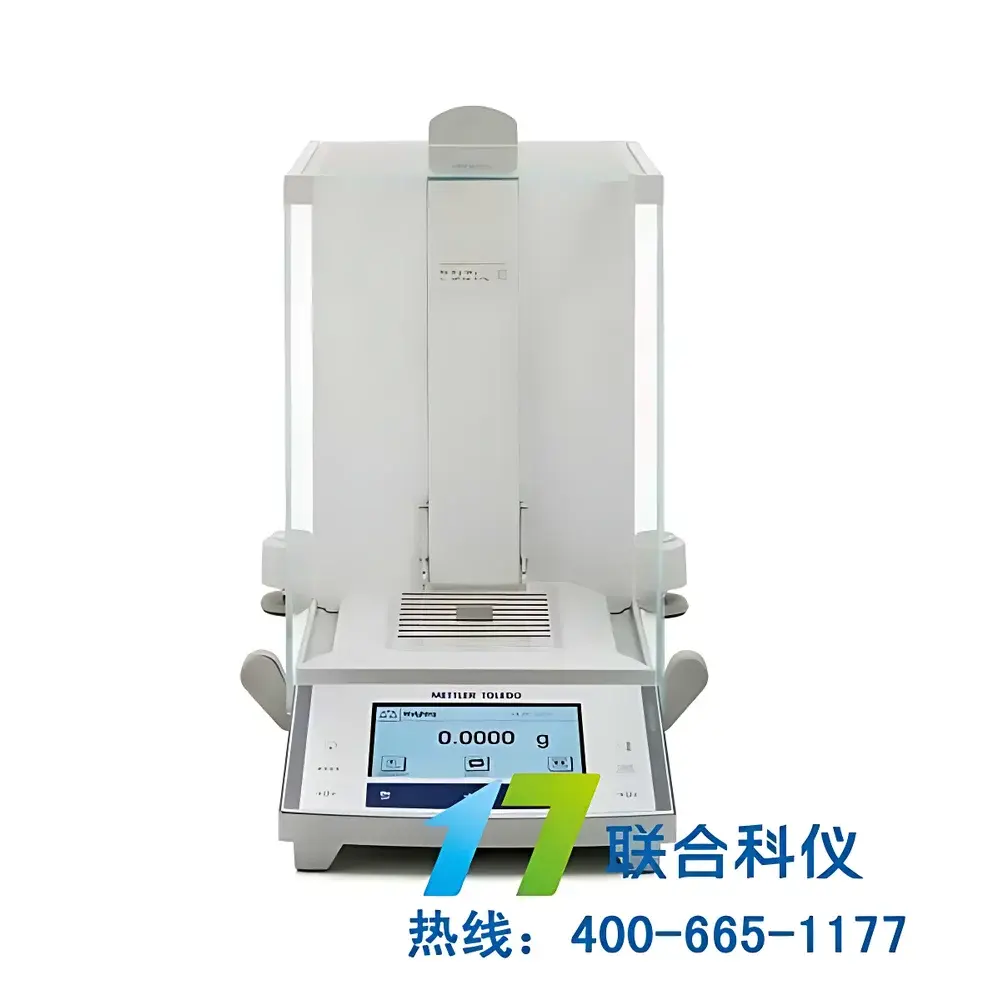
METTLER TOLEDO XS105DU Advanced Analytical Balance
| Brand | METTLER TOLEDO |
|---|---|
| Origin | Switzerland |
| Model | XS105DU |
| Instrument Type | Analytical Balance |
| Maximum Capacity | 41 g / 120 g |
| Readability | 0.01 mg / 0.1 mg |
| Repeatability | 0.02 mg (at 10 g) / 0.1 mg (at max capacity) |
| Linearity | ±0.2 mg |
| Eccentric Load Error | 0.3 mg |
| Sensitivity Drift | 0.0004% |
| Temperature-Induced Sensitivity Drift | 0.00015%/°C (10–30 °C) |
| Long-Term Sensitivity Stability | 0.0002%/year |
| Typical Weighing Time | 6 s |
| Interface Update Rate | 23 Hz |
| Draft Shield Height | 235 mm |
| Pan Dimensions | 78 × 73 mm |
| Dimensions (W×D×H) | 263 × 453 × 322 mm |
| Calibration | Internal, FACT-enabled (Fully Automatic Calibration Technology) |
| Compliance | OIML R 76-1 Class I, ISO/IEC 17025, USP <41>, <1251>, FDA 21 CFR Part 11 (with optional software configuration) |
Overview
The METTLER TOLEDO XS105DU Advanced Analytical Balance is a dual-range precision instrument engineered for high-accuracy mass determination in regulated laboratory environments. Utilizing a high-resolution electromagnetic force compensation sensor with rear-mounted design, it delivers traceable, reproducible measurements across two distinct weighing ranges—41 g at 0.01 mg readability and 120 g at 0.1 mg readability—enabling rigorous method flexibility without compromising metrological integrity. Its core architecture adheres to OIML R 76-1 Class I requirements for analytical balances, ensuring compliance with international legal metrology frameworks. The balance operates on the principle of electromagnetic force restoration, where sample mass is determined by the precisely controlled current required to counteract gravitational force on the load receptor. This principle—combined with SmartGrid™ weighing pan suspension and optimized air-damping dynamics—minimizes mechanical resonance and accelerates stabilization, achieving typical settling times of 6 seconds under standard ambient conditions (20–25 °C, <60% RH).
Key Features
- DualRange™ technology provides two independent weighing modes: high-sensitivity (41 g / 0.01 mg) for micro-quantitative analysis and extended-capacity (120 g / 0.1 mg) for preparative workflows—both calibrated and validated per OIML R 76.
- FACT (Fully Automatic Calibration Technology) employs dual internal reference masses and temperature-driven recalibration logic, compensating for thermal drift in real time—ensuring linearity stability within ±0.2 mg across 50% of maximum capacity.
- DeltaRange™ patented variable-range algorithm dynamically adjusts internal gain and filtering parameters based on load magnitude, optimizing signal-to-noise ratio and minimizing repeatability deviation (≤0.02 mg at 10 g, ≤0.1 mg at full scale).
- SmartGrid™ weighing pan—suspended via low-inertia torsion wires—is acoustically decoupled from the base structure, reducing vibration transmission and enhancing stability in non-ideal lab environments.
- ErgoClips™ modular tare accessories enable rapid attachment/detachment of standardized containers (e.g., vials, crucibles, filtration assemblies), supporting GLP-compliant SOP execution without manual re-zeroing.
- Full-touch 4.5-inch color display with customizable interface layout; detachable control terminal allows ergonomic positioning relative to fume hoods or biosafety cabinets.
- Modular draft shield with tool-free disassembly—fully autoclavable glass panels and removable base ring—facilitates residue-free cleaning and reduces cross-contamination risk in multi-user facilities.
Sample Compatibility & Compliance
The XS105DU accommodates a broad spectrum of sample forms—including powders, granules, liquids in tared vessels, filter media, and volatile solids—within its 78 × 73 mm stainless-steel pan and 235 mm vertical clearance. Its sealed sensor housing and IP54-rated electronics ensure operational reliability in environments subject to minor particulate exposure or humidity fluctuations. Regulatory alignment includes full support for ISO/IEC 17025 accreditation requirements, USP (Balance Performance Verification) and (Weighing on an Analytical Balance), and GxP data integrity standards when integrated with compliant software. Audit trail generation, electronic signature capability, and user-access-level management are enabled via optional LabX® connectivity.
Software & Data Management
Embedded firmware supports RS232, USB Device, and Ethernet interfaces for seamless integration into laboratory informatics systems. The balance natively executes 12 preconfigured applications—including statistical weighing, density determination (with auxiliary kit), formulation, and percent weighing—each with configurable tolerance thresholds and pass/fail logic. Firmware updates are performed via e-Loader II utility, which verifies cryptographic signatures and logs update metadata for audit purposes. When connected to LabX software, all weighing events—including raw values, timestamps, operator IDs, environmental metadata (optional external sensor input), and calibration history—are stored in a secure, searchable database compliant with FDA 21 CFR Part 11 requirements for electronic records and signatures.
Applications
This balance is routinely deployed in pharmaceutical quality control laboratories for active pharmaceutical ingredient (API) assay, reference standard preparation, and dissolution testing sample weighing. It supports materials science research involving catalyst loading quantification, nanomaterial dispersion mass verification, and thin-film deposition stoichiometry validation. In academic and contract research settings, it fulfills ASTM E898-22 (Standard Practice for Calibration of Analytical Balances) and ISO 17034 (Reference Material Producers) traceability protocols. Its dual-range architecture is especially valuable in method development labs where gravimetric dilution series (e.g., 10 µg to 100 mg) must be executed on a single platform without inter-instrument variability.
FAQ
What regulatory standards does the XS105DU comply with out-of-the-box?
It meets OIML R 76-1 Class I metrological requirements and incorporates hardware-level features necessary for ISO/IEC 17025 and USP / conformance. Full 21 CFR Part 11 compliance requires LabX software configuration and system validation.
How does FACT differ from standard internal calibration?
FACT uses two internal reference masses and continuous temperature monitoring to trigger recalibration only when thermal drift exceeds predefined thresholds—eliminating unnecessary calibrations while maintaining traceability between scheduled maintenance intervals.
Can the XS105DU be integrated into a LIMS or ELN environment?
Yes—via RS232, USB, or Ethernet, using ASCII-based or LabX-native protocols. Raw data export supports CSV, XML, and PDF formats with embedded metadata.
Is the draft shield compatible with glovebox or inert-atmosphere enclosures?
The modular design allows removal of side panels and partial reconfiguration; however, full inert-gas compatibility requires custom shielding adaptation and is not covered under standard warranty.
What is the recommended calibration frequency under GMP conditions?
Per USP , daily performance verification (using calibrated check weights) is mandatory; full internal calibration should occur at least once per shift in high-throughput QC labs, or per written SOP based on risk assessment and historical stability data.