
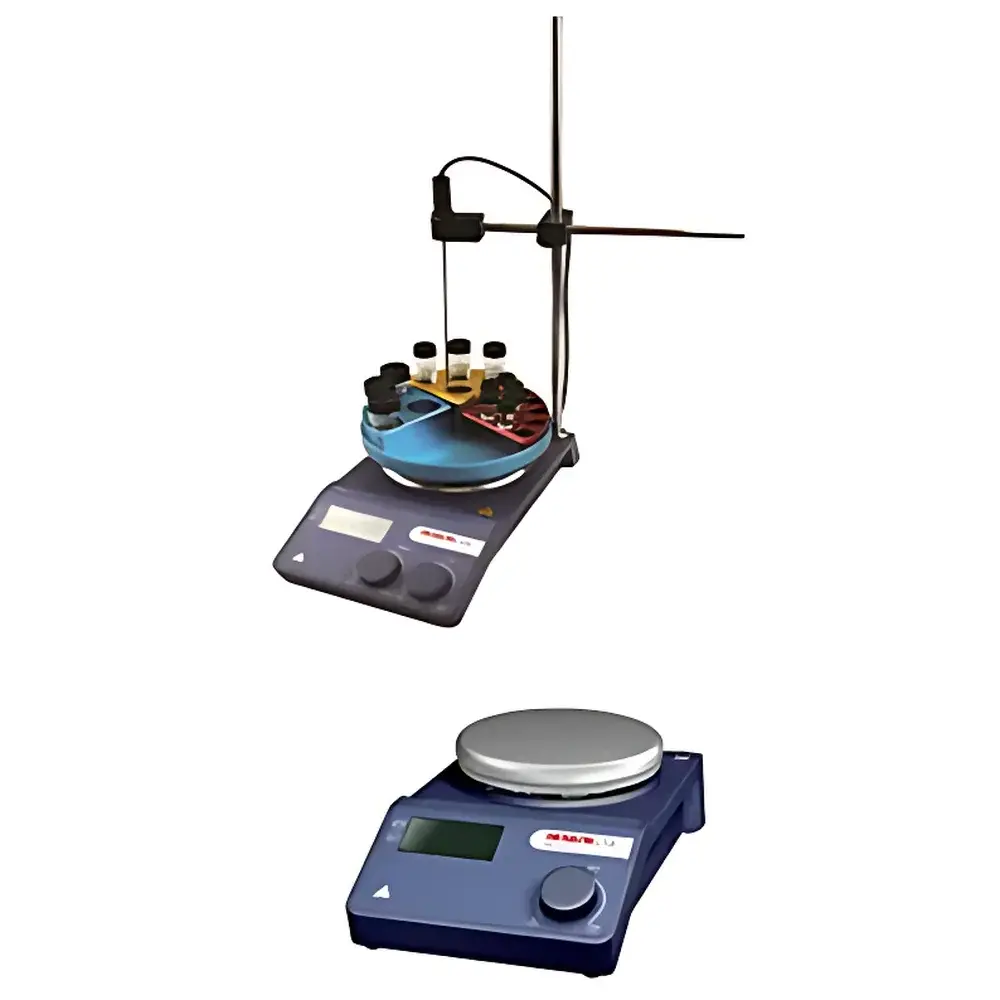
DLAB MS-H-Pro+ Digital Heating Magnetic Stirrer
| Brand | DLAB |
|---|---|
| Origin | Beijing, China |
| Model | MS-H-Pro+ |
| Stirrer Type | Magnetic Stirrer |
| Max Stirring Volume | 20 L (H₂O) |
| Speed Range | 100–1500 rpm |
| Temperature Control Range | Ambient to 340 °C |
| Heating Power | 500 W |
| Motor | Brushless DC |
| Display | Backlit LCD (Speed ±1 rpm, Temp ±0.1 °C) |
| External Temp Sensor Support | PT1000 (±0.2 °C accuracy) |
| Safety Features | Dual independent thermal cut-off circuits, programmable safety temp limit, residual heat warning |
| Interface | RS232 with Stir PC software (real-time parameter control & curve logging) |
| Protection Rating | IP42 |
| Dimensions (W×D×H) | 280 × 160 × 85 mm |
| Weight | 2.8 kg |
Overview
The DLAB MS-H-Pro+ Digital Heating Magnetic Stirrer is an engineered solution for precise, reproducible, and unattended thermal mixing in research laboratories, quality control environments, and routine analytical workflows. Based on the fundamental principle of magnetic coupling—where a rotating permanent magnet beneath the workplate induces torque in a magnetic stir bar immersed in the sample—the MS-H-Pro+ integrates high-efficiency induction heating with closed-loop digital temperature regulation. Its dual-circuit safety architecture and programmable thermal limits ensure compliance with laboratory safety protocols during extended overnight or无人操作 (unattended) operation. Designed for stability under variable ambient conditions, the unit employs fuzzy logic control algorithms and microprocessor-based feedback to maintain consistent rotational velocity and temperature setpoints—even when viscosity, volume, or ambient load fluctuates.
Key Features
- Brushless DC motor delivering stable torque across the full speed range (100–1500 rpm), with ±1 rpm display resolution and minimal drift over time
- Dual independent thermal protection circuits: one monitors surface temperature via integrated sensor; the second supports user-defined upper limit activation using either internal or external PT1000 probe (±0.2 °C accuracy)
- Backlit LCD interface showing simultaneous real-time readouts of speed (rpm) and temperature (°C), both with high-resolution display (0.1 °C, 1 rpm)
- Two interchangeable workplates: chemically resistant enamel-coated steel and corrosion-resistant stainless steel (Ø135 mm), optimized for compatibility with acidic, alkaline, or organic media
- RS232 serial interface enabling bidirectional communication with Windows-based Stir PC software—supporting remote parameter configuration, real-time graphing of speed/temperature profiles, and timestamped data export (.csv)
- Rapid heating capability: achieves +6 K/min temperature rise in 1 L water; maximum plate temperature of 340 °C with ±1 °C control accuracy at setpoint
- IP42-rated enclosure providing protection against solid objects >1 mm and vertically falling drops—suitable for standard laboratory benchtop use
Sample Compatibility & Compliance
The MS-H-Pro+ accommodates vessels up to 20 L (water-equivalent) and accepts stir bars up to 80 mm in length. Its enamel and stainless-steel workplates resist degradation from common solvents, buffers, and reagents used in life science, pharmaceutical, and materials synthesis applications. The instrument meets DIN EN 60529 for ingress protection and conforms to general electrical safety requirements for Class I laboratory equipment. While not certified to IEC 61010-1 as a standalone medical device, its dual thermal cutoffs, residual heat warning display, and programmable safety temperature limit support adherence to GLP and internal SOPs governing unattended operation. External PT1000 integration enables direct sample-core temperature monitoring—critical for reaction optimization per USP , ISO 17025, or ASTM E2912-21 guidelines.
Software & Data Management
Stir PC software (freely available from DLAB’s official website) provides full functional parity with front-panel controls and extends operational traceability. Users can define multi-step temperature/speed ramps, log time-stamped datasets with metadata (operator ID, method name, date/time), and generate audit-ready reports. All parameter changes—including safety thresholds and calibration offsets—are recorded with timestamps. While the RS232 interface does not natively support FDA 21 CFR Part 11 electronic signature functionality, raw data exports (.csv) are fully compatible with validated LIMS or ELN platforms where secondary authentication and version control are applied.
Applications
- Controlled heating and homogenization of viscous polymer solutions prior to rheological or spectroscopic analysis
- Preparation of standardized buffer solutions under GLP-compliant conditions with documented thermal history
- Accelerated solvent extraction protocols requiring precise temperature maintenance during agitation
- Synthesis of metal-organic frameworks (MOFs) and nanomaterials where nucleation kinetics depend on uniform thermal-mechanical input
- Stability testing of pharmaceutical suspensions per ICH Q1A(R3), including long-duration stirring at elevated temperatures
- Calibration verification of temperature probes using NIST-traceable reference fluids in controlled thermal gradients
FAQ
Can the MS-H-Pro+ operate unattended overnight?
Yes—its dual thermal cut-off circuits, programmable safety temperature limit, and residual heat warning enable safe unattended operation when configured per institutional risk assessment protocols.
Is external temperature feedback mandatory for accurate control?
No. Internal plate sensing provides ±1 °C accuracy. However, for process-critical applications requiring sample-core measurement (e.g., reaction monitoring), the optional PT1000 probe delivers ±0.2 °C accuracy and is recommended.
What is the maximum recommended vessel height for optimal stirring efficiency?
For consistent vortex formation and heat transfer uniformity, vessels should not exceed 300 mm in height when using the standard 80 mm stir bar—especially above 1000 rpm.
Does Stir PC software support automated method sequencing?
Yes. Up to 10 preconfigured methods—including ramp rates, hold times, and target values—can be queued and executed sequentially without manual intervention.
How is calibration traceability maintained?
The unit includes factory calibration certificates for speed and temperature. Field recalibration of temperature offset is supported via software, with all adjustments logged in the Stir PC audit trail.



