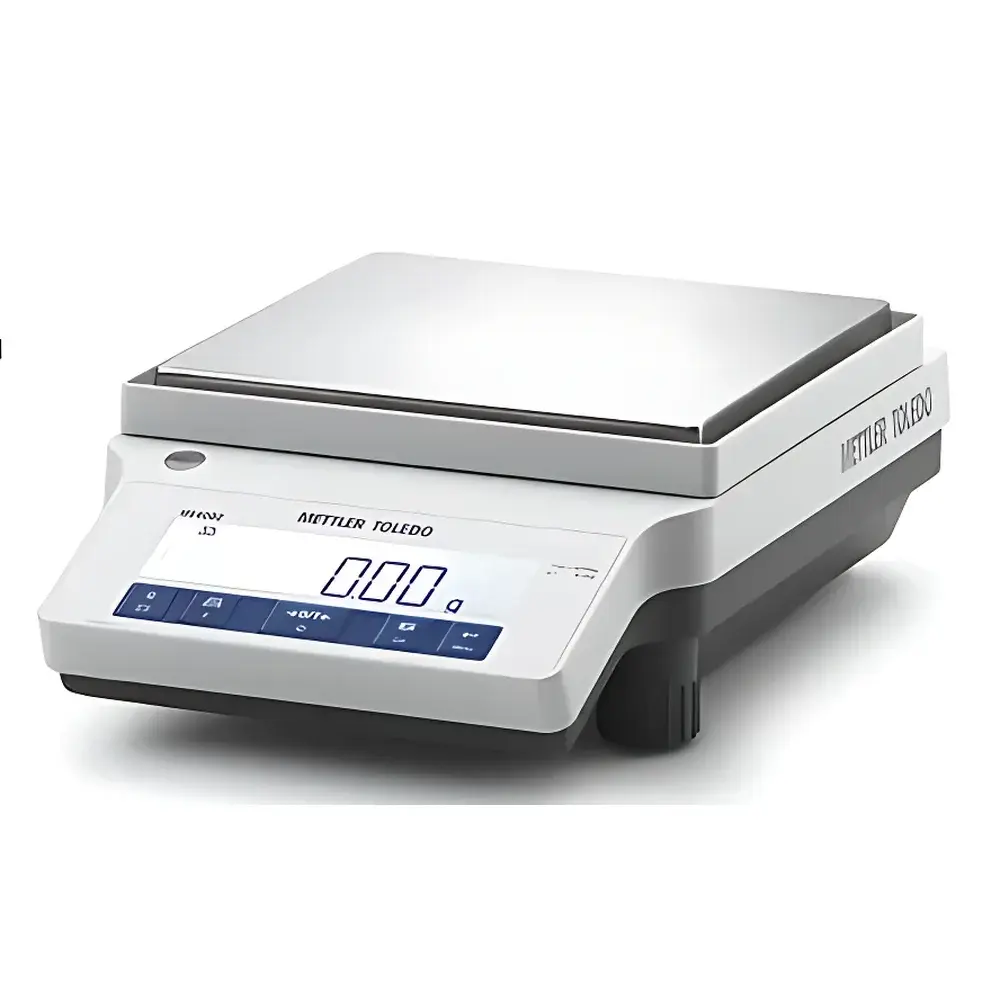
METTLER TOLEDO ME2002 Precision Balance
| Brand | METTLER TOLEDO |
|---|---|
| Origin | Shanghai, China |
| Model | ME2002 |
| Instrument Type | Precision Balance |
| Maximum Capacity | 2200 g |
| Readability | 0.01 g |
| Repeatability | 0.01 g |
| Linearity | 0.02 g |
| Calibration | Internal |
| Dimensions (W × D) | 180 × 180 mm |
| Display | Backlit LCD with large digits |
Overview
The METTLER TOLEDO ME2002 Precision Balance is an entry-level analytical-grade weighing instrument engineered for routine laboratory and quality control applications requiring consistent 0.01 g readability and robust operational reliability. Built upon METTLER TOLEDO’s decades of electromagnetic force compensation (EMFC) transducer technology, the ME2002 delivers stable, drift-resistant measurements under variable environmental conditions—including minor air currents, temperature fluctuations, and bench vibration—without compromising repeatability or linearity. Its compact footprint (180 × 180 mm base) and low-profile design integrate seamlessly into fume hoods, clean benches, and production line QC stations. Unlike mechanical or strain-gauge-based platforms, the EMFC principle ensures zero-load drift correction, high long-term stability, and immunity to mechanical wear—critical for GLP-compliant documentation and multi-shift usage in regulated environments.
Key Features
- Internal calibration system activated via single-button press—eliminates need for external weights and reduces calibration downtime.
- Backlit LCD display with oversized numeric characters (15 mm height) optimized for rapid visual verification across ambient light conditions (10–1000 lux).
- Reinforced metal frame and impact-resistant housing engineered for durability in high-traffic lab or industrial settings.
- Front-mounted leveling feet with integrated bubble level—enabling precise horizontal alignment without tools or disassembly.
- Ergonomic keypad layout with tactile feedback keys; dedicated function buttons for tare, unit toggle, and print initiation reduce operator error.
- IP42-rated enclosure provides protection against dust ingress and incidental liquid splashes during routine cleaning with ethanol or isopropanol wipes.
Sample Compatibility & Compliance
The ME2002 supports a broad range of sample forms—including powders, granules, liquids in containers, and solid components—within its 2200 g maximum capacity. Its draft shield compatibility (optional accessory) extends usability to volatile or hygroscopic materials. The balance conforms to international metrological standards including OIML R76-1 (Class II), EN 45501, and ISO 9001:2015 requirements for measurement traceability. While not certified for USP or ASTM E898-22 compliance out-of-the-box, its documented repeatability (≤0.01 g) and linearity (≤0.02 g) meet minimum performance thresholds for non-regulated QC tasks and educational use. Full audit trail functionality requires integration with METTLER TOLEDO LabX Lite software (sold separately), enabling 21 CFR Part 11–compliant electronic records when deployed on validated Windows workstations.
Software & Data Management
The ME2002 features RS232 and USB device ports for direct connection to PCs, label printers, or LIMS systems. It supports ASCII-based data output protocols compatible with Excel, LabWare, and custom Python/Node-RED ingestion pipelines. When paired with METTLER TOLEDO’s free MT-SICS software, users gain access to automated data logging, customizable report templates (PDF/CSV), and timestamped calibration history export. For GxP environments, LabX Lite enables role-based user authentication, electronic signatures, and mandatory audit trail archiving—including all weight events, parameter changes, and calibration actions—with immutable timestamps and operator ID linkage.
Applications
- Raw material receipt inspection in pharmaceutical and chemical manufacturing facilities.
- Formulation batch verification in food and nutraceutical production lines.
- Teaching laboratories for stoichiometric calculations, density determinations, and gravimetric analysis coursework.
- Environmental testing labs performing soil moisture content and filter residue mass quantification per EPA Method 1664B.
- Electronics assembly QA for component count-by-weight validation prior to SMT placement.
- In-process checks during polymer compounding where additive dosing tolerances fall within ±0.05 g.
FAQ
Is the ME2002 suitable for ISO/IEC 17025-accredited testing laboratories?
It meets basic metrological requirements for internal QC but lacks factory-issued calibration certificates with uncertainty statements—required for accredited scope. External calibration by an ISO/IEC 17025-accredited provider is necessary.
Can the balance be connected to a networked LIMS without additional hardware?
Yes—via USB-to-Ethernet adapters or RS232-to-TCP gateways—but native Ethernet is not supported. LabX Lite provides built-in LIMS API connectors for major platforms including Thermo Fisher SampleManager and Agilent OpenLab.
What is the warm-up time required before first-use calibration?
Minimum 30 minutes at stable ambient temperature (20–25 °C); full thermal stabilization for optimal repeatability occurs after 60 minutes.
Does the internal calibration compensate for temperature-induced drift during extended operation?
No—the internal calibrator corrects static offset only. For dynamic thermal compensation, consider the higher-tier ME-T or XSR series with active temperature-controlled sensor modules.
Is the ME2002 compliant with FDA 21 CFR Part 11 for electronic records?
Not independently—Part 11 compliance requires validated software (e.g., LabX Lite), controlled access, audit trails, and electronic signatures—all implemented at the system level, not the hardware level.