
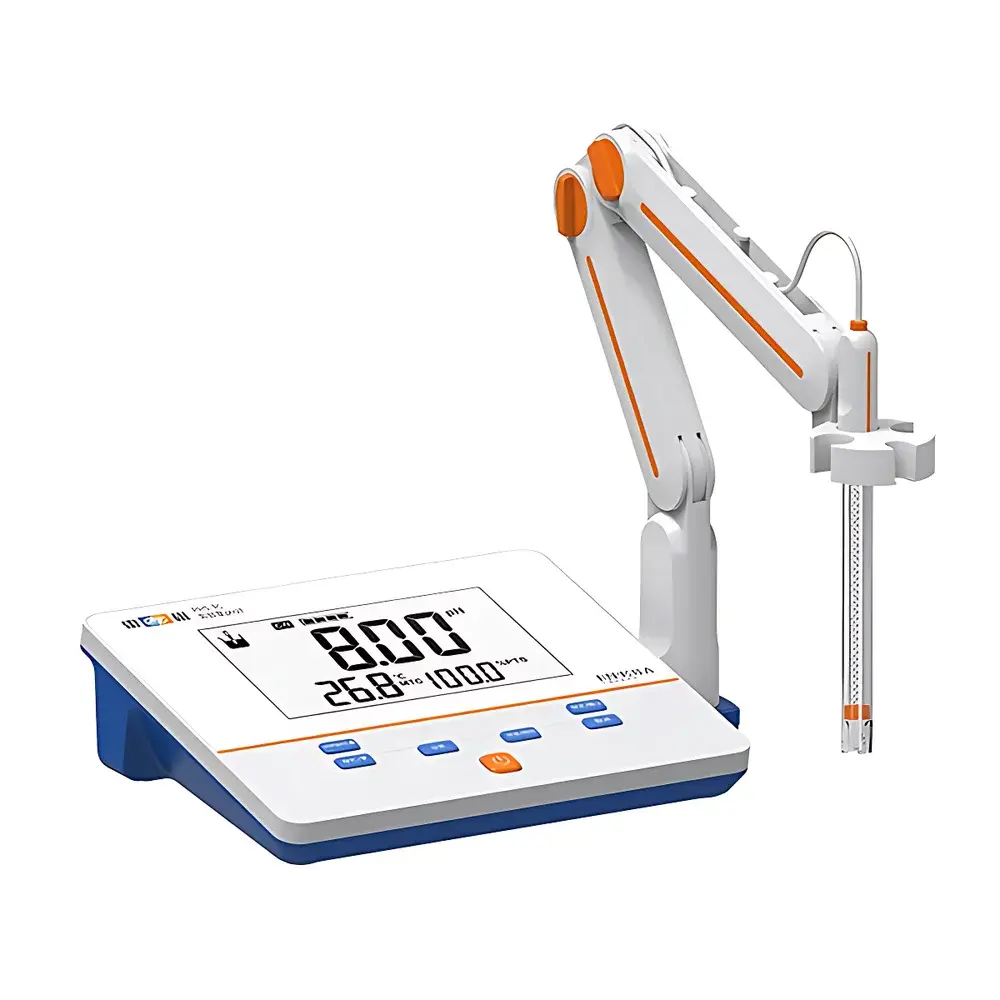
Leici PHS-3C Benchtop pH Meter
| Brand | Leici |
|---|---|
| Origin | Shanghai, China |
| Model | PHS-3C |
| Instrument Type | Benchtop |
| Parameter Type | Single-Parameter (pH/mV) |
| Measurement Accuracy | ±0.01 pH ±1 digit |
| Measurement Range | pH: 0.00–14.00 |
| mV | −1999–+1999 |
| Resolution | 0.01 pH |
| Input Impedance | 1 × 10¹² Ω |
| Stability | ±0.01 pH ±1 digit / 3 h |
| Temperature Compensation Range | 0–60 °C |
| Display | 3½-digit LED |
| Calibration Options | One-point or two-point calibration |
| Compliance | Meets Chinese National Standard GB/T 24375–2009 for laboratory pH meters |
| Power Supply | AC 220 V ± 22 V, 50 Hz ± 1 Hz |
| Dimensions | 290 × 210 × 95 mm |
| Weight | 1.5 kg |
Overview
The Leici PHS-3C is a benchtop pH/mV meter engineered for routine laboratory and quality control applications requiring reliable electrochemical measurement of aqueous solutions. It operates on the principle of potentiometric measurement, utilizing a glass electrode and reference electrode to detect hydrogen ion activity relative to a stable reference potential. The instrument conforms to the fundamental Nernst equation response (−59.16 mV/pH at 25 °C), with built-in circuitry compensating for temperature-induced deviations in electrode slope and asymmetry potential. Designed to meet the performance criteria of Class 0.01 pH meters per Chinese national standard GB/T 24375–2009, the PHS-3C delivers consistent accuracy across its full pH range (0.00–14.00) and extended mV range (−1999 to +1999 mV), making it suitable for titration endpoint detection, buffer verification, and general-purpose acidity/alkalinity assessment in academic, industrial, and municipal testing environments.
Key Features
- High-input-impedance amplifier (≥1 × 10¹² Ω) minimizes loading effects on high-resistance pH electrodes, preserving signal integrity during low-conductivity sample measurement.
- Manual temperature compensation via front-panel adjustment enables correction for solution temperature within 0–60 °C, ensuring accurate pH readings without requiring integrated thermistor probes.
- 3½-digit LED display provides clear, glare-resistant readouts of pH, mV, or temperature values — optimized for ambient lab lighting and prolonged operator use.
- Flexible calibration architecture supports both single-point (e.g., pH 7.00) and two-point (e.g., pH 4.01 and 9.21) calibration routines using standard NIST-traceable or China-certified buffer solutions.
- Robust mechanical design features a compact footprint (290 × 210 × 95 mm) and lightweight chassis (1.5 kg), facilitating placement on fume hoods, analytical workbenches, or mobile QC carts.
- Stability specification of ±0.01 pH ±1 digit over 3 hours ensures repeatability under continuous operation, meeting internal QA requirements for shift-based environmental or process monitoring.
Sample Compatibility & Compliance
The PHS-3C is intended for use with standard combination pH electrodes (e.g., Leici E-201-C or equivalent) and separate reference/glass electrode configurations. It accommodates aqueous samples with conductivity ≥100 µS/cm and viscosity compatible with conventional electrode immersion. While not designed for non-aqueous, highly viscous, or protein-fouling matrices without electrode adaptation, it performs reliably across common industrial effluents, pharmaceutical buffers, food extracts, and educational chemistry solutions. The instrument complies with GB/T 24375–2009, which defines metrological requirements for laboratory pH meters in China, including linearity, drift, and electrode response time validation. Though not certified to ISO/IEC 17025 or GLP/GMP out-of-the-box, its documented calibration traceability, stability metrics, and manual temperature compensation support integration into auditable QC workflows when paired with validated electrodes and SOPs.
Software & Data Management
The PHS-3C is a standalone analog-digital hybrid instrument with no embedded data logging, USB connectivity, or PC interface. All measurements are displayed in real time and must be manually recorded. This architecture prioritizes operational simplicity, electromagnetic immunity, and long-term reliability in environments where networked instrumentation introduces cybersecurity or interference risks. For laboratories requiring electronic records, the device is compatible with external digital loggers or camera-based documentation systems. Its calibration history, electrode maintenance logs, and daily verification checks (e.g., using pH 4.01/7.00/10.01 buffers) should be maintained per internal quality procedures aligned with ISO 17025 clause 7.7 (Measurement Traceability) and FDA 21 CFR Part 11 principles — particularly when used in regulated manufacturing or release testing where result integrity is subject to audit.
Applications
- Routine pH verification of calibration buffers and working standards in analytical labs.
- Monitoring of wastewater influent/effluent pH prior to discharge compliance reporting (e.g., under local environmental protection bureau regulations).
- Quality assurance of buffer solutions in pharmaceutical formulation and bioprocessing.
- Acid-base titration endpoint confirmation in undergraduate chemistry teaching laboratories.
- Process control of fermentation broth, dairy products, or beverage pH during pilot-scale production.
- Field-deployable benchtop verification when paired with portable electrode storage and transport kits.
FAQ
Does the PHS-3C support automatic temperature compensation (ATC)?
No — it features manual temperature compensation only. Users must measure sample temperature independently and adjust the compensation setting accordingly.
Can the PHS-3C be used with non-Chinese calibration buffers?
Yes, provided the buffer’s certified pH value at the measurement temperature is known and traceable to international standards (e.g., DIN 19266, NIST SRM 186). However, factory calibration assumes use of China-standard buffers (e.g., GB/T 11076–2013).
Is the instrument compliant with ISO/IEC 17025 or GLP?
It meets technical specifications referenced in those frameworks but requires documented calibration, preventive maintenance, and operator training to fulfill full accreditation requirements.
What electrode types are recommended for optimal performance?
Leici E-201-C combination electrodes or equivalent general-purpose glass electrodes with Ag/AgCl reference systems are recommended. For low-ionic-strength samples, electrodes with double-junction or sleeve-type liquid junctions are advised to minimize junction potential drift.
Does the unit include electrode storage solution or calibration kits?
No — electrodes, storage solution, and certified pH buffers are sold separately and must be selected based on application-specific requirements and shelf-life considerations.




