
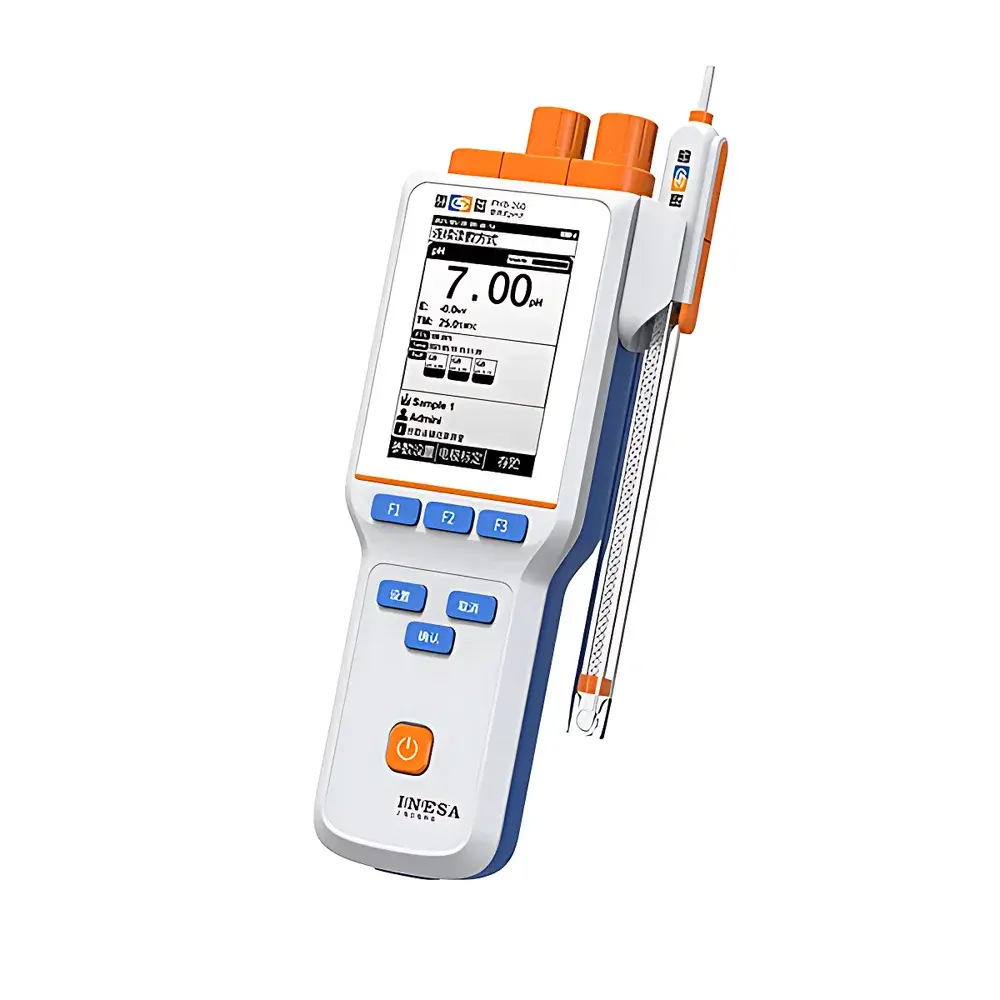
Leici PHBJ-260 Portable pH Meter
| Brand | Leici |
|---|---|
| Origin | Shanghai, China |
| Model | PHBJ-260 |
| Instrument Type | Portable |
| Parameter Type | Single-parameter (pH/mV/T) |
| Measurement Range | 0.00–14.00 pH |
| Resolution | 0.01 pH |
| Accuracy | ±0.01 pH ±1 digit |
| Temperature Compensation | Manual/Automatic (0–99 °C) |
| Display | Backlit LCD with blue illumination |
| Data Storage | 200 sets |
| Interface | RS-232 |
| IP Rating | IP65 |
| Power Supply | 4 × AA alkaline batteries |
| Buffer Options | Five selectable Chinese-standard pH calibration solutions |
| Measurement Modes | pH, mV (ORP), and temperature (−5.0–105.0 °C) |
Overview
The Leici PHBJ-260 is a field-deployable, single-parameter portable pH meter engineered for routine electrochemical measurements in environmental monitoring, industrial process control, water treatment, and educational laboratories. It operates on the fundamental principle of potentiometric measurement: the potential difference between a pH-sensitive glass electrode and a stable reference electrode is converted into a pH value using the Nernst equation (−59.16 mV/pH unit at 25 °C). Designed to meet the operational demands of mobile and semi-permanent field use, the PHBJ-260 integrates robust hardware architecture with intuitive firmware logic—enabling reliable pH, redox potential (mV), and temperature readings under variable ambient conditions. Its sealed IP65-rated enclosure ensures resistance to dust ingress and low-pressure water jets, making it suitable for outdoor sampling, boiler feedwater inspection, and municipal wastewater assessment where portability and environmental resilience are critical.
Key Features
- High-contrast backlit LCD display with user-controllable blue illumination for optimal readability in low-light or outdoor environments
- Automated calibration routines supporting one-point or two-point calibration against five pre-programmed Chinese national standard buffer solutions (pH 4.01, 6.86, 7.00, 9.18, and 10.01 at 25 °C)
- Flexible temperature compensation: manual entry or automatic detection via integrated Pt1000 sensor (range: −5.0 to 105.0 °C; resolution: 0.1 °C)
- Extended battery life management including low-voltage warning and auto-power-off after 10 minutes of inactivity
- Adjustable isopotential point setting—enabling accurate pH measurement of low-conductivity samples such as ultrapure water, deionized water, and boiler condensate when used with specialized low-resistance electrodes
- Stable baseline performance: drift ≤ ±0.01 pH ±1 digit over 3 hours under constant temperature conditions
- Comprehensive data handling: store, review, delete, or print up to 200 measurement records directly from the instrument
Sample Compatibility & Compliance
The PHBJ-260 is validated for aqueous-phase measurements across a broad conductivity range (≥2 µS/cm typical), including drinking water, surface water, effluent streams, cooling tower fluids, and steam-cycle condensates. When paired with appropriate electrodes—such as Leici’s E-201-C composite pH electrode or high-impedance electrodes for ultrapure water—the system complies with methodological expectations outlined in ISO 10523 (Water quality — Determination of pH), ASTM D1293 (Standard Test Methods for pH of Water), and China’s HJ 1147–2020 (Environmental Monitoring Technical Specification for Surface Water and Wastewater). While not certified for GLP/GMP-regulated production environments, its traceable calibration protocols, audit-ready data storage, and RS-232 serial output support alignment with internal QA/QC documentation requirements.
Software & Data Management
Instrument data can be exported via RS-232 interface to TP-16 thermal printers for hard-copy reporting or transferred to Windows-based PCs using Leici’s official data acquisition software (v3.2+). The software enables time-stamped export of raw datasets (.csv), generation of calibration reports with slope/offset verification, and graphical trending of sequential pH/mV/temperature measurements. All stored records retain metadata including date/time stamp, calibration status flag, temperature reading, and electrode identification (if entered manually). No cloud synchronization or remote firmware updates are supported—ensuring data sovereignty and minimizing cybersecurity exposure in regulated infrastructure settings.
Applications
- Field-based pH monitoring of rivers, lakes, and groundwater wells during environmental impact assessments
- In-process verification of neutralization steps in chemical manufacturing and pharmaceutical wastewater pretreatment
- Boiler water alkalinity control and corrosion risk evaluation in power generation facilities
- Calibration verification and routine QC checks in teaching labs and vocational training centers
- On-site validation of membrane integrity in reverse osmosis systems through feed/permeate pH differentials
- Supporting ISO/IEC 17025-compliant testing laboratories where documented measurement uncertainty budgets include contributions from instrument resolution (0.01 pH), accuracy (±0.01 pH), and temperature-induced drift
FAQ
Does the PHBJ-260 support US or European buffer standards (e.g., NIST-traceable pH 4.01, 7.00, 10.01)?
No—the device is configured exclusively for Chinese national standard buffers. Users requiring international calibration must perform manual slope/offset adjustment using external reference values.
Can the instrument measure pH in non-aqueous or high-alcohol-content samples?
Not recommended. The PHBJ-260 is optimized for aqueous electrolyte solutions. Non-aqueous solvents may cause junction potential errors, glass membrane dehydration, or reference electrode instability.
Is the RS-232 interface compatible with modern USB-to-serial adapters?
Yes—standard FTDI- or CP2102-based adapters function reliably under Windows 10/11 with appropriate COM port drivers installed.
What is the expected service life of the built-in temperature sensor?
The Pt1000 thermistor exhibits long-term stability with typical drift <0.1 °C/year under normal operating conditions (20–40 °C ambient, non-condensing humidity).
Does the device provide measurement uncertainty estimates per ISO/IEC Guide 98-3?
No—it does not calculate or display expanded uncertainty. Users must derive combined uncertainty using manufacturer-specified accuracy, resolution, calibration uncertainty, and temperature compensation error contributions.






