
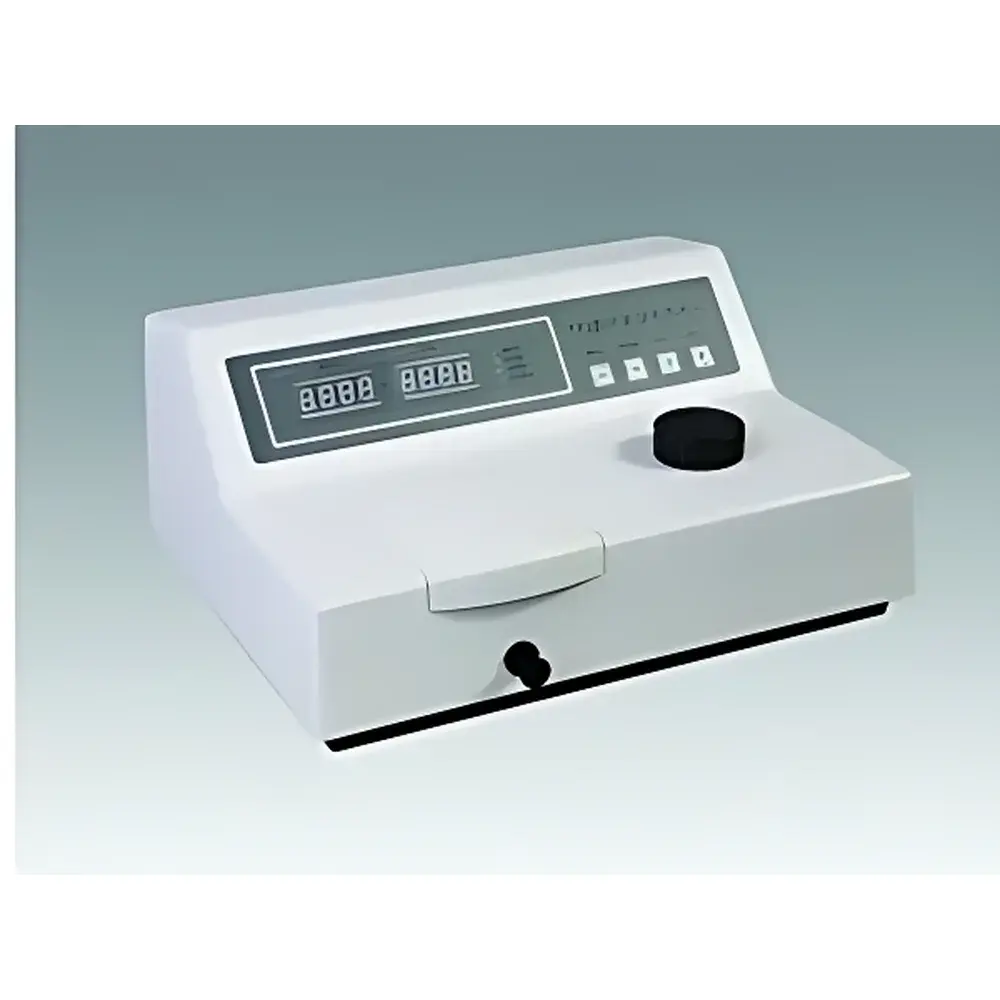
Shanghai SOPTOP 722 Visible Spectrophotometer
| Brand | SOPTOP |
|---|---|
| Origin | Shanghai, China |
| Model | 722 |
| Optical System | Single-beam |
| Detector Type | Photodiode Array |
| Wavelength Range | 325–1000 nm |
| Wavelength Accuracy | ±2 nm |
| Wavelength Repeatability | ±1 nm |
| Spectral Bandwidth | 4 nm |
| Stray Light | ≤0.5% T (at 360 nm) |
| Transmittance Accuracy | ±0.5% T |
| Transmittance Repeatability | ±0.2% T |
| Baseline Stability | ≤±0.5% T / 5 min |
| Measurement Modes | Transmittance (0–199.9% T), Absorbance (−0.3 to 2.5 A), Factor (F: 0–9999), Concentration (C: 0–9999) |
Overview
The Shanghai SOPTOP 722 Visible Spectrophotometer is a precision single-beam optical instrument engineered for quantitative analysis in the visible spectral region (325–1000 nm). It operates on the fundamental principle of Beer–Lambert law-based absorption photometry, where sample absorbance at a selected wavelength is linearly correlated with analyte concentration under controlled pathlength and matrix conditions. Designed for routine laboratory environments—including educational institutions, quality control labs in food and pharmaceutical manufacturing, environmental monitoring facilities, and industrial R&D centers—the 722 delivers reliable, repeatable transmittance and absorbance measurements without requiring complex alignment or high-maintenance optics. Its fixed 4 nm spectral bandwidth ensures adequate resolution for standard colorimetric assays while maintaining signal-to-noise performance suitable for entry-level to mid-tier analytical workflows.
Key Features
- Digital wavelength display with manual selection across 325–1000 nm, enabling precise method setup and traceable wavelength referencing.
- Integrated auto-zero (0% T) and auto-full-scale (100% T) calibration functions, reducing operator dependency and minimizing baseline drift between measurements.
- Direct concentration readout mode: users may input a pre-determined concentration factor or standard concentration value to obtain real-time concentration results without post-acquisition calculation.
- Robust mechanical design with thermally stable optical housing, supporting consistent performance over extended operation cycles (baseline stability ≤±0.5% T within 5 minutes).
- Photodiode array detector offering uniform sensitivity across the visible range and enhanced long-term signal reproducibility compared to single phototube configurations.
- Compliant with ISO 9001-certified manufacturing practices; meets core performance criteria aligned with ASTM E275 and ISO 6223 for visible spectrophotometric instrumentation verification.
Sample Compatibility & Compliance
The 722 accommodates standard 10 mm pathlength cuvettes (glass or plastic), supporting liquid-phase analysis of aqueous, organic, and mildly corrosive solutions. It is routinely deployed in applications requiring adherence to GLP-compliant documentation protocols—particularly in academic teaching labs and contract testing facilities where audit-ready measurement traceability is essential. While not equipped with electronic audit trail or 21 CFR Part 11-compliant software out-of-the-box, its analog/digital hybrid architecture allows integration into validated workflows via external data logging systems. The instrument satisfies minimum performance thresholds specified in Chinese national standard JJG 178–2015 (Calibration Regulations for Visible Spectrophotometers) and serves as a reference-grade platform for internal method validation per USP and EP 2.2.25 guidelines.
Software & Data Management
The 722 operates via front-panel controls with no embedded PC interface; all data are displayed locally on an LED readout and must be manually recorded or captured via optional RS-232 serial output (available on select firmware versions). For laboratories requiring digital archiving, third-party data acquisition software—compatible with standard ASCII output protocols—can be configured to log absorbance, transmittance, and concentration values with timestamping. While native software is not supplied, the instrument’s deterministic response and stable analog output enable seamless incorporation into LIMS environments when paired with certified analog-to-digital converters meeting IEC 61000-4-3 immunity standards.
Applications
- Quantitative determination of transition metal ions (e.g., Fe²⁺/Fe³⁺, Cu²⁺, Cr⁶⁺) using established colorimetric reagents such as 1,10-phenanthroline or diphenylcarbazide.
- Enzyme kinetics monitoring (e.g., NADH/NADPH oxidation at 340 nm) in biochemistry teaching labs and preliminary assay development.
- Water quality assessment: nitrate, phosphate, and ammonia nitrogen analysis per APHA Standard Methods 4500 series.
- Food additive quantification (e.g., tartrazine, sunset yellow) in compliance with GB 5009.x national food safety standards.
- Pharmaceutical excipient purity screening and dissolution profile verification in non-GMP pilot-scale settings.
FAQ
Is the 722 compliant with FDA 21 CFR Part 11?
No—the instrument lacks built-in electronic records, user authentication, or audit trail functionality required for Part 11 compliance. Validation requires external data capture systems with appropriate controls.
Can it measure below 325 nm?
No—the optical design and detector sensitivity are optimized exclusively for the visible range (325–1000 nm); UV measurements require a dedicated UV-Vis system.
What cuvette types are supported?
Standard 10 mm square quartz, glass, or disposable plastic cuvettes; pathlength deviation beyond ±0.1 mm may affect absorbance linearity.
Does it support kinetic or scanning modes?
No—it is a fixed-wavelength or manually stepped instrument; spectral scanning and time-resolved measurements are not supported.
How often should wavelength accuracy be verified?
Per ISO/IEC 17025 recommendations, verify annually using NIST-traceable holmium oxide or didymium filters; additional checks advised after transport or mechanical shock.






