SOPTOP JA2003 Precision Analytical Balance
| Brand | SOPTOP |
|---|---|
| Origin | Shanghai, China |
| Model | JA2003 |
| Maximum Capacity | 200 g |
| Readability | 1 mg |
| Repeatability | ±1 mg |
| Linearity | ±2 mg |
| Pan Diameter | Φ110 mm |
| Draft Shield Dimensions (W×D×H) | 190 × 205 × 225 mm |
| External Dimensions (W×D×H) | 215 × 330 × 325 mm |
| Calibration | External |
| Display | Backlit LCD |
| Interface | RS232 |
| Weighing Units | g, oz, ct, etc. |
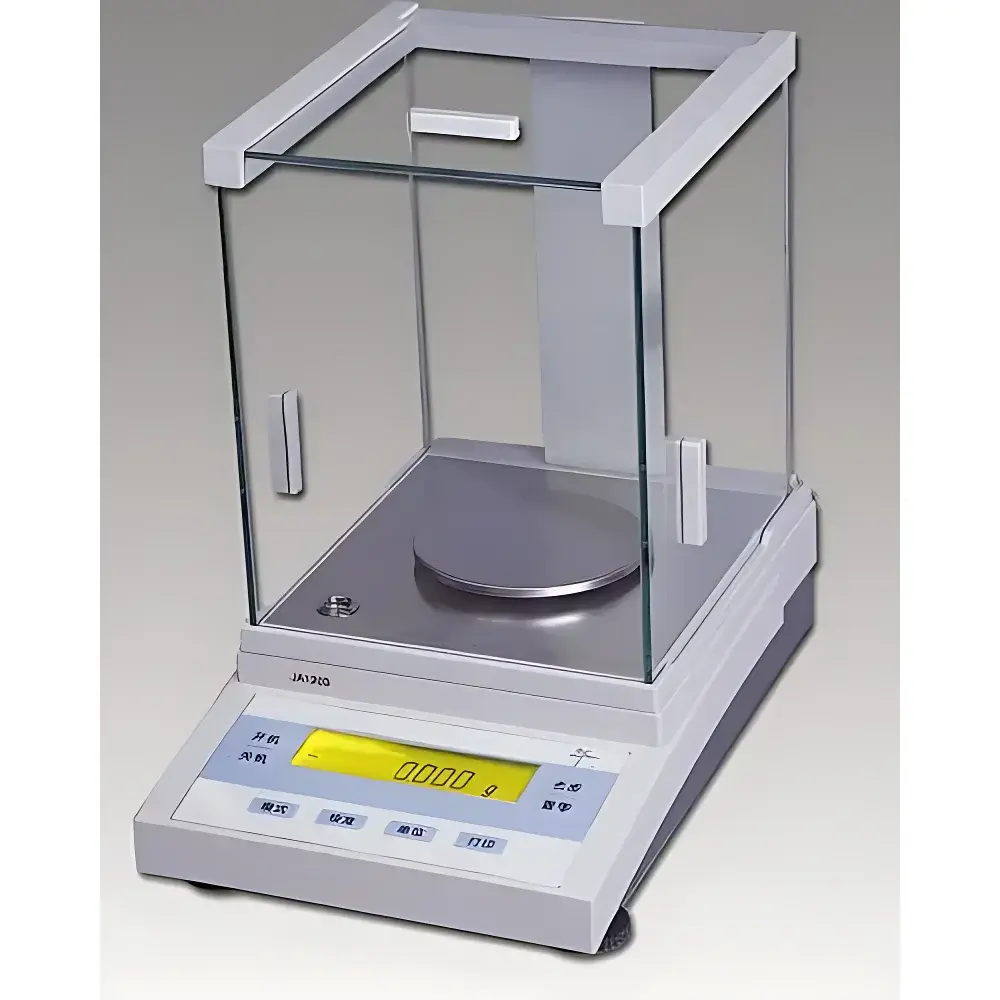
| Features | Electromagnetic force sensor, draft shield with five-sided glass, dynamic temperature compensation, adjustable weighing speed, auto-zero tracking, overload protection & alarm, full-range tare, counting function, under-hook weighing |
Overview
The SOPTOP JA2003 Precision Analytical Balance is an entry-level high-reliability analytical balance engineered for routine laboratory weighing tasks requiring sub-milligram resolution and consistent repeatability. Based on electromagnetic force compensation (EMFC) technology, the instrument achieves stable mass measurement by balancing the gravitational force of a sample against a precisely controlled electromagnetic force generated within a high-stability sensor. This principle ensures minimal mechanical wear, long-term calibration stability, and immunity to ambient vibration when operated on a level, rigid surface. Designed for environments where accuracy, ease of operation, and regulatory traceability are essential — including QC laboratories, educational institutions, and R&D facilities — the JA2003 delivers 1 mg readability across its 200 g maximum capacity, meeting foundational requirements for ISO/IEC 17025-compliant weighing procedures and supporting GLP documentation workflows.
Key Features
- High-stability electromagnetic force sensor with ultra-thin profile design, minimizing thermal drift and enhancing response time.
- Five-sided transparent glass draft shield (190 × 205 × 225 mm) providing unobstructed visibility and effective air current isolation without compromising ergonomic access.
- Backlit LCD display with intuitive icon-driven interface, supporting multi-language menu navigation (English default).
- Dynamic temperature compensation algorithm continuously adjusts internal reference parameters to mitigate thermal influence on zero point and sensitivity.
- Adjustable weighing speed settings allow optimization for volatile or static-prone samples; fast mode for gross weighing, slow mode for high-precision stabilization.
- Integrated below-balance hook enables density determination, magnetic susceptibility assessment, and suspended weighing applications.
- Four-stage shock absorption system dampens floor-borne vibrations, improving measurement stability in non-dedicated lab spaces.
- RS232 serial interface supports direct data export to LIMS, Excel, or custom QA software; compatible with standard ASCII protocol for seamless integration.
Sample Compatibility & Compliance
The JA2003 accommodates a broad range of solid and granular samples via its 110 mm diameter stainless steel weighing pan. Its open-top, five-panel shield configuration permits convenient handling of flasks, crucibles, and irregularly shaped containers while maintaining environmental isolation. The balance complies with international metrological standards including OIML R76-1 (2006) for non-automatic weighing instruments and satisfies the minimum performance criteria outlined in USP for analytical balances used in pharmaceutical testing. While not inherently 21 CFR Part 11 compliant, audit-ready operation is supported through external software logging of calibration events, user logins, and weight records when paired with validated data capture systems.
Software & Data Management
Data output is configured via RS232 using fixed-format ASCII transmission (e.g., “S+000.123 g” upon stabilization), enabling compatibility with third-party laboratory informatics platforms. The balance supports automatic print-on-stabilization and manual trigger modes. Though no proprietary PC software is bundled, the device is fully interoperable with common serial-to-USB adapters and open-source terminal emulators (e.g., PuTTY, Tera Term). For regulated environments, users may implement electronic record validation protocols per ALCOA+ principles by pairing the JA2003 with timestamped, user-authenticated data acquisition tools that enforce edit history retention and digital signature support.
Applications
- Pharmaceutical formulation: active ingredient dispensing, excipient ratio verification, and batch release testing per pharmacopeial monographs.
- Chemical synthesis: stoichiometric reagent weighing, catalyst loading, and yield calculation in teaching and research labs.
- Materials science: powder density profiling, coating mass uniformity checks, and additive manufacturing feedstock verification.
- Food & beverage QA: nutritional labeling compliance, moisture content pre/post-drying mass differentials, and portion control auditing.
- Environmental testing: filter paper mass change analysis for particulate matter (PM2.5/PM10) gravimetric quantification per EPA Method 201A.
FAQ
What is the recommended calibration frequency for the JA2003?
Calibration should be performed before first use, after relocation, following exposure to significant temperature shifts, and at defined intervals aligned with internal SOPs — typically daily for critical applications or prior to each analytical session.
Does the JA2003 support internal calibration?
No — it requires external calibration using certified weights traceable to national standards (e.g., NIST, PTB). A Class M2 or better weight is recommended for 200 g verification.
Can the balance store multiple user profiles?
No — user identification must be maintained externally via lab notebook entries or integrated LIMS workflows, as the device lacks onboard user authentication.
Is the RS232 interface optically isolated?
No — galvanic isolation is not built-in; use of an isolated USB-to-RS232 adapter is advised in electrically noisy industrial environments.
How does the dynamic temperature compensation function operate?
An internal thermistor network monitors sensor housing temperature gradients in real time, applying empirically derived correction coefficients to offset thermal-induced zero drift and sensitivity variation.