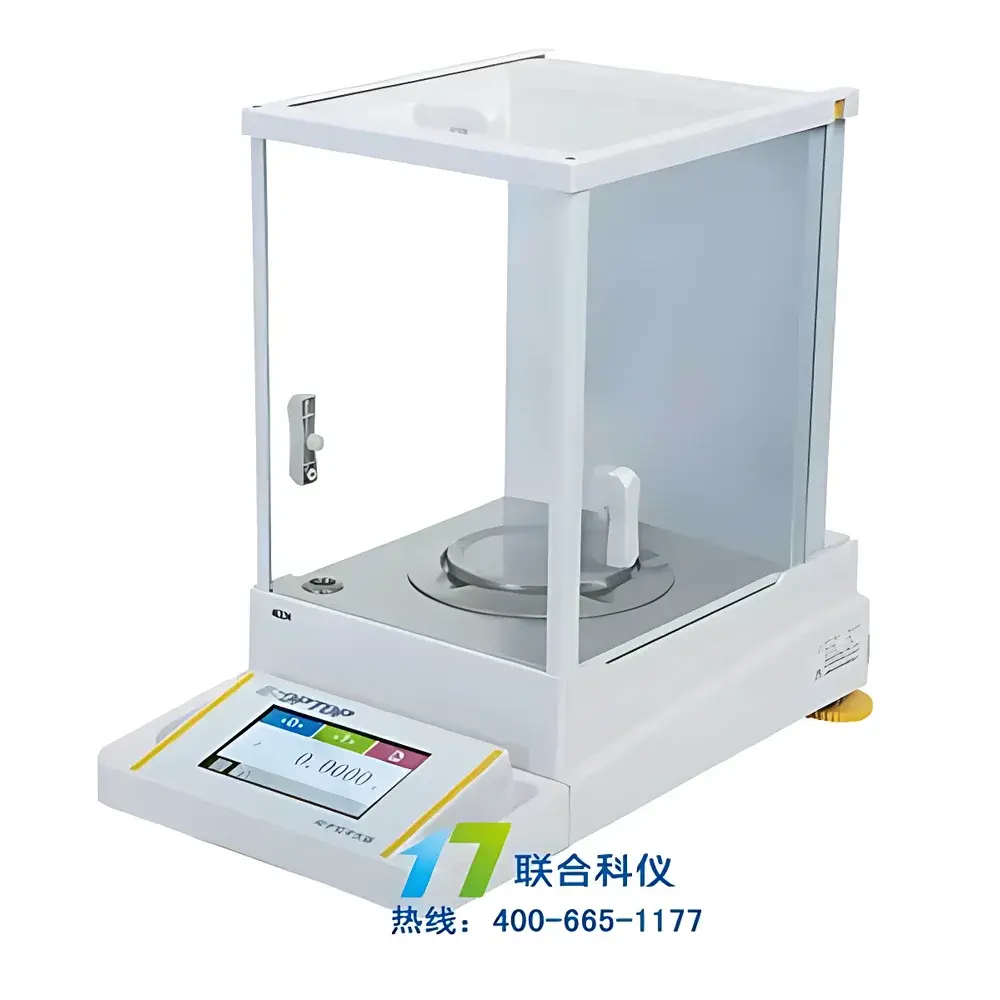
SoopTop AE124C Internal Calibration Analytical Balance
| Brand | SoopTop |
|---|---|
| Origin | Shanghai, China |
| Model | AE124C |
| Type | Analytical Balance |
| Maximum Capacity | 120 g |
| Readability | 0.0001 g |
| Repeatability (Standard Deviation) | 0.0001 g |
| Calibration | Internal |
| Pan Diameter | Ø90 mm |
| Dimensions (W×D×H) | 365 × 223 × 338 mm |
| Net Weight | 5.5 kg |
| Windshield Effective Volume | 160 × 165 × 200 mm |
Overview
The SoopTop AE124C is a high-precision internal calibration analytical balance engineered for routine and regulated laboratory environments where traceable mass measurement, operational reliability, and ergonomic usability are critical. Based on electromagnetic force compensation (EMFC) transduction, the AE124C delivers stable, drift-compensated readings with a readability of 0.0001 g across its 120 g maximum capacity. Its integrated internal calibration mechanism—activated at user-defined intervals or upon environmental change detection—ensures continuous metrological traceability without external weights, reducing operator dependency and minimizing downtime. Designed in compliance with international weighing standards including OIML R76 and ISO/IEC 17025 requirements for calibration laboratories, the AE124C supports GLP- and GMP-aligned workflows through built-in audit trail readiness and hardware-level calibration verification.
Key Features
- True-color TFT LCD display (4.3″) with high-contrast graphics and intuitive icon-based navigation—optimized for readability under varied ambient lighting and compatible with gloved operation.
- Capacitive full-screen touch interface with haptic feedback and multi-point gesture support, enabling precise input even with double-layer nitrile or latex gloves.
- Ergonomic front-panel leveling system with integrated bubble level indicator and low-profile adjustable feet—designed to minimize posture strain during extended setup and daily use.
- Robust overload-protected weighing pan (Ø90 mm stainless steel) featuring a reinforced suspension architecture that safeguards the EMFC sensor against mechanical shock up to 200% of rated load.
- Integrated draft shield with sliding glass doors and removable side panels—engineered to maintain laminar airflow while allowing unobstructed access during sample placement and retrieval.
- Transport lock with dual-stage glass door immobilization system—prevents pendulum motion and sensor displacement during relocation or shipping.
- Environmental monitoring module (temperature & drift compensation) continuously adjusts gain parameters to maintain accuracy across typical lab temperature fluctuations (15–30 °C).
Sample Compatibility & Compliance
The AE124C accommodates standard analytical vessels—including weighing boats, crucibles, volumetric flasks, and small vials—within its 160 × 165 × 200 mm effective windscreen volume. Its sealed housing meets IP42 ingress protection specifications, providing resistance to dust accumulation and incidental liquid splashes. The balance conforms to regulatory expectations for instrument qualification: it supports IQ/OQ documentation templates aligned with USP , ASTM E898, and ISO 9001:2015. Internal calibration events are timestamped and logged in non-volatile memory, satisfying basic FDA 21 CFR Part 11 data integrity prerequisites when paired with optional PC connectivity and compliant software.
Software & Data Management
The AE124C features an embedded application suite supporting common analytical workflows: parts counting, percentage weighing, density determination (with optional density kit), net/gross/tare toggling, and dynamic averaging. All operations generate structured metadata—including date/time stamp, operator ID (via optional keypad login), calibration status, and environmental deviation flags. Data export is supported via RS232 and optional USB-to-serial interface, enabling seamless integration with LIMS platforms or validated Excel-based reporting tools. Firmware updates are performed via USB drive with cryptographic signature verification to ensure integrity and version control.
Applications
This analytical balance is routinely deployed in pharmaceutical QC labs for active pharmaceutical ingredient (API) assay preparation, reference standard weighing, and filter weight loss analysis per USP . It serves academic research groups conducting gravimetric synthesis validation, catalyst loading quantification, and thermogravimetric sample preparation. In food safety testing, it supports moisture content determination by loss-on-drying (LOD) protocols (AOAC 950.46), while environmental labs utilize it for filter-based particulate matter (PM₂.₅/PM₁₀) collection weighing in accordance with EPA Method 201A. Its internal calibration architecture makes it particularly suitable for satellite labs lacking dedicated metrology staff.
FAQ
What calibration standards does the internal calibration routine follow?
The AE124C performs internal calibration using a factory-traceable, temperature-stabilized reference mass. The procedure complies with OIML R76-1 Annex C and implements automatic linearity verification at 0%, 50%, and 100% of full scale.
Is the balance compatible with GLP-compliant electronic record systems?
Yes—when connected via RS232 to validated third-party software (e.g., LabX, BalanceLink), the AE124C provides time-stamped, immutable records with operator identification and calibration history, meeting core ALCOA+ principles.
Can the touchscreen be operated with standard laboratory gloves?
The capacitive interface is calibrated for responsiveness with both single- and double-layer nitrile, latex, and vinyl gloves—no stylus required.
What is the recommended warm-up time before first use?
A minimum 30-minute stabilization period is advised after power-on to achieve thermal equilibrium in the EMFC sensor and internal reference system.
Does the AE124C support multiple unit conversions during a single weighing session?
Yes—it offers instantaneous switching among grams, milligrams, carats, ounces, troy ounces, and grain units without interrupting the current weighing process or resetting tare.