
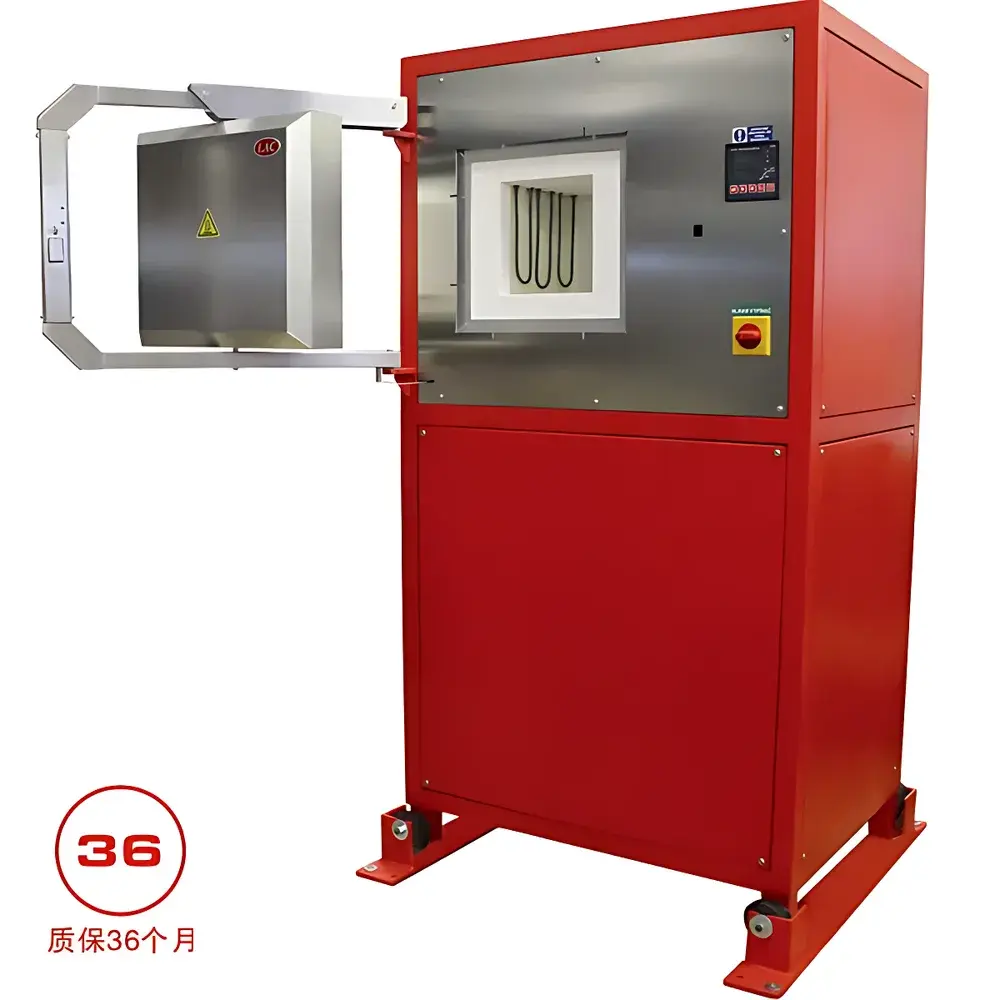
LAC VP02/18 High-Temperature Box Furnace (1800 °C)
| Brand | LAC |
|---|---|
| Origin | Czech Republic |
| Model | VP02/18 |
| Max Temperature | 1800 °C |
| Temperature Uniformity | ±1 °C |
| Max Power | 3 kW |
| Ramp Time to 1800 °C | 135 min |
| Heating Element | Silicon Molybdenum (MoSi₂) Rods |
| Internal Chamber Dimensions | 130 × 150 × 135 mm (W × H × D) |
| Controller | HT205 (30 programs, 15 segments each, LAN interface) |
| Thermocouple Type | Type B |
| Door Operation | Manual side-opening with safety limit switch |
| Cooling | Integrated fan for electronics |
| Exhaust Port | Standard |
| Design | Benchtop |
Overview
The LAC VP02/18 is a precision-engineered high-temperature box furnace designed for sustained operation up to 1800 °C in inert, oxidizing, or vacuum-compatible environments. It employs silicon molybdenum (MoSi₂) heating elements—optimized for long-term stability and resistance to oxidation above 1200 °C—and operates on the principle of radiant heat transfer within a thermally insulated chamber. Unlike general-purpose muffle furnaces rated below 1400 °C, the VP02/18 is specifically engineered for applications requiring thermal stability at extreme temperatures, including ceramic sintering, refractory material testing, high-purity oxide synthesis, and advanced materials research. Its operational envelope is intentionally constrained: continuous use below 1200 °C is not recommended, as prolonged low-temperature exposure accelerates MoSi₂ element degradation and compromises temperature uniformity across the working zone. This design reflects LAC’s adherence to materials science best practices—prioritizing elemental longevity and measurement fidelity over broad operational flexibility.
Key Features
- High-temperature capability up to 1800 °C, validated per IEC 60584-2 for Type B thermocouple accuracy
- ±1 °C temperature control precision maintained over full operating range, achieved via PID algorithm with auto-tuning and adaptive gain scheduling
- Benchtop configuration (VP02 series) optimized for space-constrained laboratories while retaining structural rigidity and thermal mass consistency
- Manually actuated side-hinged door with integrated mechanical limit switch—ensures power cutoff upon door opening per EN 61000-6-4 safety requirements
- Dual-layer insulation architecture: outer ceramic fiber board + inner high-purity alumina-silica composite lining, minimizing thermal loss and surface temperature rise
- Integrated cooling fan dedicated exclusively to solid-state relay and controller electronics—prevents thermal drift during extended ramp-hold cycles
- Standard exhaust port (M12 thread) compatible with active venting systems and pressure-balanced gas purging setups
Sample Compatibility & Compliance
The VP02/18 accommodates crucibles and sample holders fabricated from high-purity alumina, zirconia, graphite (in inert/vacuum), or molybdenum—materials selected to avoid contamination and maintain dimensional stability at peak temperature. It complies with CE marking directives (2014/30/EU EMC, 2014/35/EU LVD) and meets essential requirements of ISO 15190:2019 for laboratory equipment safety. While not certified for Class I Div 1 hazardous locations, its construction supports integration into GLP-compliant workflows when paired with audit-trail-capable controllers (e.g., HT200 with HTMonit software). The furnace does not include built-in atmosphere control; however, optional protective gas inlet kits—equipped with calibrated rotameters and pressure regulators—enable reproducible argon, nitrogen, or forming gas environments aligned with ASTM C1171 and ISO 2739 standards.
Software & Data Management
The standard HT205 controller provides Ethernet (LAN) connectivity for remote monitoring and basic program upload/download. For traceable, regulated environments, the optional HT200 controller extends functionality with USB 2.0 and RS-485 (EIA-485) interfaces, supporting bidirectional communication with LAC’s HTMonit software suite. HTMonit enables real-time temperature logging, multi-channel data overlay (e.g., furnace setpoint vs. B-type thermocouple feedback), and export to CSV or XML formats compliant with 21 CFR Part 11 requirements when deployed with user access controls and electronic signature modules. All controller firmware revisions are version-locked and documented per LAC’s quality management system (ISO 9001:2015 certified), ensuring repeatability across instrument lifecycles.
Applications
- Sintering of ultra-high-temperature ceramics (UHTCs), including ZrB₂–SiC composites and HfC-based systems
- Thermal gravimetric analysis (TGA) pre-heating stages requiring stable 1600–1800 °C soak conditions
- Calibration of high-temperature reference standards against fixed points (e.g., Co–C, Pd–Fe)
- Heat treatment of single-crystal substrates prior to epitaxial growth (e.g., SiC, AlN)
- Decomposition kinetics studies of rare-earth oxides under controlled oxidative atmospheres
- Pre-firing of investment casting molds for aerospace-grade superalloys
FAQ
Why is operation below 1200 °C discouraged?
MoSi₂ heating elements undergo microstructural phase changes below 1200 °C in air, leading to accelerated pest oxidation and irreversible embrittlement. Sustained use in this range reduces element service life by >70% and introduces axial thermal gradients exceeding ±5 °C.
Can the furnace be used under vacuum?
Yes—when fitted with optional vacuum flanges and cooled feedthroughs (not included), the VP02/18 achieves base pressures <10⁻² mbar with appropriate pumping. However, MoSi₂ elements require initial oxidation pre-treatment before vacuum cycling.
Is the HT205 controller compliant with FDA 21 CFR Part 11?
No—the HT205 lacks audit trail, electronic signature, and role-based access control. HT200 + HTMonit is required for Part 11 compliance.
What is the expected lifetime of MoSi₂ elements at 1800 °C?
Under continuous operation with proper ramp/soak profiles and ambient cooling between cycles, typical service life exceeds 3000 hours at 1800 °C, per LAC’s accelerated life testing per ISO 14644-1 Class 5 cleanroom protocols.
Does the furnace include overtemperature protection?
Yes—a redundant independent overtemperature cut-off circuit (OTC) triggers at 1850 °C using a separate Type S thermocouple, halting power delivery and activating audible alarm per EN 61000-6-2 immunity standards.



