
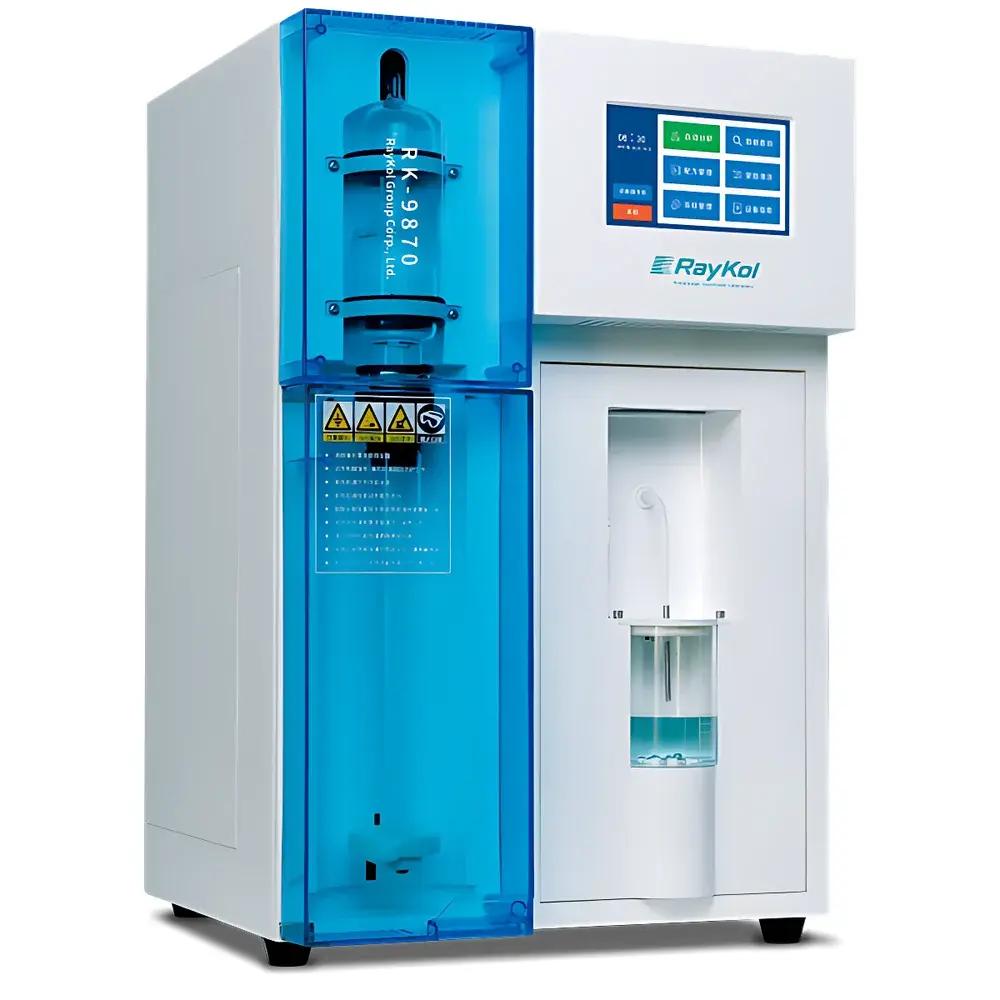
Raykol RK-9870 Fully Automated Kjeldahl Nitrogen Analyzer
| Brand | Raykol |
|---|---|
| Origin | Fujian, China |
| Manufacturer Type | Direct Manufacturer |
| Instrument Type | Kjeldahl Nitrogen Analyzer |
| Automation Level | Fully Automated |
| Nitrogen Determination Range | 0.1–240 mg N |
| Steam Distillation Time | 10–9990 s |
| Repeatability | ≤0.5% RSD |
| Sample Weight Capacity | Solids ≤5.00 g, Liquids ≤20 mL |
| Nitrogen Recovery Rate | 99–101% |
| Power Consumption | 2000 W |
| Dimensions (L×W×H) | 500 × 460 × 710 mm |
Overview
The Raykol RK-9870 Fully Automated Kjeldahl Nitrogen Analyzer is an integrated, benchtop analytical system engineered for precise and traceable quantification of total nitrogen content in organic and inorganic samples via classical Kjeldahl digestion and steam distillation methodology. Based on the internationally standardized AOAC 984.27, ISO 8968-1, and ASTM D1122 protocols, the RK-9870 implements a closed-loop, fully automated workflow—from acid digestion (performed off-instrument using compatible digesters) through alkaline distillation, boric acid trapping, and potentiometric titration—to deliver robust, GLP-compliant nitrogen data. Its design prioritizes operational safety, analytical reproducibility, and regulatory readiness, making it suitable for routine quality control laboratories in food, feed, agricultural, environmental, and pharmaceutical sectors where nitrogen-to-protein conversion is a critical specification.
Key Features
- 7-inch full-color capacitive touchscreen interface with seamless Chinese/English language switching and intuitive icon-driven navigation
- Three-tier electronic user permission management (Administrator, Supervisor, Operator) supporting audit-trail-enabled operation logs compliant with FDA 21 CFR Part 11 requirements
- Auto-standby mode activates after 60 minutes of inactivity, reducing power consumption and enhancing system longevity
- Built-in protein conversion coefficient database (user-editable), enabling automatic calculation and reporting of both nitrogen content (coefficient = 1.0) and protein equivalents (e.g., 6.25 for cereals, 5.70 for dairy, 6.38 for meat)
- RGB-intensity adaptive photometric detection system dynamically adjusts LED illumination intensity to maintain optimal signal-to-noise ratio across low- and high-concentration titration endpoints
- Front-accessible, transparent titration cup chamber for real-time visual monitoring of titration progress and simplified cleaning/maintenance
- Onboard non-volatile memory stores up to 1,000,000 test records with timestamp, operator ID, sample ID, method parameters, raw titration curves, and final results
- Integrated 57-mm thermal line printer with auto-cut function for immediate hardcopy output of reports and calibration logs
- Steam generator fabricated from electropolished AISI 304 stainless steel, resistant to corrosion from ammonium hydroxide and condensate under continuous operation
- Comprehensive hardware safety architecture including door-interlocked steam chamber, leakage current protection, overtemperature cutoff for steam boiler (>220 °C), low-water level shutdown, digestion tube position verification sensors, and real-time acoustic/visual alarm escalation
Sample Compatibility & Compliance
The RK-9870 accommodates a broad range of solid and liquid matrices—including grains, flour, dairy powders, meat homogenates, soil extracts, wastewater digests, and pharmaceutical excipients—within defined mass/volume limits (≤5.00 g solids or ≤20 mL liquids per run). All wet chemistry steps adhere to ISO 5983-1:2009 (Animal feeding stuffs — Determination of nitrogen content) and ISO 1871:2009 (Cereals and cereal products — Determination of nitrogen content). The instrument’s electronic record integrity, role-based access control, and time-stamped audit trail meet GLP and GMP documentation standards; optional IQ/OQ documentation packages are available for regulated environments requiring formal validation.
Software & Data Management
The embedded firmware supports CSV export via USB port and optional Ethernet connectivity for LIS/HIS integration. Data files include metadata headers (method name, calibration date, reagent lot numbers, analyst ID), raw titration voltage vs. time profiles, first-derivative peak identification, and final nitrogen/protein values with uncertainty estimates. All stored entries are immutable post-acquisition; modifications require dual-authorized override with reason-code annotation. System logs retain login attempts, parameter changes, alarm events, and maintenance alerts for ≥12 months.
Applications
- Food & Beverage: Crude protein certification in raw materials and finished products per Codex Alimentarius standards
- Animal Feed: Compliance testing against EU Regulation (EC) No 152/2009 for nitrogenous nutrient labeling
- Agriculture: Soil total Kjeldahl nitrogen (TKN) assessment for fertilizer formulation and sustainability reporting
- Environmental Labs: Wastewater TKN analysis per EPA Method 351.2 and ISO 11905-1
- Pharmaceuticals: Excipient nitrogen assay and residual catalyst screening in API synthesis intermediates
FAQ
Does the RK-9870 include digestion functionality?
No—the RK-9870 performs only distillation and titration. Digestion must be conducted separately using a compatible block digester (e.g., Raykol HT Series) prior to loading samples into the analyzer.
Can the instrument be calibrated with certified reference materials?
Yes—calibration is performed using potassium hydrogen phthalate (KHP) or ammonium sulfate standard solutions traceable to NIST SRM 20a; calibration frequency follows internal SOPs or ISO/IEC 17025 requirements.
Is remote software update supported?
Firmware updates are delivered via encrypted USB drive; network-based OTA updates are not implemented for security and regulatory stability reasons.
What titrant concentration is recommended?
0.1 mol/L HCl or H2SO4 is standard; the system automatically compensates for actual titer value entered during setup.
How is data backup handled?
Manual export to external USB storage is required; no cloud or network backup is embedded to preserve data sovereignty and prevent unauthorized access.
Related Products






