
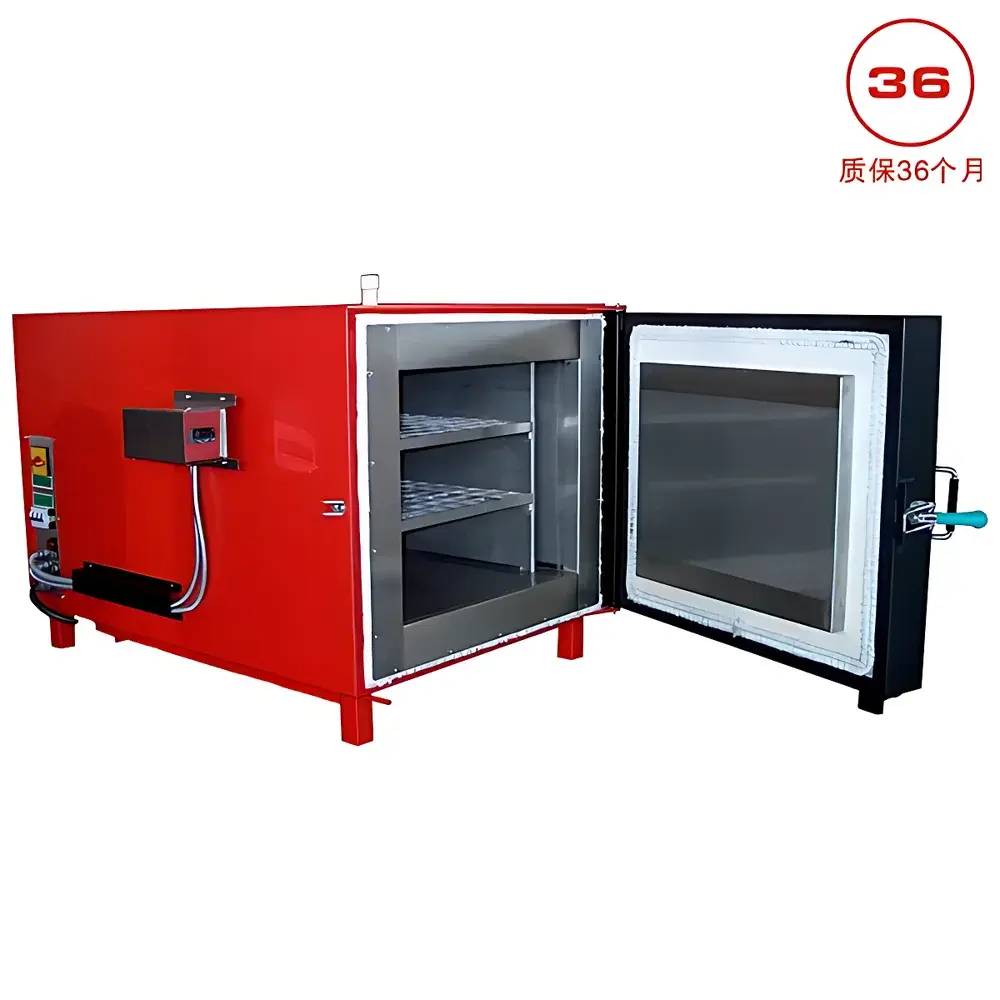
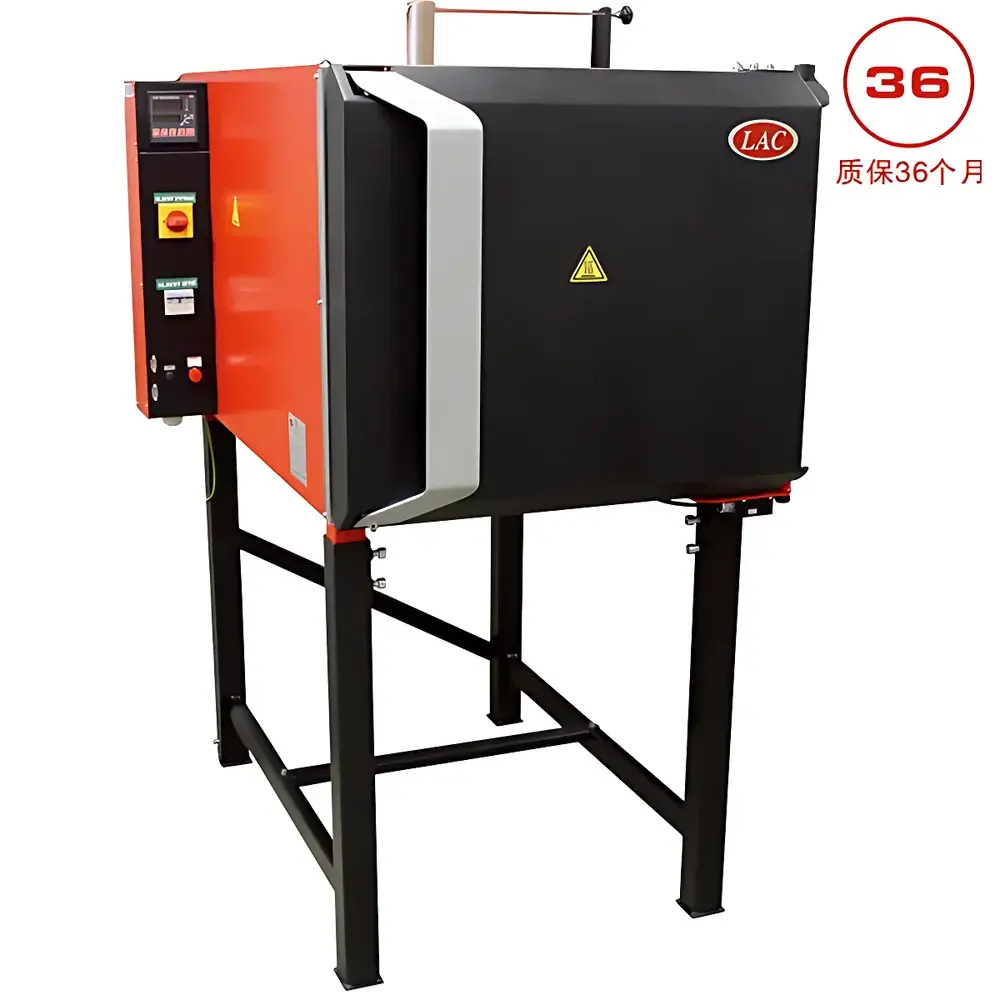
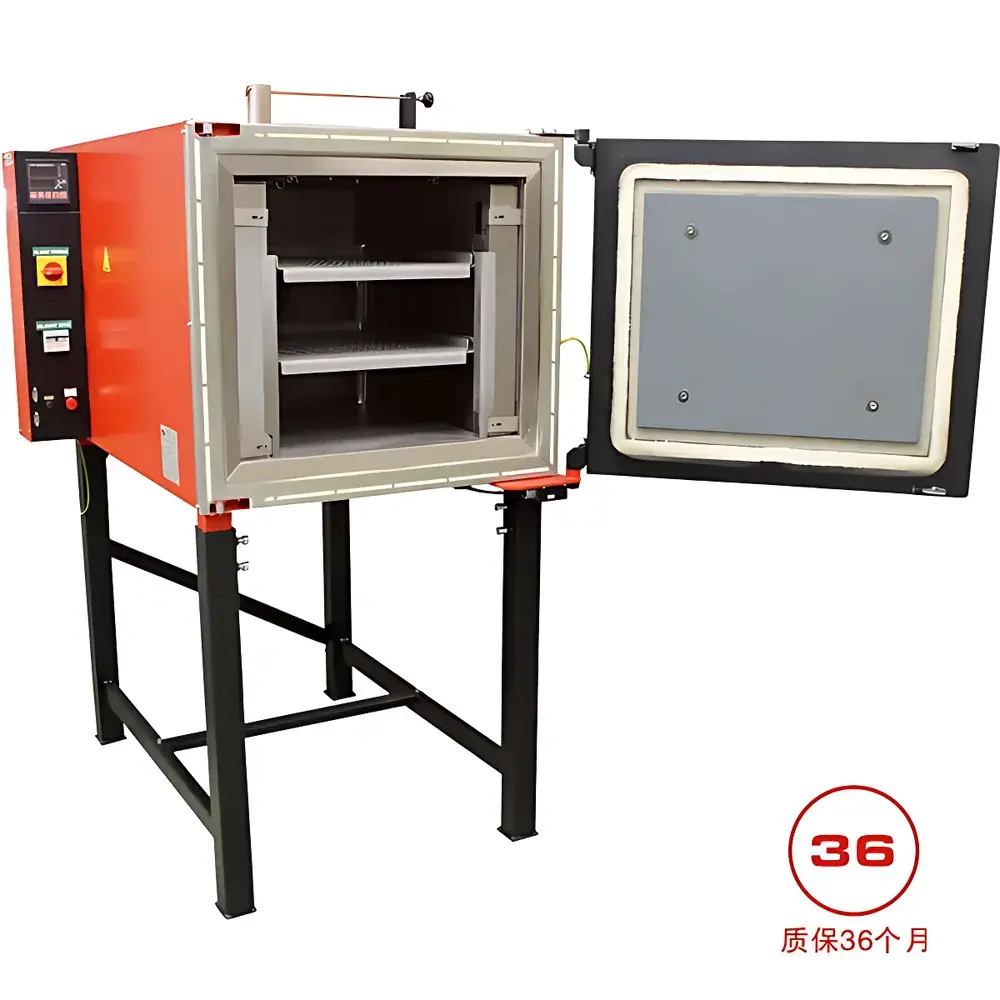
LAC PP20/85 Air-Circulating Box-Type Muffle Furnace (Max 850°C)
| Brand | LAC |
|---|---|
| Origin | Czech Republic |
| Model | PP20/85 |
| Furnace Type | Benchtop Air-Circulating Muffle Furnace |
| Max Temperature | 850°C |
| Temperature Uniformity | ≤ ±10°C (per DIN 17052-1, ΔT at 10% volume) |
| Control Accuracy | ±1°C |
| Heating Method | Resistance Wire (NiCr Alloy) |
| Internal Chamber Dimensions | 300 × 200 × 350 mm (W × H × D) |
| Max Power Consumption | 3 kW |
| Time to Max Temp | ~80 min |
| Standard Controller | HT205 (30 programmable profiles, 15 steps/profile, LAN interface) |
| Cooling | Uncontrolled forced-air cooling (optional), controlled cooling available on non-sealed variants |
| Construction | Stainless Steel Inner Chamber, High-Resistance Ventilation Fins, Dual SS Shelving (excl. PP20), Manual Side-Hinged Door, Solid-State Relay (SSR), Door Safety Interlock |
| Compliance | Designed to meet DIN 17052-1 thermal uniformity requirements for heat treatment equipment |
Overview
The LAC PP20/85 is a precision-engineered, air-circulating benchtop muffle furnace developed in the Czech Republic for laboratory and light industrial thermal processing applications. Unlike static-heating furnaces, it employs a robust axial fan-driven convection system that actively circulates ambient or inert atmosphere across the heating chamber—ensuring exceptional thermal homogeneity and repeatable heat transfer kinetics. Its operational envelope spans from ambient to 850°C, making it suitable for tempering, stress-relieving, annealing, sintering of low-melting alloys, and controlled oxidation studies. The furnace’s structural integrity derives from a double-walled insulated housing with high-density ceramic fiber insulation and a corrosion-resistant stainless steel inner chamber (AISI 310S grade), engineered for long-term stability under cyclic thermal loads. All critical components—including the NiCr resistance heating elements, K- or N-type thermocouples, and solid-state relays—are selected for durability, low maintenance, and electromagnetic compatibility in regulated lab environments.
Key Features
- Air-circulation architecture optimized for thermal uniformity: Achieves ≤ ±10°C deviation across 10% of chamber volume per DIN 17052-1 at 450–850°C operating range
- HT205 digital controller as standard: Supports 30 independent programs, each with up to 15 ramp-hold steps; includes LAN interface for networked monitoring and remote parameter adjustment
- Benchtop footprint (PP20 variant) with side-hinged manual door—ergonomically designed for frequent sample loading/unloading in constrained lab spaces
- Double-layer thermal insulation with low-conductivity ceramic fiber and reflective aluminum foil backing minimizes external surface temperature rise and energy consumption
- Integrated safety systems: Door-mounted microswitch interlock cuts power upon opening; SSR-based zero-cross switching eliminates audible relay chatter and extends component life
- Modular construction enables field-upgradable options including RS232/EIA-485 serial interfaces, HTMonit PC-based supervision software, and calibrated thermocouple measurement loops traceable to national standards
Sample Compatibility & Compliance
The PP20/85 accommodates standard crucibles (alumina, quartz, stainless steel), metal coupons, powder compacts, and small-scale ceramic preforms within its 300 × 200 × 350 mm usable chamber volume. Its airflow design prevents localized overheating and supports consistent phase transformation in ferrous and non-ferrous metallurgical samples. For regulatory compliance, the furnace meets mechanical and electrical safety requirements per IEC 61000-6-3 (EMC) and IEC 61000-6-4, and its thermal performance aligns with DIN 17052-1 for industrial heat treatment equipment. Optional HT205 controller firmware supports audit trails and user-access logging—facilitating GLP/GMP-aligned documentation when paired with HTMonit software and time-stamped data export (CSV/Excel). While not intrinsically rated for hazardous atmospheres, semi-hermetic configurations with manual or automated protective gas inlets (N₂, Ar) are available for oxide-sensitive processes.
Software & Data Management
The standard HT205 controller features embedded Ethernet connectivity, enabling integration into local lab networks without additional gateways. HTMonit—a Windows-based universal monitoring application—is supplied with each unit and provides real-time temperature profiling, multi-furnace synchronization, alarm notification (email/SNMP), and CFR Part 11-compliant electronic signatures when used with validated installation protocols. Data logs include timestamped setpoint/actual values, program step status, SSR duty cycle, and thermocouple millivolt readings—exportable in ISO 8601-compliant CSV format. Optional RS232 or EIA-485 interfaces support legacy SCADA or LIMS integration via Modbus RTU protocol. Calibration reports for installed thermocouples (including uncertainty budgets per ISO/IEC 17025) are available upon request.
Applications
- Metallurgical heat treatment: Tempering of tool steels, stress relief of welded assemblies, austempering of ductile iron
- Materials research: Sintering trials of metal matrix composites, thermal aging of polymer-filled ceramics, binder burnout in investment casting patterns
- Quality control labs: ASTM E220-compliant thermocouple calibration verification, ISO 9001 process validation for thermal stabilization steps
- Academic teaching: Demonstrating kinetic effects of heating rate on phase evolution (e.g., martensite suppression in Fe-C systems)
- Electronics manufacturing: Pre-baking of PCB substrates, flux residue removal prior to conformal coating
FAQ
What is the typical thermal uniformity profile inside the chamber at 650°C?
At 650°C, measured uniformity across the central 10% volume (per DIN 17052-1 methodology) is ≤ ±8°C—verified during factory acceptance testing using a 9-point thermocouple array.
Can the furnace be operated under inert gas without modification?
No. A semi-hermetic configuration with gas inlet/outlet ports and adjustable manual valve must be specified at time of order; standard units are vented to ambient.
Is the HT205 controller compliant with FDA 21 CFR Part 11?
The controller itself is not Part 11-certified, but HTMonit software—when deployed on validated Windows systems with role-based access controls and electronic signature workflows—supports Part 11 implementation for audit-ready thermal process records.
What maintenance intervals are recommended for the circulation fan and heating elements?
Fan bearings require inspection every 2,000 operating hours; heating elements are rated for ≥ 10,000 hours at 850°C continuous operation and should be visually inspected annually for sagging or oxidation.
Does the furnace support ramp-soak programming with multiple cycles?
Yes—HT205 allows nested cycling (e.g., “soak → cool to 200°C → reheat to 700°C → hold”) via sequential program linking, with full step-by-step override capability during runtime.



