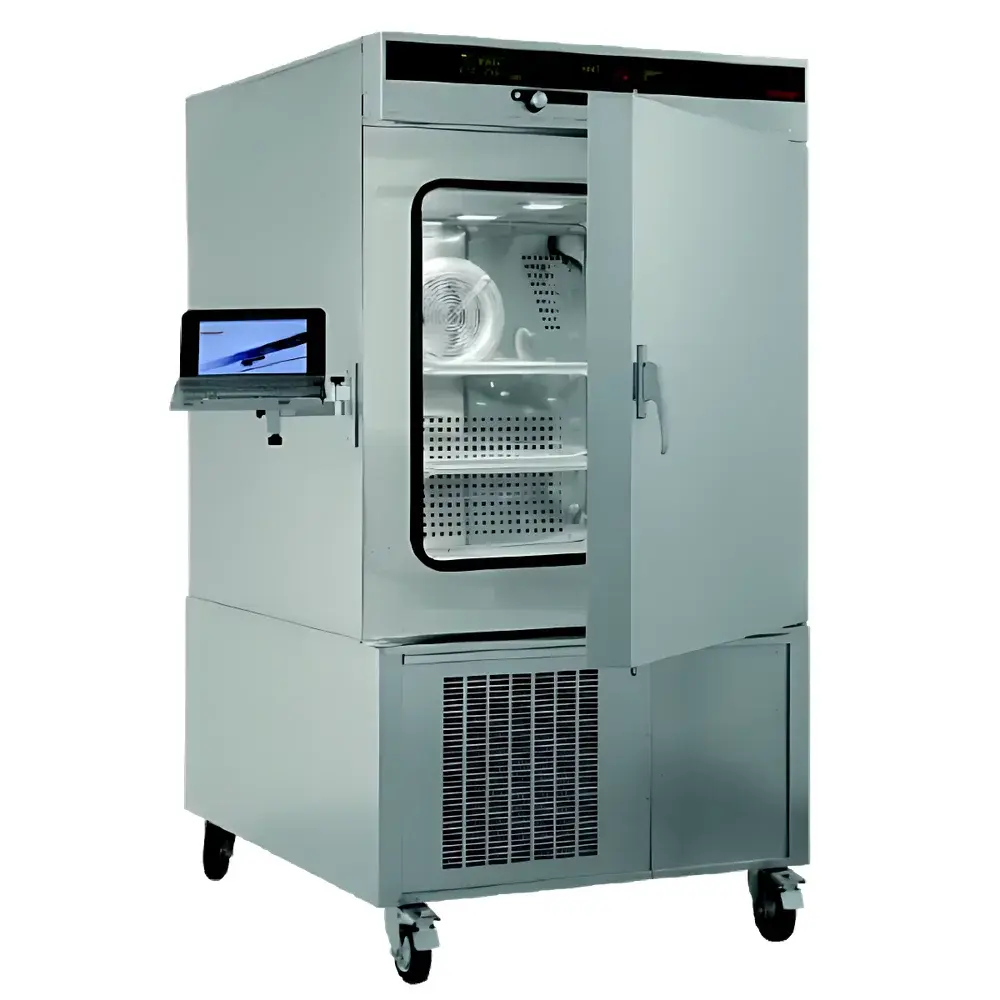
Memmert CTC 256 / TTC 256 Drug Stability Testing Chamber
| Brand | Memmert |
|---|---|
| Origin | Germany |
| Manufacturer | Memmert GmbH & Co. KG |
| Model | CTC 256 / TTC 256 |
| Temperature Range (dry) | −42 °C to +190 °C |
| Temperature Range (humidified) | +10 °C to +95 °C |
| Humidity Range | 10 %rh to 98 %rh |
| Cooling Rate | 80 min (180 °C → −40 °C) |
| Heating Rate | 20 min (−40 °C → 180 °C) |
| Insulation | Triple-layer aerospace-grade vacuum-insulated walls |
| Refrigeration | Dual parallel compressors with electronic refrigerant metering |
| Defrost | Automatic cyclic defrost system |
| Evaporator | Stainless steel |
| Noise Level | <60 dB(A) |
| Compliance | DIN EN 60068-2-1, -2-2, -2-3 |
Overview
The Memmert CTC 256 and TTC 256 Drug Stability Testing Chambers are precision-engineered environmental simulation systems designed explicitly for pharmaceutical stability studies in compliance with ICH Q1–Q5 guidelines and regulatory requirements under FDA 21 CFR Part 11, EU Annex 11, and WHO TRS 1019. These chambers employ a dual-mode thermal architecture—CTC models feature active humidification/dehumidification via dynamic dew point control, while TTC variants operate in dry-heat mode only—enabling rigorous execution of long-term, accelerated, and intermediate stability protocols per ICH Q1A(R3). The core measurement principle relies on high-fidelity PID-controlled air circulation coupled with platinum resistance thermometers (PT1000) and capacitive humidity sensors traceable to NIST standards. Temperature uniformity is maintained at ±0.3 °C (at 25 °C) and ±0.5 °C (across full range), with humidity uniformity of ±1.5 %rh (40–80 %rh), validated per ISO 16770:2021. The triple-layer vacuum-insulated chamber wall—derived from aerospace thermal management principles—minimizes thermal bridging and condensation ingress, ensuring stable boundary conditions during extended exposure cycles up to 180 days.
Key Features
- Dual independent compressor system with electronic expansion valve control enables precise refrigerant flow modulation, optimizing energy efficiency across wide operating ranges.
- Stainless steel evaporator coil resists corrosion from repeated condensate exposure and aggressive humidity cycling—critical for GLP-compliant multi-year validation programs.
- Automatic cyclic defrost algorithm prevents ice accumulation without interrupting test continuity; no manual intervention required during unattended operation.
- Low-noise fan array (<60 dB[A]) ensures compatibility with shared laboratory environments and minimizes mechanical vibration transfer to sensitive samples.
- Thermal ramp rates validated per ASTM E2052-20: 20 min (+180 °C from −40 °C), 80 min (−40 °C from +180 °C)—enabling rapid protocol transitions without compromising thermal homogeneity.
- Integrated real-time monitoring of chamber internal pressure differential eliminates false humidity drift caused by barometric fluctuations.
Sample Compatibility & Compliance
The CTC/TTC 256 accommodates standard ICH-compliant stability storage configurations—including open trays, sealed vials, blister packs, and primary/secondary packaging—within its 256 L working volume. All internal surfaces are electropolished stainless steel (AISI 316L), non-outgassing, and compliant with USP for pharmaceutical contact materials. The system meets DIN EN 60068-2-1 (cold), -2-2 (dry heat), and -2-3 (damp heat) for environmental stress screening, and supports IQ/OQ/PQ documentation packages aligned with GMP Annex 15 and ASTM E2500-13. Full audit trail functionality—including user access logs, parameter change history, and alarm event timestamps—is enabled via optional Memmert eCOM software, satisfying FDA 21 CFR Part 11 electronic record requirements.
Software & Data Management
The integrated Memmert LabSoft control interface provides intuitive touchscreen operation with password-protected access levels (operator, supervisor, administrator). All temperature/humidity setpoints, ramp profiles, and hold durations are programmable with up to 99 segments per cycle. Data logging occurs at 1-second intervals to internal flash memory (10-year retention) and optionally streams to networked servers via Ethernet or Wi-Fi. Export formats include CSV, PDF reports with digital signatures, and XML for LIMS integration. When paired with Memmert’s validated eCOM software suite, the system delivers automated calibration verification, trend analysis of sensor drift, and deviation alerting with configurable SMS/email escalation—supporting continuous process verification per ICH Q5C and EU GMP Chapter 4.
Applications
- ICH Q1A(R3) long-term stability testing (25 °C/60 %rh, 30 °C/65 %rh) and accelerated studies (40 °C/75 %rh).
- Photostability assessment per ICH Q5B when integrated with optional UV/visible light modules.
- Excipient compatibility screening under controlled humidity gradients.
- Package integrity evaluation via cyclic humidity-temperature stress (e.g., 40 °C ↔ 25 °C with 75 %rh ↔ 60 %rh transitions).
- Forced degradation studies requiring precise thermal ramping without overshoot or hysteresis.
- Reference standard storage under certified温湿度 conditions per USP .
FAQ
What is the difference between CTC and TTC models?
The CTC series integrates dynamic humidification and dehumidification using a dual-heat-exchanger system, enabling full 10–98 %rh control. The TTC model operates in dry-heat-only mode (−42 °C to +190 °C), optimized for thermal-only stress testing.
Is the chamber suitable for GMP-regulated stability programs?
Yes—validated IQ/OQ/PQ documentation templates, 21 CFR Part 11-compliant e-signature support, and full electronic audit trails are available as factory-installed options.
How is temperature uniformity verified across the chamber volume?
Uniformity is confirmed per ISO 16770:2021 using 9-point sensor mapping (center + 8 corners) at three load conditions (empty, 50 %, 100 %), with results traceable to DAkkS-accredited calibration.
Can the system be integrated into an existing laboratory network?
Yes—standard Ethernet (TCP/IP) and optional Wi-Fi enable remote monitoring, data export to LIMS/ELN, and centralized fleet management via Memmert’s cloud-based LabManager platform.
What maintenance is required to sustain long-term accuracy?
Annual sensor recalibration (traceable to NIST), biannual compressor oil inspection, and quarterly verification of door seal integrity are recommended—full service schedules are embedded in the LabSoft maintenance planner.