
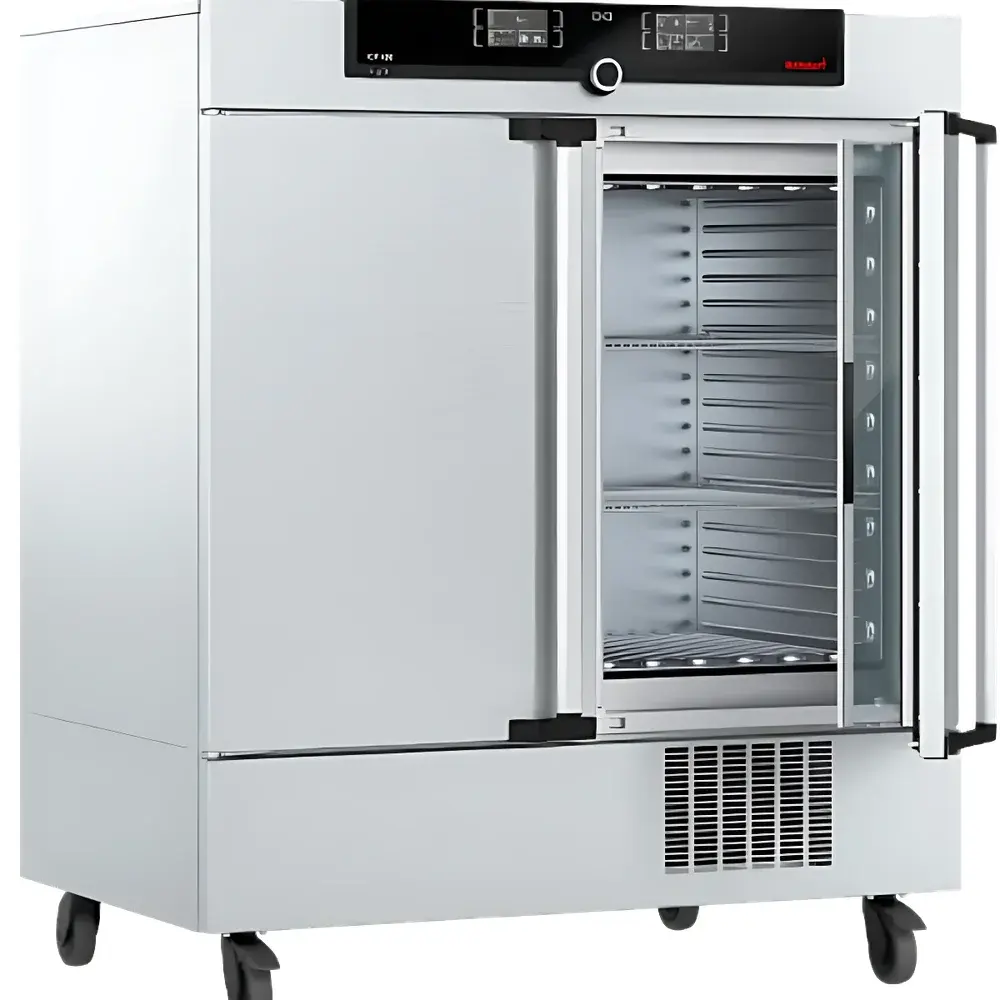
Memmert ICP Series Low-Temperature Incubators
| Brand | Memmert |
|---|---|
| Origin | Germany |
| Manufacturer | Memmert GmbH & Co. KG |
| Type | Benchtop Temperature-Controlled Incubator |
| Models | ICP 110 / 260 / 450 / 750 |
| Temperature Range | −12 °C to +60 °C |
| Chamber Volume | 110 L / 260 L / 450 L / 750 L (model-dependent) |
| Heating/Cooling System | Compressor-based with Air-Jacket Thermal Management |
| Air Circulation | Adjustable fan speed (10–100% in 10% increments) |
| Illumination Option | Programmable Day/Night Cycle with Simulated Sunlight Spectrum |
| Energy-Saving Mode | Adaptive Defrost & Load-Responsive Cooling |
| Noise Level | ≤45 dB(A) at 1 m (typical, full load, 25 °C ambient) |
| Compliance | CE, ISO 13485 (manufacturing), EN 61000-6-3 (EMC), EN 61000-6-2 (immunity), VDI/VDE 2655 Blatt 2 (incubator performance testing) |
Overview
The Memmert ICP Series Low-Temperature Incubators are precision-engineered benchtop environmental chambers designed for stable, reproducible temperature control across a broad operational range from −12 °C to +60 °C. Unlike conventional water-jacketed or Peltier-cooled units, the ICP leverages a high-efficiency compressor-based cooling system integrated with an air-jacket thermal architecture—enabling rapid thermal response, minimal temperature overshoot, and exceptional stability (±0.3 °C at setpoint, typical). The air-jacket design isolates the inner chamber from ambient fluctuations while ensuring uniform heat distribution via forced convection. This architecture supports both low-temperature microbiological cultivation (e.g., psychrophilic strains) and elevated-temperature applications such as enzyme kinetics or cell line expansion—all within a single platform certified for laboratory-grade reliability under GLP and ISO 17025-aligned operation.
Key Features
- Compressor-driven refrigeration: Enables true sub-zero capability down to −12 °C with sustained stability, eliminating reliance on volatile refrigerants or thermoelectric limitations.
- Air-jacket thermal management: Dual-wall insulation with circulating air layer minimizes thermal bridging and reduces recovery time after door opening by up to 40% compared to standard convection incubators.
- Programmable ventilation control: Fan speed adjustable in 10% increments (10–100%) allows fine-tuning of airflow for sensitive cultures or low-moisture samples—critical for preventing desiccation in long-term assays.
- Day/night illumination module (optional): LED light source with tunable intensity and spectral output (400–700 nm) enables circadian rhythm studies; programmable lighting profiles synchronize with temperature and fan modulation.
- Intelligent energy optimization: Adaptive defrost cycle triggered only when frost accumulation is detected; cooling power modulated in real time based on internal load and ambient conditions—reducing average power consumption by ≥25% versus fixed-cycle systems.
- Acoustically optimized operation: Compressor and fan assembly mounted on vibration-dampening mounts; acoustic enclosure maintains noise emission ≤45 dB(A) even during peak cooling demand.
Sample Compatibility & Compliance
The ICP series accommodates standard microbiological vessels—including Petri dishes, multiwell plates, culture flasks (up to T225), and serum bottles—without compromising thermal homogeneity. Interior chamber surfaces are electropolished stainless steel (AISI 304), non-porous and autoclavable, supporting stringent cleaning protocols required in ISO 13485-certified medical device manufacturing environments. All models comply with EN 61000-6-2 (electromagnetic immunity) and EN 61000-6-3 (emission), and meet VDI/VDE 2655 Blatt 2 criteria for temperature uniformity (±0.8 °C max deviation across working volume) and stability (±0.3 °C over 24 h). Data integrity features—including audit-trail-enabled event logging and password-protected parameter locking—are compatible with FDA 21 CFR Part 11 requirements when paired with Memmert’s optional software suite.
Software & Data Management
Integrated touchscreen interface (7″ capacitive, IP65-rated) provides intuitive access to all operating parameters, including ramp/soak profiles, alarm thresholds, and calibration offsets. Optional PTP (Process Temperature Protocol) software enables remote monitoring, automated report generation (PDF/CSV), and electronic signature support for regulated workflows. All temperature data—including sensor readings, setpoints, alarms, and door-open events—are timestamped and stored internally for ≥10,000 hours. Export formats include .csv and .xlsx; encrypted USB export ensures compliance with institutional data governance policies. Firmware updates are delivered via signed packages to prevent unauthorized modification.
Applications
- Cultivation of cold-adapted microorganisms (e.g., Pseudomonas fluorescens, Colwellia psychrerythraea) in environmental and food safety testing labs.
- Low-temperature storage and conditioning of polymer-based biomaterials prior to rheological or tensile evaluation.
- Accelerated stability testing of pharmaceutical intermediates per ICH Q1A(R3) guidelines at sub-ambient conditions.
- Controlled photobioreactor pre-conditioning for algal growth studies requiring synchronized light/temperature cycles.
- Calibration and verification of secondary temperature sensors in metrology laboratories accredited to ISO/IEC 17025.
FAQ
What is the minimum achievable temperature and how quickly can the chamber reach it?
The ICP achieves −12 °C nominal with full-load stability within 90 minutes from 22 °C ambient, verified per VDI/VDE 2655 Blatt 2 test protocol.
Is humidity control available on the ICP series?
No—humidity regulation is not integrated; the ICP is optimized exclusively for precise temperature control. For combined temp/humidity applications, Memmert’s HPP series is recommended.
Can the ICP be validated for GxP environments?
Yes—factory-installed IQ/OQ documentation packages are available; users may perform PQ using traceable PT100 probes and Memmert’s validation support toolkit.
Does the air-jacket system require maintenance or periodic refilling?
No—the air-jacket is a passive, sealed thermal barrier; no consumables, fluids, or scheduled servicing are required beyond routine chamber cleaning and annual sensor calibration.
Are third-party data loggers compatible with the ICP’s analog outputs?
Yes—0–10 V and 4–20 mA analog outputs mirror chamber temperature and status signals, enabling integration with building management systems (BMS) or external SCADA platforms.



