
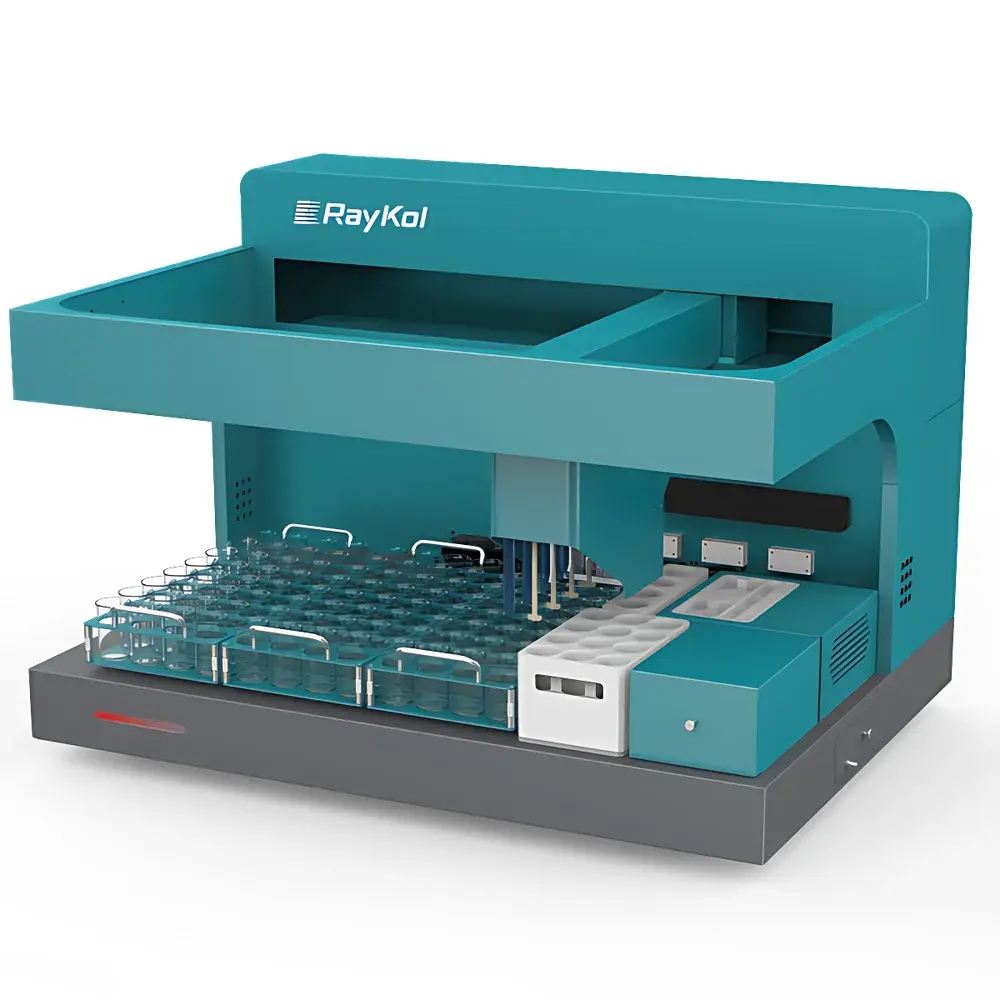
Raykol AT 300 Fully Automated Soil pH Analyzer
| Brand | Raykol |
|---|---|
| Model | AT 300 |
| Origin | Fujian, China |
| Manufacturer | Raykol Group |
| Instrument Type | Automated Soil pH Analyzer |
| Sample Capacity | 96-position rack |
| Parallel Channels | 4 independent detection channels |
| pH Resolution | 0.001 |
| Sample Vessels | Compatible with 100 mL centrifuge tubes and 50 mL tall-form beakers |
| Calibration | Automatic electrode calibration with built-in temperature compensation |
| Reagent Handling | Up to 3 reagents independently programmable |
| Liquid Handling | Precision peristaltic pumps with auto-calibration |
| Mixing | Motor-driven stirrer for homogeneous suspension |
| Cleaning | Dedicated wash station with configurable rinse cycles |
| Compliance | Designed to support protocols per NY/T 1121.2–2006 and LY/T 1239–1999 |
| Software | Method-driven interface with audit trail, user-level access control, and configurable alarm thresholds (reagent low, waste full) |
| Data Output | Auto-generated PDF/CSV reports with timestamp, operator ID, calibration log, and raw sensor readings |
Overview
The Raykol AT 300 Fully Automated Soil pH Analyzer is an integrated laboratory platform engineered for high-throughput, standardized measurement of soil acidity in accordance with internationally recognized agricultural and environmental testing protocols. It employs potentiometric pH measurement based on a calibrated glass combination electrode immersed in a standardized soil–water slurry (1:2.5 or 1:5 w/v ratio), following the equilibrium principle defined in NY/T 1121.2–2006 and LY/T 1239–1999. Unlike manual or semi-automated methods, the AT 300 eliminates operator-dependent variability by automating the entire analytical sequence—sample positioning, buffer dispensing, suspension preparation, equilibration stirring, electrode immersion, real-time pH acquisition, temperature compensation (via integrated Pt100 sensor), electrode rinsing, and report generation. Its architecture supports unattended operation across multiple shifts, making it suitable for central soil testing laboratories, agricultural extension services, and environmental monitoring agencies handling >100 samples per day.
Key Features
- Fully automated workflow: sequential execution of sample loading, reagent addition (up to three independently controlled reagents), mechanical stirring (adjustable speed and duration), pH sensing, automatic electrode calibration, and post-measurement cleaning.
- High-density sample processing: 96-position universal carrier accommodates either 100 mL centrifuge tubes or 50 mL tall-form beakers—enabling direct use of field-collected containers without transfer.
- Quad-channel parallel analysis: four synchronized detection modules operate concurrently, delivering up to 384 pH determinations per standard 8-hour shift under typical protocol conditions.
- Precision liquid handling: peristaltic pumps with factory-calibrated flow profiles ensure volumetric accuracy within ±0.5% CV across 1–50 mL dispense ranges; pump calibration is performed automatically prior to each batch.
- Electrode integrity assurance: integrated calibration station uses NIST-traceable pH 4.01, 7.00, and 10.01 buffers; slope and offset are logged and validated before each analytical run.
- Thermal equilibrium management: real-time temperature monitoring at both sample and reference junction ensures ISO/IEC 17025-compliant temperature compensation (±0.1 °C resolution).
Sample Compatibility & Compliance
The AT 300 accepts heterogeneous soil matrices—including clay-rich, organic, saline, and calcareous soils—without manual pretreatment beyond air-drying and sieving (<2 mm). Its mechanical stirring system maintains consistent suspension homogeneity for ≥5 minutes, satisfying the equilibration time requirement specified in NY/T 1121.2–2006. The instrument’s firmware enforces mandatory procedural checkpoints (e.g., minimum stir duration, electrode stabilization time, calibration validity window) to prevent out-of-specification runs. All measurement metadata—including calibration logs, reagent lot numbers, operator credentials, and environmental chamber temperature—are embedded in exported reports to satisfy GLP documentation requirements. The system architecture supports 21 CFR Part 11-compliant electronic signatures when deployed with validated LIMS integration.
Software & Data Management
The AT 300 Control Suite is a Windows-based application featuring role-based access control (administrator, analyst, reviewer), method versioning, and immutable audit trails. Preloaded SOP templates align with Chinese Ministry of Agriculture standards, while custom workflows can be constructed using drag-and-drop logic blocks (e.g., conditional re-runs upon slope deviation >5%). Real-time dashboards display system status, reagent levels, waste volume, and ongoing assay progress. Data export conforms to ASTM E1447 and ISO/IEC 17025 Annex A.3 requirements: CSV files include raw mV readings, calculated pH, temperature, electrode impedance, and uncertainty estimates derived from calibration history. PDF reports embed digital signatures and QR-coded traceability links to original instrument logs.
Applications
- Regional soil fertility mapping programs requiring rapid pH stratification (e.g., precision agriculture zoning)
- Environmental impact assessments evaluating acidification trends near industrial sites or mining operations
- Regulatory compliance testing for landfill cover soil specifications (EPA SW-846 Method 9040C)
- Long-term ecological research plots monitoring pH drift under climate change scenarios
- Quality control in commercial compost and biochar production facilities
- Teaching laboratories demonstrating standardized soil chemical analysis per FAO guidelines
FAQ
What soil-to-water ratios does the AT 300 support?
The system natively executes 1:2.5 and 1:5 (w/v) ratios as defined in NY/T 1121.2–2006; custom ratios between 1:1 and 1:10 are programmable via method editor.
Can the AT 300 integrate with our existing LIMS?
Yes—it provides HL7 v2.5 and ASTM E1384-compliant ASCII output; API-based integration (RESTful JSON) is available under extended validation agreement.
Is electrode maintenance automated?
The system performs daily storage solution exchange, weekly KCl refill prompts, and automatic junction cleaning cycles using ultrasonic-assisted flush; electrode performance metrics are trended over time.
How is measurement uncertainty quantified?
Uncertainty budgets incorporate calibration certificate tolerances, temperature probe error, electrode drift rate (tracked per batch), and repeatability data from control samples—reported per GUM (JCGM 100:2008) principles.
Does the AT 300 meet ISO/IEC 17025 accreditation requirements?
When operated under documented procedures—including daily verification with CRM SRM 2710a and quarterly interlaboratory comparison—it fulfills Clause 7.7 (Measurement Uncertainty) and Clause 7.8 (Reporting Results) of ISO/IEC 17025:2017.
Related Products







