
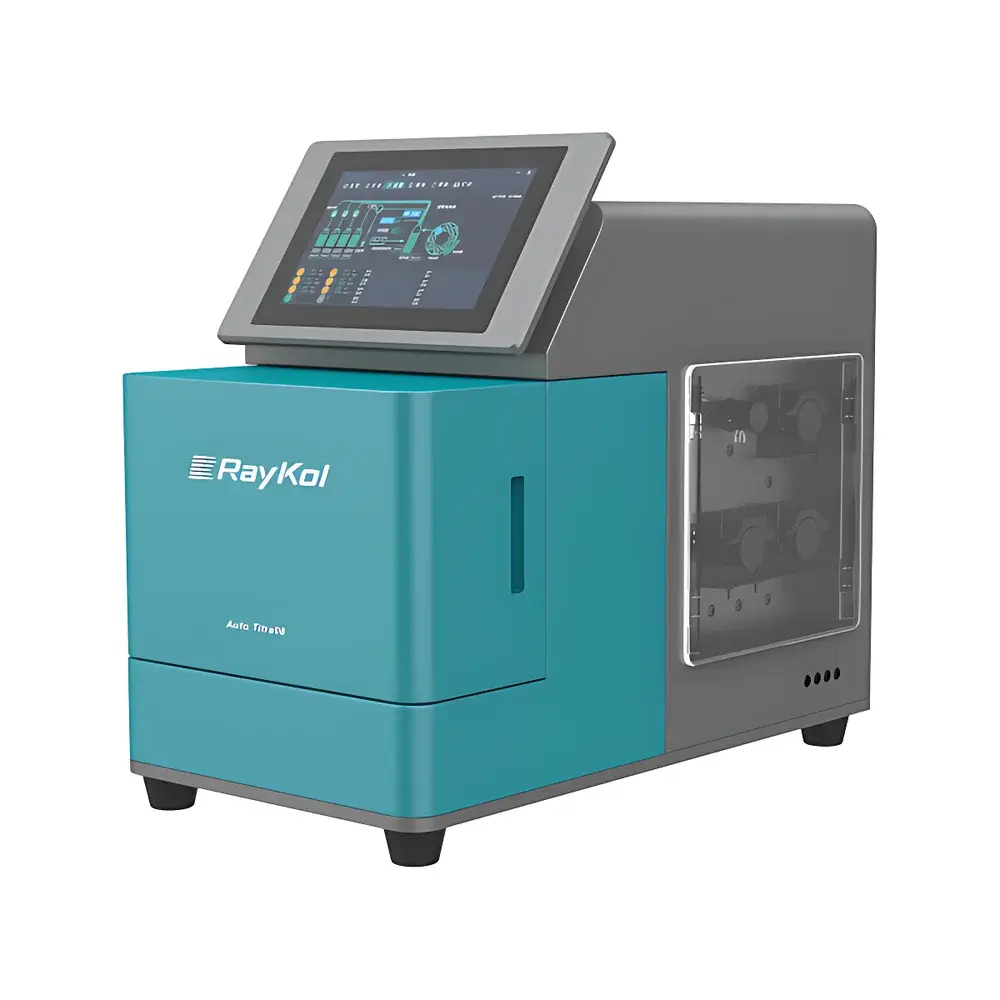
Raykol Auto Titra Series Automated Colorimetric Titrator
| Brand | Raykol |
|---|---|
| Origin | Fujian, China |
| Manufacturer Type | Original Equipment Manufacturer (OEM) |
| Country of Origin | China |
| Model | Auto Titra |
| Price Range | USD 14,000 – 42,500 |
Overview
The Raykol Auto Titra Series Automated Colorimetric Titrator is an integrated, microprocessor-controlled titration platform engineered for high-reproducibility colorimetric endpoint detection in routine and regulatory-compliant analytical laboratories. Unlike potentiometric or pH-based titrators, the Auto Titra employs RGB spectral color recognition—capturing real-time chromatic shifts across the full visible spectrum (approx. 380–750 nm)—to emulate human visual endpoint judgment with objective, algorithm-driven consistency. This optical detection method eliminates subjectivity inherent in manual titration, particularly critical in applications where indicator color transitions are subtle (e.g., bromothymol blue in alkalinity assays) or prone to observer fatigue. The system operates on the principle of controlled reagent addition coupled with continuous digital image acquisition and pixel-intensity analysis of the titration vessel’s solution surface. Its architecture supports both single-sample and batch-mode operation (up to 8 samples per run), making it suitable for QC/QA workflows in environmental monitoring, food safety testing, and public health laboratories adhering to ISO/IEC 17025 and GLP requirements.
Key Features
- Full-spectrum RGB color sensing module with adaptive white-balance calibration, enabling reliable endpoint detection across diverse indicators (phenolphthalein, methyl orange, eriochrome black T, etc.)
- Programmable titration profiles: users define stepwise volume increments, pause durations, mixing intervals, and endpoint tolerance thresholds per method
- Dual-mode dispensing control—constant-rate or dynamic-rate delivery—optimizes speed without compromising precision near equivalence points
- Integrated magnetic stirrer with variable speed (100–1200 rpm) and auto-synchronization to titrant addition cycles for homogeneous reaction kinetics
- Modular sample rack accommodating standard 50 mL, 100 mL, and 250 mL borosilicate glass titration vessels; optional custom vial holders available
- Standalone embedded operating system (Linux-based) with 10.1-inch capacitive touchscreen interface; no external PC required for operation or report generation
- Onboard data processing engine performing automatic equivalence point calculation (first-derivative or inflection-point algorithms), statistical summary (mean, SD, RSD), and PDF report export with digital signature support
Sample Compatibility & Compliance
The Auto Titra accommodates aqueous, alcoholic, and low-viscosity organic solvent-based matrices typical in food, water, and beverage analysis. It complies with method-specific validation criteria outlined in USP , AOAC Official Methods®, and relevant Chinese national standards (e.g., GB 5009.x, HJ 828-2017). All hardware components in contact with reagents—including PTFE-coated syringes, chemically resistant tubing (PharMed® BPT), and glass reaction vessels—meet USP Class VI biocompatibility and FDA 21 CFR Part 11 readiness for audit trails, electronic signatures, and user-access controls. The system supports IQ/OQ documentation packages for laboratory qualification under GMP and ISO 17025 frameworks.
Software & Data Management
The instrument runs Raykol TitraOS v3.2 firmware, featuring method library management, user role-based permissions (admin/operator/auditor), and encrypted local storage of raw image sequences, titration curves, and metadata (operator ID, timestamp, environmental temp/humidity logs). Data export options include CSV (for LIMS integration), XML (for ELN systems), and password-protected PDF reports compliant with ISO/IEC 17025 clause 7.8. Audit trail functionality records all critical events—including parameter changes, reagent refills, calibration actions, and report generation—with immutable timestamps and user attribution. Optional cloud synchronization (via secure TLS 1.3) enables remote monitoring and centralized method deployment across multi-site laboratories.
Applications
- Environmental testing: COD (HJ 828-2017), permanganate index (GB/T 11892-1989), total hardness (EDTA complexometric titration), chloride (Mohr method)
- Food & beverage analysis: peroxide value (GB 5009.227-2016), sulfur dioxide (GB 5009.34-2016), acid value (GB 5009.229-2016), free fatty acids, vitamin C (iodometric)
- Public health & drinking water: alkalinity, residual chlorine (DPD colorimetric), fluoride (SPADNS method), nitrate (brucine method)
- Industrial QA: detergent alkalinity, pharmaceutical excipient assay (e.g., citric acid content), electroplating bath concentration control
FAQ
What colorimetric methods does the Auto Titra support?
It supports all visually detectable indicator-based titrations using common acid-base, redox, precipitation, and complexometric indicators—provided the endpoint transition falls within the detectable RGB gamut and exhibits sufficient contrast against background.
Can the system be validated for regulated environments?
Yes. The Auto Titra includes built-in tools for system suitability testing (SST), repeatability verification, and traceable calibration using certified reference materials. IQ/OQ protocols and 21 CFR Part 11 compliance documentation are available upon request.
How is waste managed during operation?
An integrated waste collection manifold with level sensors and sealed containment directs effluent into a removable, labeled waste reservoir. Overflow protection and splash-resistant design meet IEC 61010-1 safety requirements.
Is remote software update supported?
Firmware updates are delivered via USB drive or secure HTTPS download; automatic over-the-air updates are disabled by default to maintain method integrity and regulatory traceability.
What maintenance is required for long-term reliability?
Routine tasks include monthly optical window cleaning, biannual syringe seal inspection, and annual photometric calibration using NIST-traceable color standards. No consumables beyond standard titration vessels and reagents are required.



