
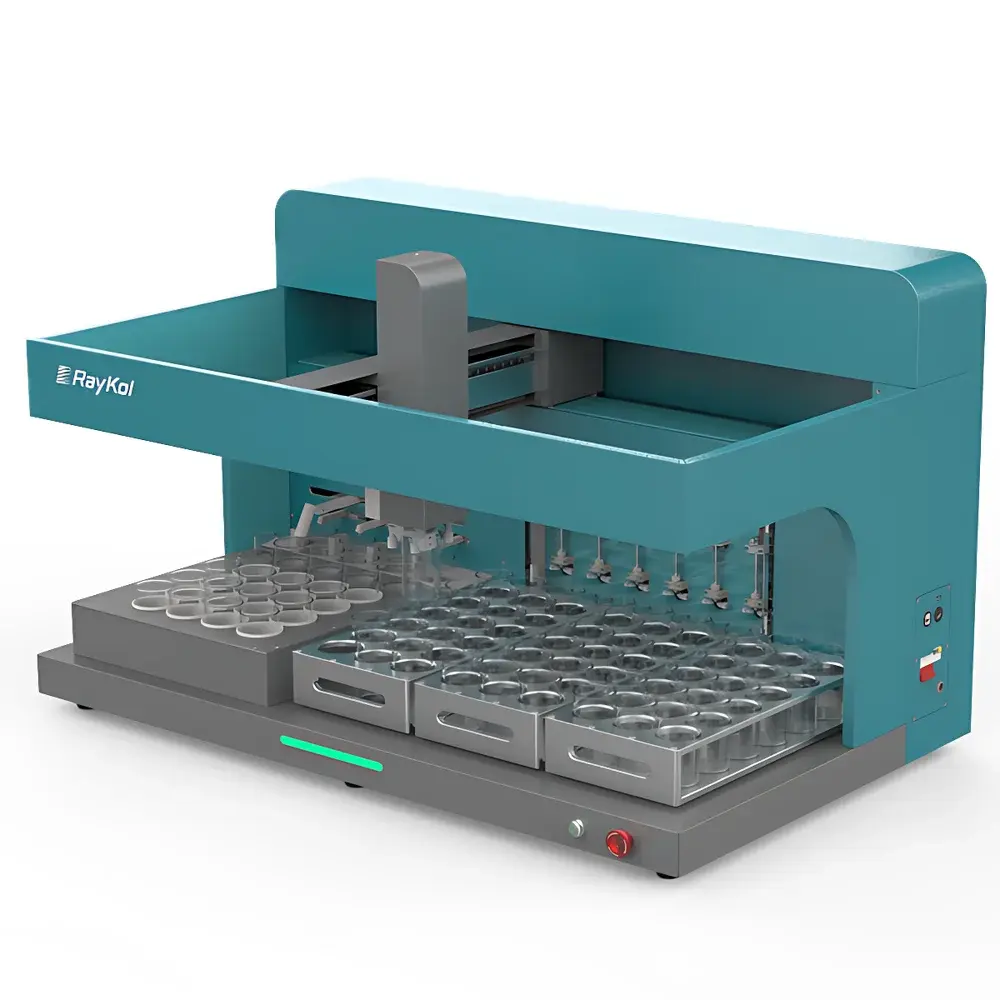
Raykol AT100 Automated Permanganate Index Analyzer
| Brand | Raykol |
|---|---|
| Origin | Fujian, China |
| Manufacturer Type | Manufacturer |
| Origin Category | Domestic |
| Model | AT100 |
| Pricing | Upon Request |
| Measurement Principle | Colorimetric Endpoint Detection with Simulated Human Visual Recognition |
| Instrument Type | Laboratory Benchtop Analyzer |
| Range | 0.5–4.5 mg/L KMnO₄ |
| Single-Test Duration | 60 s |
| Sample Capacity | 54 positions (cyclic loading) |
| Digestion Stations | 16 water-bath heated positions |
| Titration Channels | 4 independent syringe-pump-driven channels |
| Compliance | GB/T 11892–1989, GB/T 5750.7–2016, ISO 8467:1986 |
Overview
The Raykol AT100 Automated Permanganate Index Analyzer is a fully integrated laboratory instrument engineered for precise, reproducible, and compliant determination of the permanganate index (also known as potassium permanganate consumption or CODMn) in drinking water, surface water, groundwater, and wastewater samples. It implements a standardized colorimetric endpoint detection method based on simulated human visual recognition — a principle aligned with classical titrimetric procedures defined in national and international standards. Unlike manual methods requiring 30-minute boiling water-bath digestion, manual pipetting, subjective endpoint judgment, and hazardous handling of concentrated sulfuric acid and hot permanganate solutions, the AT100 automates the entire analytical sequence: reagent dispensing, temperature-controlled water-bath digestion, redox titration with standardized sodium oxalate solution, real-time colorimetric endpoint monitoring, stoichiometric calculation, and report generation. The system operates under controlled thermal conditions (typically 100 °C ± 1 °C), ensuring consistent reaction kinetics and minimizing inter-operator variability.
Key Features
- End-to-end automation: Fully unattended execution of sample loading, acid reagent addition, 16-position water-bath digestion (with auto-refill and overflow protection), 4-channel independent titration, and digital endpoint recognition.
- High-throughput design: 54-sample carousel supports cyclic reloading; enables continuous batch processing without manual intervention between runs.
- Optical endpoint detection: Patented color-sensing module replicates human visual perception under standardized illumination, eliminating subjective bias while maintaining full compliance with GB/T 11892–1989 and ISO 8467:1986 endpoint criteria.
- Independent fluidic architecture: Four isolated syringe pumps with chemically resistant tubing ensure cross-contamination-free titration across all channels — critical for trace-level accuracy and method robustness.
- Integrated safety systems: Water-level sensors trigger automatic replenishment during digestion; dual-level overflow safeguards prevent spillage; acid-resistant reagent handling paths minimize operator exposure to corrosive media.
- Thermally stabilized titration: On-board heating and insulation of titrant delivery lines maintain consistent reagent temperature, reducing volumetric drift caused by ambient fluctuations.
Sample Compatibility & Compliance
The AT100 is validated for use with raw and treated water matrices meeting the scope of GB/T 5750.7–2016 (Standard Methods for Examination of Drinking Water – Organic Parameters) and GB/T 11892–1989 (Water Quality – Determination of Permanganate Index). It accommodates sample volumes of 100 mL (standard) and supports optional dilution protocols for samples exceeding the 4.5 mg/L upper limit. All operational parameters — digestion time, temperature ramp profiles, titrant concentration, and endpoint sensitivity thresholds — are programmable within regulatory constraints. The instrument’s firmware and audit trail functionality support GLP-compliant environments; electronic records include timestamped method parameters, raw absorbance curves, calculated results, and user authentication logs — facilitating 21 CFR Part 11 readiness when deployed with validated IT infrastructure.
Software & Data Management
The AT100 is operated via an intuitive Windows-based control interface with preloaded standard methods for major regulatory frameworks. Users may modify digestion duration, titrant flow rate, color threshold algorithms, and reporting templates without code-level access. All measurement data — including spectral traces, titration curves, intermediate calculations, and final permanganate index values — are stored in structured SQLite databases with automatic backup scheduling. Reports export to PDF or CSV formats and integrate seamlessly with LIMS platforms via configurable ODBC drivers. Audit trails capture every parameter change, result modification, and user login event with immutable timestamps — essential for QA/QC documentation and external inspection readiness.
Applications
- Drinking water quality surveillance per national regulatory mandates
- Surface and groundwater monitoring programs for organic pollution assessment
- Wastewater treatment plant influent/effluent characterization
- Environmental impact assessments and baseline studies
- Research laboratories conducting comparative oxidation capacity studies
- Third-party testing facilities requiring high-volume, auditable, and repeatable CODMn analysis
FAQ
Does the AT100 comply with ISO 8467:1986?
Yes — its digestion protocol, reagent concentrations, endpoint detection logic, and calculation algorithm strictly follow the procedural requirements and acceptance criteria outlined in ISO 8467:1986.
Can the instrument handle turbid or colored samples?
The optical sensor includes background compensation routines to mitigate interference from low-to-moderate turbidity and natural chromophores; however, highly turbid or particulate-laden samples should be pre-filtered per GB/T 11892–1989 guidelines.
Is method validation documentation available?
Raykol provides a comprehensive validation package including precision (repeatability and intermediate precision), linearity, limit of quantitation (LOQ), and robustness data generated in accordance with ICH Q2(R2) principles.
What maintenance is required for long-term reliability?
Routine tasks include quarterly calibration of syringe pumps, biannual verification of water-bath temperature uniformity, and periodic replacement of optical filters and fluidic tubing — all guided by built-in maintenance alerts and service logs.
Related Products







