
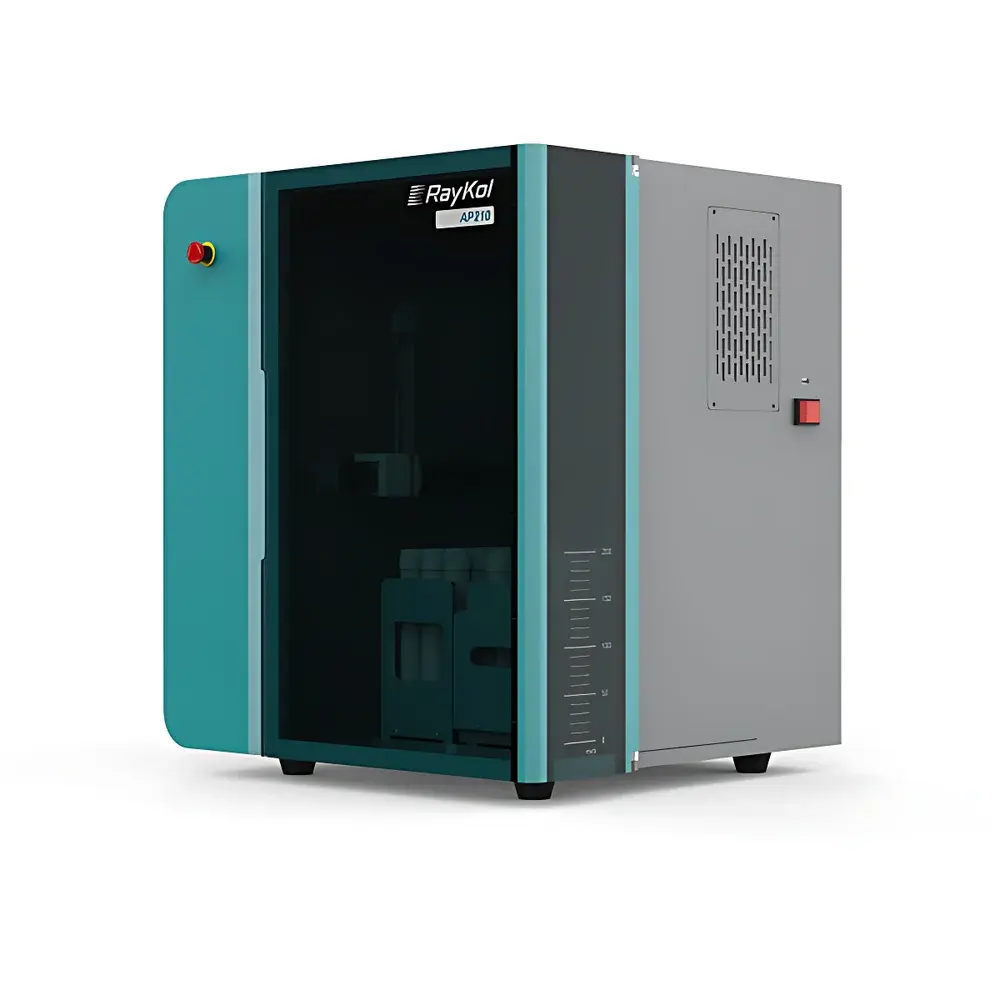
Raykol AP-210 Automated Acid Addition System
| Brand | Raykol |
|---|---|
| Origin | Fujian, China |
| Manufacturer Type | Direct Manufacturer |
| Country of Origin | China |
| Model | AP-210 |
| Plate Positions | 8 |
| Pipetting Accuracy | <1% CV |
| Pipetting Volume Range | 0–100 mL |
| Sample Throughput | Up to 48 samples per run |
| Dimensions (W×D×H) | 50 × 40 × 60 cm |
Overview
The Raykol AP-210 Automated Acid Addition System is an engineered solution for precise, reproducible, and operator-safe reagent dispensing in sample preparation workflows—particularly acid digestion prior to elemental analysis by ICP-OES, ICP-MS, AAS, or XRF. Designed around a dual-peristaltic-pump architecture with PFA fluidic pathways and corrosion-resistant motion control, the AP-210 operates on volumetric displacement principles to deliver consistent acid volumes across heterogeneous sample matrices. It eliminates manual pipetting variability, reduces exposure to hazardous fumes (e.g., HNO₃, HCl, HF, H₂SO₄), and supports high-throughput laboratories requiring GLP-compliant documentation and traceable method execution. The system integrates seamlessly into regulated environments where adherence to ISO/IEC 17025, USP , and FDA 21 CFR Part 11 is required.
Key Features
- Dual independent peristaltic pumps with programmable flow rates up to 4 mL/s per channel—enabling parallel or sequential acid addition to maximize throughput without cross-contamination.
- Eight chemically inert reagent channels with automatic switching; compatible with concentrated mineral acids including nitric, hydrochloric, hydrofluoric, and perchloric acid.
- PFA-lined fluid path and corrosion-resistant three-axis robotic arm ensure long-term reliability in aggressive chemical environments.
- Z-axis height adjustment (motorized) accommodates diverse digestion vessel geometries—from 50 mL polypropylene tubes to 100 mL quartz or PTFE Teflon® vessels—without manual recalibration.
- Integrated HEPA-grade particulate filter and acid-resistant exhaust fan mitigate airborne aerosol carryover and prevent cross-sample contamination.
- Wireless connectivity (Wi-Fi) enables remote operation via PC or tablet—removing personnel from fume hoods during acid addition cycles.
- Full instrument coating with electrophoretic epoxy and stainless-steel hardware enhances resistance to acid vapor corrosion and extends service life beyond 5 years under routine use.
Sample Compatibility & Compliance
The AP-210 accepts standard digestion racks (e.g., 48-position polypropylene or quartz trays) and automatically detects rack presence and orientation via optical sensors. It supports common digestion vessels used in EPA Method 3050B, 3051A, 3052; ISO 11466; and ASTM D5762. All firmware and software modules comply with data integrity requirements for audit trails, electronic signatures, and method version control—fully aligned with ALCOA+ principles (Attributable, Legible, Contemporaneous, Original, Accurate). Instrument validation documentation includes IQ/OQ protocols supporting GMP and GLP laboratory accreditation.
Software & Data Management
The AP-210 Control Suite features a graphical user interface with drag-and-drop method builder, allowing users to define A/B zone configurations, volume gradients, pause intervals, and multi-step acid sequences (e.g., pre-digestion HNO₃ + post-digestion H₂O₂). Every dispense event logs timestamp, pump speed, volume delivered, reagent ID, sample position, and operator credentials. Raw log files export in CSV or XML format for LIMS integration. Audit trail functionality meets FDA 21 CFR Part 11 requirements, including immutable records, role-based access control, and electronic signature support.
Applications
The system is routinely deployed in accredited environmental testing labs (soil, sediment, wastewater), food safety surveillance (GB 5009 series), pharmaceutical QC (ChP 2020, heavy metals testing), agricultural product monitoring (NY/T 1100-2006), and geological resource analysis (HJ 491-2019, HJ 751-2015). It is validated for applications requiring strict stoichiometric control—such as closed-vessel microwave digestion, open-vessel hotplate digestion, and leaching procedures per TCLP or SPLP protocols.
FAQ
What types of acids are compatible with the AP-210?
Concentrated nitric acid (≤70%), hydrochloric acid (≤37%), hydrofluoric acid (≤49%), sulfuric acid (≤98%), and hydrogen peroxide (≤30%)—all handled via PFA tubing and fluoropolymer valves.
Does the system support method validation per ISO/IEC 17025?
Yes—full IQ/OQ documentation, calibration certificates for pump verification, and traceable accuracy reports (<1% CV at 10 mL and 100 mL) are provided.
Can the AP-210 integrate with existing LIMS or ELN platforms?
Yes—via standardized API endpoints and configurable CSV/XML export templates compliant with ASTM E1578 and ISO 15143-2.
Is remote troubleshooting supported?
Yes—the embedded web server allows secure remote diagnostics and firmware updates over authenticated HTTPS connections.
What maintenance is required for long-term operation?
Quarterly pump tube replacement, annual HEPA filter change, and biannual verification of Z-axis positioning repeatability (±0.2 mm) using certified gauge blocks.



