
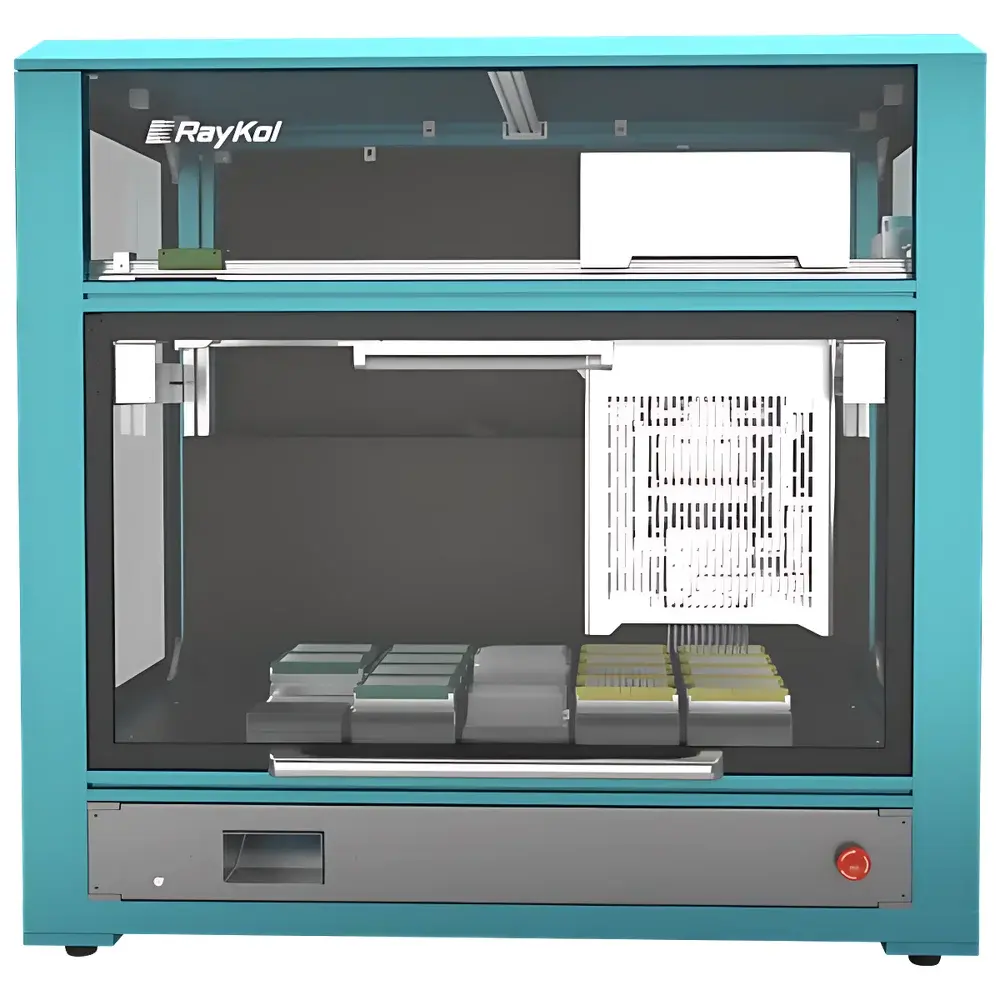
Raykol Vitae 180-96 Proteinomics Sample Preparation Workstation
| Brand | Raykol |
|---|---|
| Origin | Fujian, China |
| Manufacturer Type | Authorized Distributor |
| Country of Origin | China |
| Model | Vitae 180-96 |
| Plate Positions | 18 |
| Pipetting Precision | ±0.5 µL |
| Pipetting Range | 2.5–200 µL |
| Sample Throughput | 8–96 samples per run |
| Dimensions (W × D × H) | 1100 × 1100 × 750 mm |
Overview
The Raykol Vitae 180-96 Proteinomics Sample Preparation Workstation is an integrated, benchtop liquid handling platform engineered for end-to-end automation of mass spectrometry (MS)-ready peptide sample preparation from complex biological matrices. It implements a solid-phase alkylation (SPA)-based workflow—leveraging covalent immobilization of proteins onto functionalized magnetic beads—followed by on-bead reduction, alkylation, and trypsin digestion under thermally controlled oscillation. Unlike conventional off-bead enzymatic protocols, this architecture minimizes sample loss, suppresses chemical noise, and eliminates manual transfer steps that introduce variability. The system operates on the principle of magnetic bead-based solid-phase extraction (SPE), where protein capture, washing, and in-situ proteolysis are spatially confined to the bead surface—enabling high recovery (>85% typical for plasma/serum), reproducible digestion kinetics, and compatibility with low-input (≤10 µg) and high-complexity samples (e.g., tissue lysates, primary cell pellets). Designed for compliance-driven environments, the workstation supports traceable execution of SOPs across clinical proteomics, biomarker discovery, and pharmacoproteomics workflows.
Key Features
- Modular architecture integrating refrigerated reagent storage (4–10 °C), programmable magnetic separation units, temperature-controlled shaking (25–65 °C), and robotic plate handling via dual-gripper arm.
- Dual-mode pipetting: 96-channel head for parallel processing of full SBS-format microplates (e.g., 96-well deep-well or PCR plates); 8-channel head for precise reagent dispensing and serial dilution.
- 18-position SBS-compatible deck layout—including 15 assignable positions for consumables, reagent reservoirs, and waste containers—ensuring flexibility for multi-step protocols requiring >10 reagents.
- Open-platform design with standardized adapter interfaces (ANSI/SLAS-compliant), enabling seamless integration of third-party kits (e.g., Thermo Fisher, Waters, Bio-Rad) and custom magnetic bead chemistries.
- Touchscreen software with drag-and-drop protocol builder; each step supports independent parameter definition (aspiration/dispense speed, mixing cycles, incubation duration, magnet engagement timing) and version-controlled method storage.
- Integrated biosafety options: optional UV-C sterilization module (254 nm), HEPA-filtered positive/negative pressure enclosures (ISO Class 5 compliant airflow), and light-shielded operation mode for photosensitive reagents.
Sample Compatibility & Compliance
The Vitae 180-96 accommodates diverse upstream sample types without pre-processing: human plasma and serum (EDTA/heparin), urine (acidified or native), cultured mammalian cells (adherent/suspension), flash-frozen tissue homogenates (RIPA/SDC lysis buffers), and exosome-enriched fractions. All liquid handling operations adhere to ISO 8655-6 (gravimetric verification of pipette accuracy) and ASTM E2915-21 (performance criteria for automated sample prep systems). Protocol logs include timestamped audit trails, user authentication, and electronic signatures—fully compatible with FDA 21 CFR Part 11 requirements when deployed with validated networked data management. System validation packages support IQ/OQ/PQ documentation aligned with GLP and GMP frameworks used in clinical assay development.
Software & Data Management
The Vitae Control Suite runs on Windows 10 IoT Enterprise and provides role-based access control (RBAC), real-time instrument status monitoring, and automatic generation of CSV-formatted run reports containing pipette calibration records, magnet actuation logs, thermal profiles, and error codes. Raw method files (.vpr) are encrypted and digitally signed to prevent unauthorized modification. Exported data integrates natively with downstream analysis platforms including MaxQuant, Proteome Discoverer, and Skyline via standardized mzML/mzXML metadata injection. Software updates follow IEC 62304-compliant medical device software lifecycle practices, with release notes documenting traceability to regulatory change controls.
Applications
- Clinical biomarker discovery: Quantitative profiling of differential protein expression across large-cohort biobank samples (n > 500).
- Pharmacodynamic monitoring: Time-resolved analysis of drug-induced post-translational modifications (e.g., phosphorylation, ubiquitination) in PBMCs or tumor biopsies.
- Diagnostic assay development: Standardized production of reference peptide standards for LC-MS/MS-based companion diagnostics (e.g., HER2, KRAS, EGFR variants).
- Pathogenesis studies: Comparative proteomics of CSF, synovial fluid, or bronchoalveolar lavage (BAL) samples in neurodegenerative or autoimmune disease models.
- Therapeutic antibody characterization: Automated deglycosylation and middle-down digestion of monoclonal antibodies prior to intact mass analysis.
FAQ
What sample input volumes does the Vitae 180-96 support for plasma/serum processing?
Typical input ranges from 10–100 µL per well, scalable via dilution modules; minimum recommended protein load is 5 µg for robust MS detection.
Can the system perform on-bead TMT or iTRAQ labeling?
Yes—the heating/shaking module supports controlled amine labeling at 37 °C for 1 hr; optional nitrogen purge ports prevent oxidation during labeling reactions.
Is method transfer from manual SPA protocols straightforward?
All published Raykol SPA kit protocols include validated instrument methods; average transfer time is <2 hours with no optimization required for standard workflows.
How is carryover addressed during high-abundance sample processing?
The system performs post-pipette tip wash (3× ethanol/water) and implements air-gap aspiration; measured carryover is <0.002% (tested using bovine serum albumin spike-recovery assays).
Does the workstation support LIMS integration?
Yes—via RESTful API and HL7 v2.5 message schema; supports bidirectional sample ID assignment, result push, and QC flagging to major LIMS platforms (e.g., LabVantage, STARLIMS, Thermo SampleManager).



