
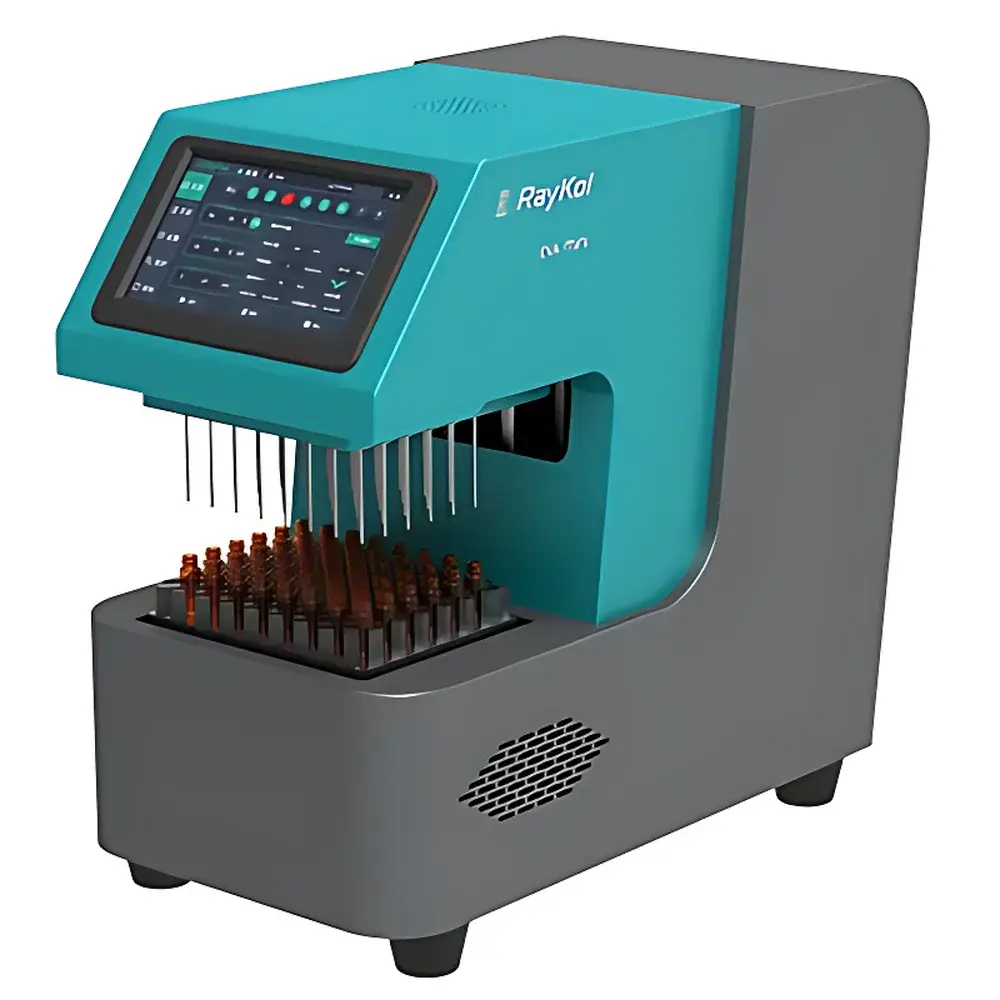
Raykol EVA Mini Automated Parallel Evaporator
| Brand | Raykol |
|---|---|
| Origin | Fujian, China |
| Manufacturer Type | Original Equipment Manufacturer (OEM) |
| Country of Origin | China |
| Model | EVA Mini |
| Instrument Type | Automated Quantitative Concentrator |
| Temperature Range | 0–100 °C |
| Temperature Control Accuracy | ±0.1 °C |
| Sample Capacity | 24-, 48-, or 96-well microplates |
| Compatible Vessels | 2 mL GC vials, 1–2 mL centrifuge tubes, shallow/deep 96-well plates |
Overview
The Raykol EVA Mini Automated Parallel Evaporator is an engineered solution for high-throughput, quantitative solvent removal from multiple samples simultaneously—designed specifically for laboratories requiring reproducible, trace-level concentration in regulated and research-intensive environments. Operating on the principle of controlled nitrogen gas flow combined with precise conductive heating, the EVA Mini delivers consistent evaporation kinetics across all sample positions by maintaining uniform thermal gradients and calibrated gas delivery. Unlike conventional single-sample evaporators, this system implements parallel processing architecture to support standardized workflows in pharmaceutical QC, environmental residue analysis, clinical biochemistry, and forensic toxicology. Its modular design integrates seamlessly into automated lab ecosystems, supporting both manual operation via embedded HMI and integration-ready communication protocols for LIMS or robotic liquid handlers.
Key Features
- Parallel nitrogen gas delivery with eight independent electromagnetic valves—enabling per-column activation to minimize gas consumption and optimize resource efficiency.
- Motorized, programmable needle descent mechanism: vertical travel speed and endpoint position are fully adjustable in real time, ensuring optimal gas-liquid interface interaction without splashing or cross-contamination.
- Uniform temperature distribution across the heated aluminum sample block: maintained within ±1 °C across all wells at setpoints between ambient and 100 °C, verified per ISO/IEC 17025 calibration practices.
- Pressure-regulated proportional flow control at each needle tip—guaranteeing identical volumetric flow rates (standardized to mL/min at STP) across all channels regardless of positional resistance or plate geometry.
- Multi-format compatibility: supports 96-well shallow/deep plates, 24- and 48-well plates, 2 mL GC vials, and 1–2 mL centrifuge tubes—all accommodated on a single interchangeable platform without hardware modification.
- Optional heated gas module available for enhanced evaporation kinetics when processing polypropylene (PP) microplates, where ambient-temperature gas may induce condensation or uneven drying.
Sample Compatibility & Compliance
The EVA Mini is validated for use with common laboratory consumables including polypropylene, polyethylene, and glass vials compliant with ASTM D4169 and USP . Its thermal and pneumatic control architecture meets essential requirements for GLP and GMP-aligned laboratories—including audit-trail-capable method storage, parameter locking, and user-access-level configuration. While not certified as FDA 21 CFR Part 11 compliant out-of-the-box, the system’s firmware architecture supports third-party electronic signature and data integrity modules when deployed with validated software extensions. All electrical components conform to IEC 61010-1 safety standards for laboratory equipment.
Software & Data Management
Control is executed via a built-in 7-inch capacitive touchscreen running a deterministic real-time OS. The interface provides direct access to temperature ramp profiles, needle descent velocity (0.1–5 mm/s), dwell time per well, gas-on/off sequencing, and multi-step method programming. Up to 100 user-defined methods can be saved locally with timestamped metadata (operator ID, date/time, version). Export options include CSV-formatted logs of all active parameters and event timestamps—compatible with standard ELN platforms. Remote monitoring is supported via Ethernet (TCP/IP) using Modbus RTU protocol for integration into centralized lab automation systems.
Applications
- Pharmaceutical residue analysis: quantitative concentration of LC-MS/MS extracts from plasma, urine, or tissue homogenates prior to injection.
- Environmental monitoring: preparation of pesticide, PAH, or PCB extracts from water, soil, or sediment matrices following QuEChERS or SPE cleanup.
- Clinical proteomics: parallel desalting and concentration of digested peptide fractions prior to nano-LC-MS analysis.
- Food safety testing: reduction of solvent volume in multi-residue pesticide screening workflows compliant with EN 15662 and AOAC 2007.01.
- Forensic toxicology: high-reproducibility evaporation of blood or hair extracts containing controlled substances prior to derivatization and GC-MS analysis.
FAQ
What microplate formats does the EVA Mini support?
The system natively accommodates 96-well shallow and deep well plates, as well as 24- and 48-well configurations. Optional adapters enable secure positioning of 2 mL GC vials and 1–2 mL conical centrifuge tubes.
Is the nitrogen gas stream heated during operation?
Standard configuration delivers ambient-temperature nitrogen; however, an optional heated gas module is available to raise inlet gas temperature up to 60 °C—recommended for low-volatility solvents or PP-based microplates.
How is temperature uniformity verified across the sample block?
Raykol performs factory calibration using NIST-traceable PT100 sensors at nine spatially distributed points; final validation reports document deviation ≤±1 °C at all operational setpoints.
Can the EVA Mini be integrated into robotic workcells?
Yes—the instrument features front-accessible microplate loading zones, optional telescoping rails for robotic arm reach, and industrial I/O signals (dry contact inputs/outputs) for handshake synchronization with third-party handlers.
Does the system support audit trail functionality for regulated environments?
The base firmware logs all parameter changes and method executions with timestamps and operator IDs. Full 21 CFR Part 11 compliance requires deployment with validated external software middleware that manages electronic signatures and immutable log archiving.



