
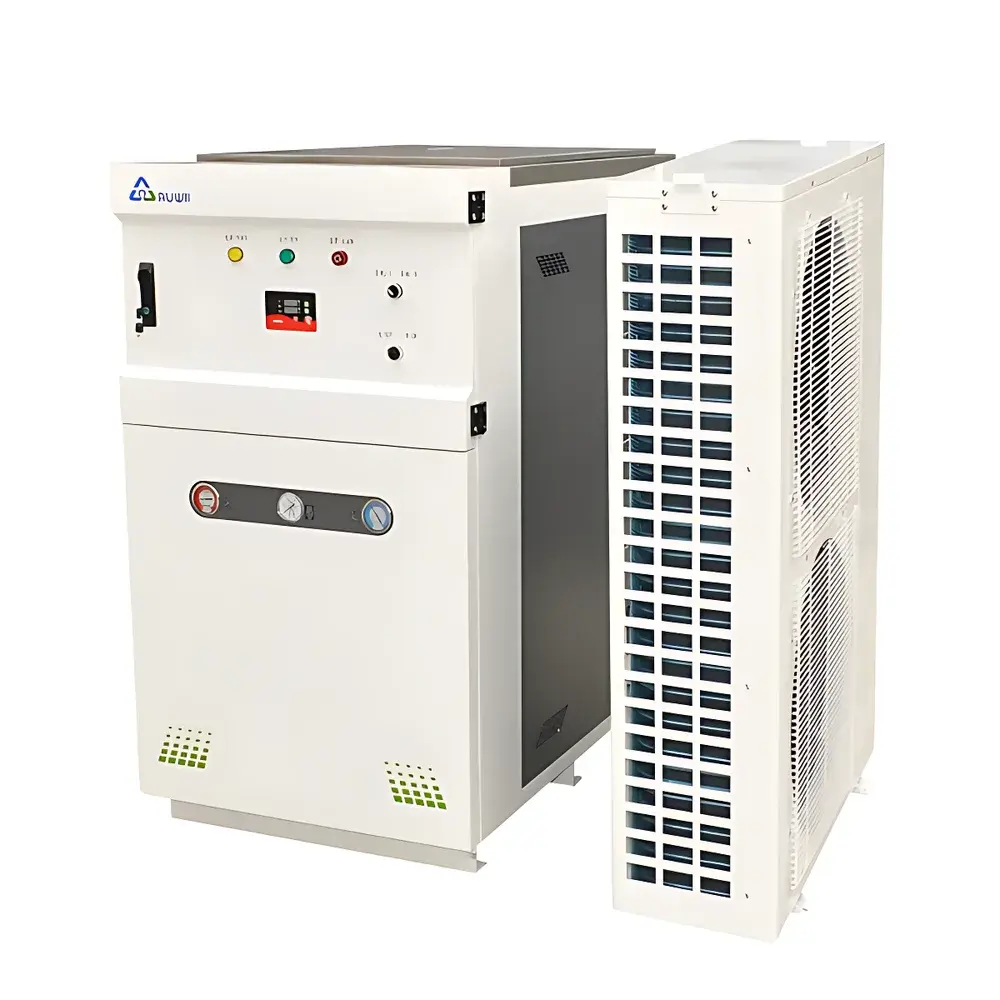
Purkinje RG Series XRD-Specific Circulating Chiller
| Origin | Beijing, China |
|---|---|
| Manufacturer Type | Authorized Distributor |
| Origin Category | Domestic (China) |
| Model | RG Series |
| Price Range | USD 1,400 – 2,800 |
| Instrument Type | Split-System |
| Cooling Method | Water-Cooled |
| Temperature Stability Range | 5–35 °C |
| Cooling Capacity | 5–88 kW |
| Temperature Stability | ±2 °C |
| Circulating Pump Pressure | Multiple Configurations Available |
| Circulating Pump Flow Rate | Multiple Configurations Available |
| Reservoir Volume | Multiple Configurations Available |
| Operating Principle | Phase-Change Refrigeration |
Overview
The Purkinje RG Series XRD-Specific Circulating Chiller is an engineered thermal management solution designed exclusively for high-precision, heat-sensitive analytical instrumentation—particularly X-ray diffractometers (XRD), X-ray fluorescence spectrometers (XRF), transmission and scanning electron microscopes (TEM/SEM), plasma etching systems, and vacuum deposition equipment. Unlike general-purpose chillers, the RG Series employs a rigorously validated split-system architecture grounded in thermodynamic principles of vapor-compression refrigeration with phase-change heat transfer. Its dual-unit configuration—comprising a dedicated outdoor condensing unit and a low-noise indoor circulation unit—ensures effective thermal separation: all waste heat and primary acoustic emissions are isolated outdoors, while the indoor unit maintains near-silent operation (<45 dB(A) typical) and zero internal heat generation. This design directly addresses the stringent thermal stability requirements of XRD systems, where even sub-degree temperature drift can induce lattice parameter error, peak broadening, or detector thermal noise—compromising Bragg angle resolution and quantitative phase analysis fidelity.
Key Features
- Split-system architecture with physically separated condensing (outdoor) and evaporative/circulation (indoor) units to eliminate thermal and acoustic coupling with sensitive instruments
- Industrial-grade outdoor unit constructed entirely from corrosion-resistant metals—no structural plastic components—to ensure long-term reliability under continuous duty cycles
- Stainless steel reservoir with large access opening for visual water quality inspection, manual cleaning, and inhibitor replenishment—critical for preventing biofilm formation and scaling in recirculated deionized water loops
- Integrated refrigeration safeguards: high/low pressure monitoring, compressor overheat protection, overcurrent cutoff, phase-sequence and phase-loss detection
- Intelligent outdoor unit controls including low-ambient compressor crankcase heater and variable-speed condenser fan—enabling stable operation across ambient temperatures from −25 °C to +45 °C (suitable for year-round deployment in northern and southern China)
- High-head, multi-stage centrifugal circulation pump with configurable pressure (up to 6 bar) and flow rate (up to 30 L/min)—compatible with complex coolant manifolds and high-backpressure instrument interfaces
Sample Compatibility & Compliance
The RG Series chiller is compatible with standard laboratory coolant media—including deionized water, 20–30% ethylene glycol/water mixtures, and proprietary instrument-grade coolants—as specified by XRD OEMs (e.g., Bruker, Rigaku, Malvern Panalytical). It meets IEC 61000-6-3 (EMC emission limits) and IEC 61000-6-2 (immunity to electrical disturbances). While not certified to UL/CSA safety standards out-of-box, it complies with GB 4706.1–2005 (Chinese national safety standard for electrical appliances) and incorporates dual redundant temperature sensors per ASME BPE-2022 guidelines for critical fluid control. Its closed-loop design supports GLP-compliant documentation when integrated with external data loggers; optional RS485/Modbus RTU interface enables audit-trail-capable temperature and alarm logging per FDA 21 CFR Part 11 requirements when paired with validated SCADA software.
Software & Data Management
The RG Series features a local digital controller with LED display, real-time setpoint/actual temperature readout, and event-driven alarm codes (e.g., “E03: Low Flow”, “E12: High Discharge Pressure”). For networked environments, optional Ethernet or RS485 Modbus RTU connectivity allows integration into centralized facility monitoring systems (e.g., Siemens Desigo, Schneider EcoStruxure). All operational parameters—including cumulative runtime, compressor cycles, and fault history—are stored in non-volatile memory. When deployed in regulated laboratories, users may configure external programmable logic controllers (PLCs) or LabVIEW-based acquisition systems to capture timestamped temperature, pressure, and flow data at ≤1 Hz intervals—supporting IQ/OQ validation protocols and ISO/IEC 17025 traceability requirements.
Applications
- X-ray diffraction (XRD) systems requiring stable thermal environment for Cu/Kα or Mo/Kα sources and cryogenic sample stages
- X-ray fluorescence (XRF) spectrometers with high-power sealed-tube or rotating-anode X-ray generators
- Transmission electron microscopes (TEM) and field-emission SEMs with liquid-nitrogen-free cooling for beamline optics and detectors
- Plasma-enhanced chemical vapor deposition (PECVD) and reactive ion etching (RIE) tools demanding consistent electrode and chamber wall temperature control
- Vacuum metallization systems, including electron-beam evaporation and magnetron sputtering units with high-duty-cycle power supplies
FAQ
Is the RG Series compatible with Bruker D8 Advance XRD systems?
Yes—the RG Series meets Bruker’s recommended coolant specifications (deionized water, 15–25 °C setpoint, ≥2.5 bar minimum outlet pressure) and has been validated for direct integration with D8 Advance, D2 Phaser, and ECO models.
Can the chiller operate continuously at 5 °C ambient temperature?
Yes—integrated crankcase heaters and low-ambient fan speed control enable reliable startup and sustained operation down to −25 °C outdoor ambient, with no risk of refrigerant migration or oil viscosity issues.
Does the system support remote monitoring via Ethernet?
Standard units include RS485 Modbus RTU; Ethernet gateway modules (e.g., Moxa NPort) are available as accessories for TCP/IP integration into building management systems.
What maintenance intervals are recommended for the stainless steel reservoir?
Visual inspection every 3 months; full drain, rinse, and biocide treatment every 6 months—or more frequently if conductivity exceeds 5 µS/cm in deionized water loops.
Is GMP-compliant calibration documentation available?
Factory calibration certificates (traceable to NIM, China) are provided; on-site IQ/OQ protocol execution and 3Q validation support can be arranged through authorized service partners.



