
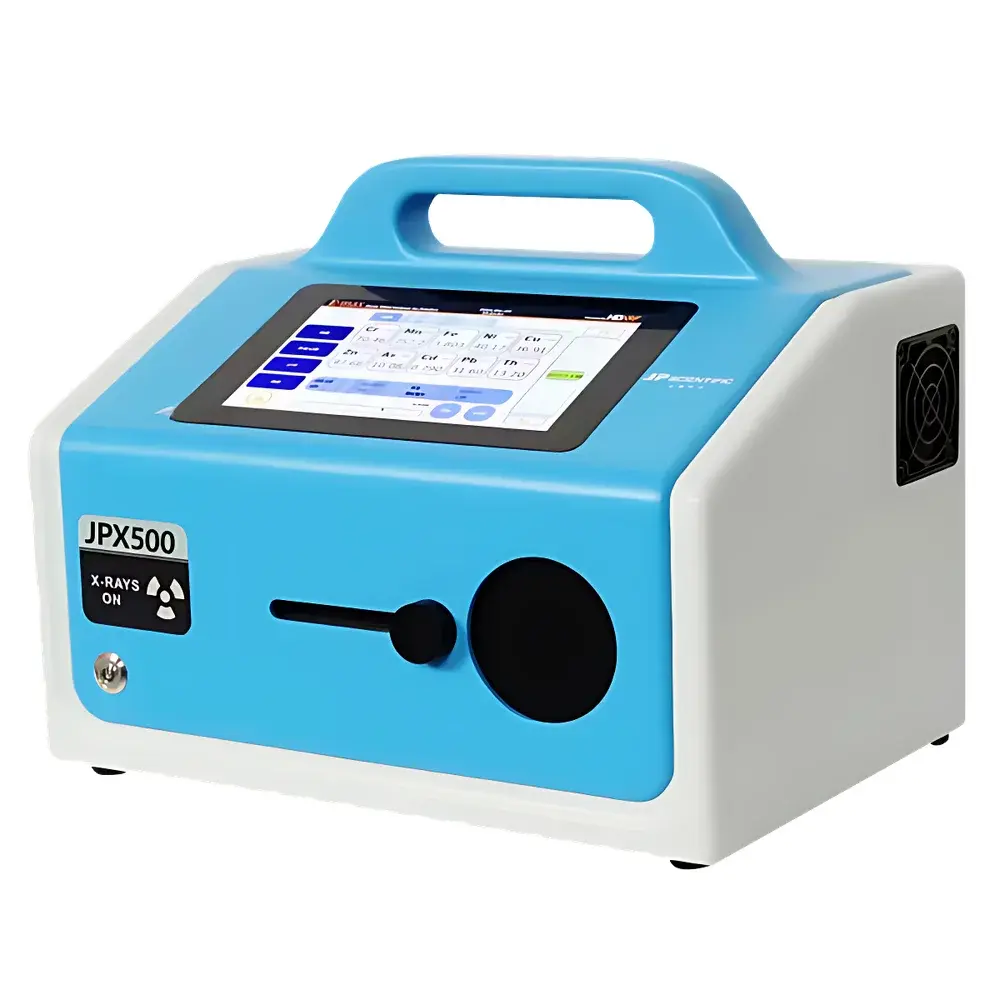
Raykol JPX500 High-Precision Energy Dispersive X-Ray Fluorescence Spectrometer
| Brand | Raykol |
|---|---|
| Origin | Jiangsu, China |
| Manufacturer Type | Direct Manufacturer |
| Product Category | Domestic |
| Model | JPX500 |
| Application Form Factor | Handheld/Portable |
| Industry Use | General-Purpose |
| Elemental Range | Al to U (40+ elements) |
| Quantification Range | 0.03 ppm – 100% |
| Energy Resolution | <140 eV (at Mn Kα) |
| Repeatability (RSD) | ≤0.08% |
| Detector | High-Performance Silicon Drift Detector (SDD) |
Overview
The Raykol JPX500 is a handheld, high-precision energy dispersive X-ray fluorescence (ED-XRF) spectrometer engineered for field-deployable elemental analysis across environmental, agricultural, food safety, and industrial regulatory workflows. Unlike conventional polychromatic ED-XRF systems, the JPX500 integrates monochromatic excitation via doubly curved crystal (DCC) optics — a core component of High-Definition XRF® (HDXRF®) technology — which selectively filters and focuses incident X-rays onto the sample at optimal energies for target element excitation (e.g., Cd K-edge at 26.7 keV). This monochromatic approach significantly suppresses background scatter and matrix interference, yielding superior signal-to-noise ratios (S/N), sub-ppm detection limits, and quantification accuracy without requiring vacuum or helium purge. Designed for compliance with international regulatory frameworks — including China’s GB 15618–2018 (Soil Risk Control Standard for Agricultural Land), US EPA Method 6200, and ISO 12847 — the JPX500 delivers laboratory-grade performance in a rugged, battery-operated platform weighing under 9 kg.
Key Features
- Monochromatic HDXRF® Excitation: Doubly curved crystal (DCC) optics deliver focused, energy-tuned X-ray beams optimized for heavy metal excitation (e.g., Cd, Pb, As, Hg), minimizing spectral overlap and enhancing sensitivity.
- High-Resolution SDD Detection: Fast-response silicon drift detector with <140 eV resolution at Mn Kα ensures precise peak deconvolution for multi-element analysis in complex matrices (soil, grain, plant tissue, water filters).
- Robust Quantitative Engine: Fundamental Parameters (FP)-based software corrects for matrix absorption, enhancement, and particle size effects — validated against CRM reference materials (e.g., NIST SRM 2710a, GBW07401) for trace-to-major element quantification (0.03 ppm – 100%).
- Field-Optimized Workflow: Touchscreen interface with pre-loaded method libraries for soil screening (Cd, Pb, As), food crop testing (rice, wheat, vegetables), and wastewater filter analysis; measurement times configurable from 30 s to 20 min.
- Ruggedized Portable Design: IP54-rated enclosure, operating temperature range of −5 °C to 50 °C, integrated Li-ion battery (≥8 h runtime), and ergonomic form factor (30 × 23 × 26 cm) for extended field use.
Sample Compatibility & Compliance
The JPX500 supports direct solid, powder, and filtered-liquid (e.g., GF/F membrane) analysis without digestion or dilution. It is validated for heterogeneous samples including air-dried soils, milled cereals, dried plant tissues, pharmaceutical tablets, and sedimented water particulates. All quantitative methods adhere to GLP principles and support audit trails per FDA 21 CFR Part 11 when used with optional secure software licensing. Regulatory alignment includes: GB 15618–2018 (Cd limit: 0.3 mg/kg in agricultural soil), EU Commission Regulation (EU) No 2023/915 (Cd in rice), and USP / for elemental impurities in pharmaceuticals. Certified performance data are traceable to NIST and CNAS-accredited reference standards.
Software & Data Management
JPX500 operates on Raykol’s proprietary XRF AnalyzeSuite™ v4.x, featuring intuitive workflow-driven acquisition, real-time spectral visualization, and automated report generation (PDF/CSV). The software implements full FP modeling with user-adjustable parameters (tube voltage, current, filter selection, dwell time), supports method validation per ISO/IEC 17025, and logs all instrument settings, calibration history, and operator ID for GMP/GLP compliance. Data export includes raw spectra, peak tables, uncertainty estimates (k=2), and QC metrics (recovery %, RSD). Optional cloud synchronization enables centralized data review, remote calibration updates, and multi-site method harmonization.
Applications
- Agricultural Land Screening: Rapid Cd, Pb, As, and Cr assessment in topsoil to support land classification, remediation prioritization, and post-remediation verification per GB 15618–2018.
- Food & Feed Safety: On-site quantification of >15 regulated inorganic contaminants (Cd, Pb, Hg, As, Ni, Cu, Zn, etc.) in rice, wheat, maize, soybeans, and animal feed — compliant with GB 2762–2022 and Codex Alimentarius limits.
- Water Quality Monitoring: Analysis of heavy metals retained on 0.45 µm membrane filters from groundwater, surface water, and industrial effluents — enabling rapid triage prior to ICP-MS confirmation.
- Pharmaceutical & Cosmetic QA: Screening of catalyst residues (Pd, Pt, Ni) and toxic elements (As, Cd, Hg, Pb) in APIs and excipients per ICH Q3D and USP .
- Recycling & Waste Characterization: Sorting and grading of electronic scrap, slag, and construction debris based on elemental composition profiles.
FAQ
Does the JPX500 require sample digestion or acid preparation before analysis?
No — it performs direct solid-phase analysis of air-dried, homogenized soils, grains, and plant tissues. Liquid samples must be pre-concentrated on certified filters.
How is measurement repeatability verified?
Repeatability (RSD ≤0.08%) is validated using certified reference materials (e.g., GBW07401 soil, NIST SRM 1568b rice flour) across ≥10 replicate measurements under identical conditions.
Is the instrument compliant with FDA 21 CFR Part 11 requirements?
Yes — with optional Secure Mode enabled, the system provides electronic signatures, audit trails, role-based access control, and data integrity safeguards required for regulated environments.
What elements can be reliably quantified below 1 ppm in soil?
Cd, Pb, As, Cr, Cu, Zn, and Ni achieve detection limits of 0.03–0.15 ppm in typical agricultural soils (sand–loam matrix, 2 mm particle size, 120 s count time).
Can the JPX500 be calibrated for site-specific matrices?
Yes — users may develop custom FP calibrations using local CRMs or spiked reference samples, with full traceability to primary standards and uncertainty propagation reporting.





