
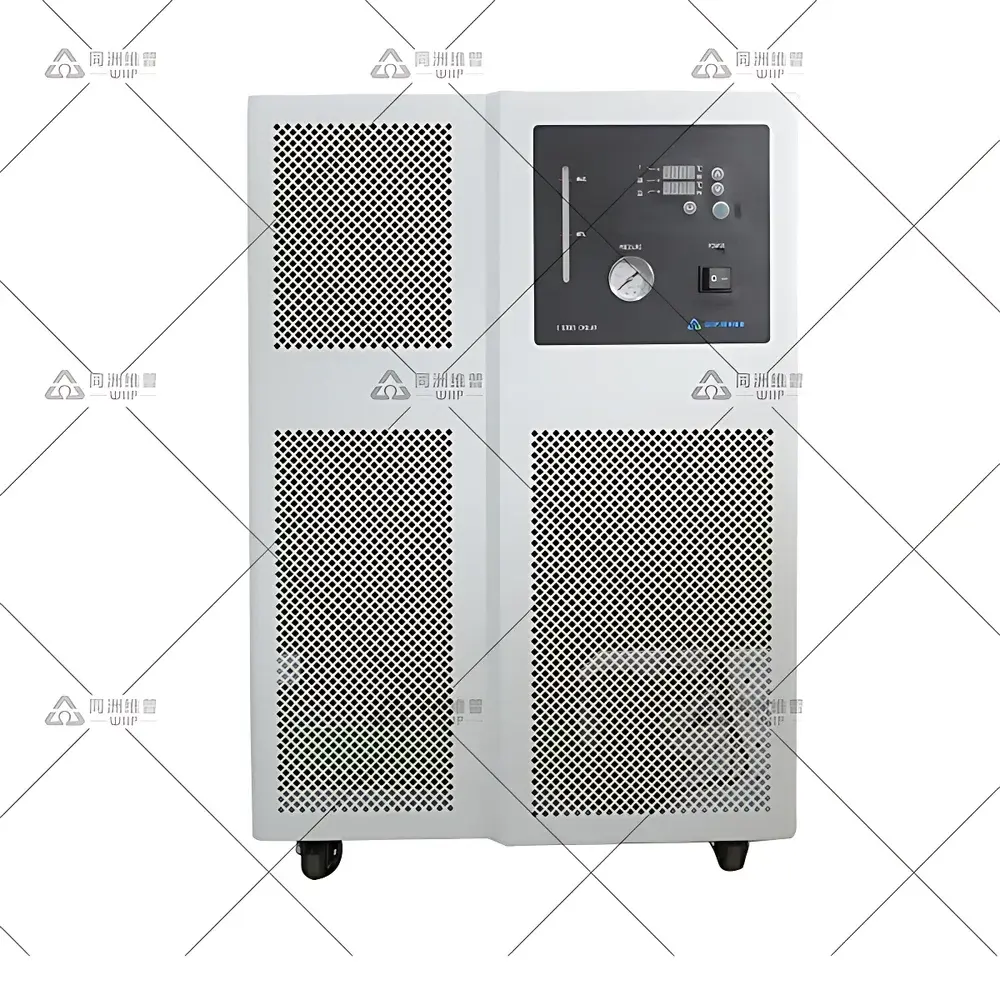
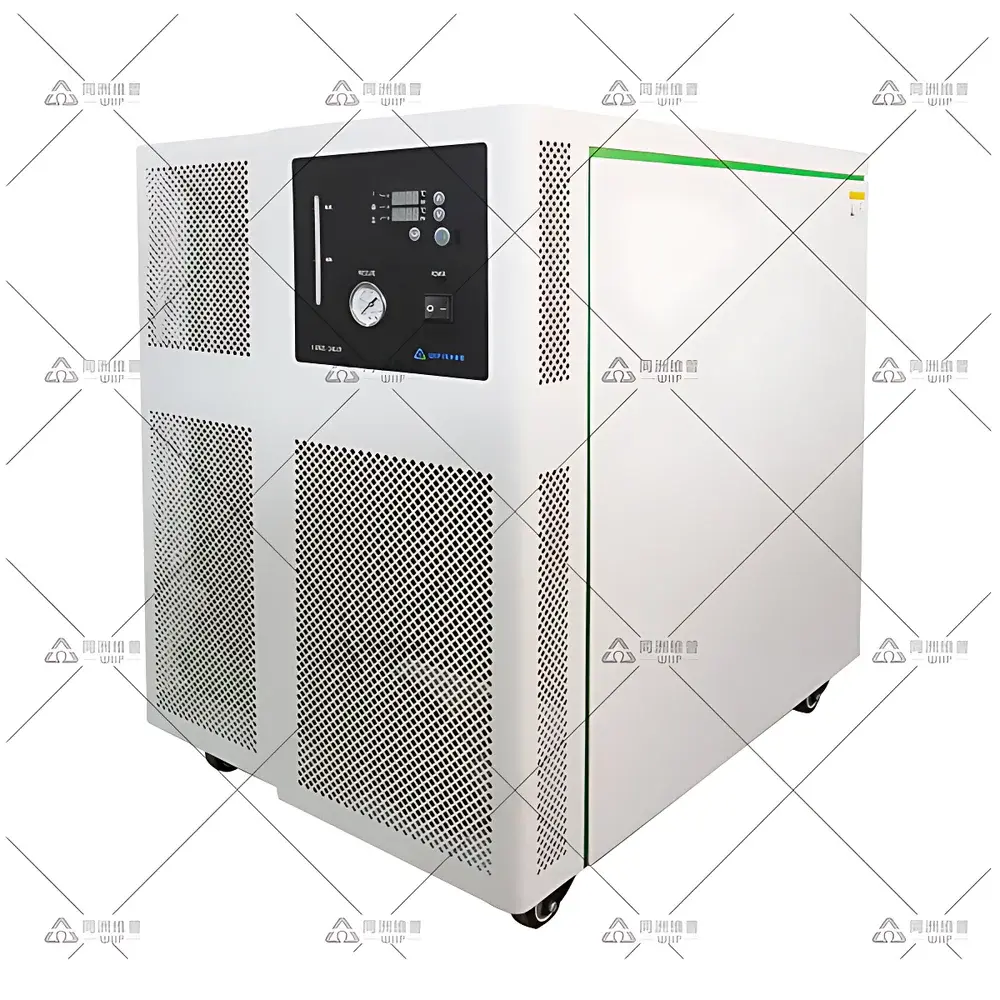
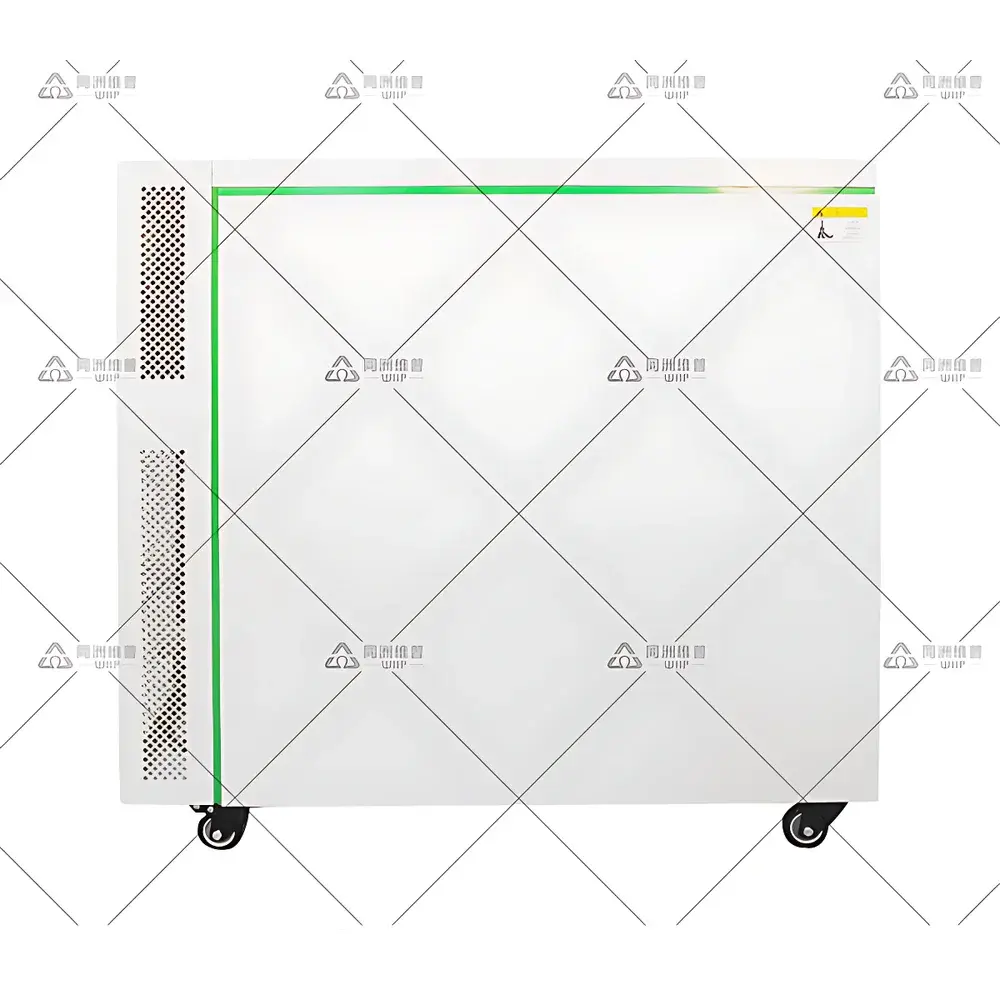
Tongzhou Weipu E5s Compact Horizontal Circulating Chiller
| Brand | Tongzhou Weipu |
|---|---|
| Origin | Beijing, China |
| Manufacturer Type | Direct Manufacturer |
| Instrument Type | Integrated Unit |
| Cooling Method | Water-Cooled |
| Temperature Control Range | 5–35 °C |
| Refrigeration Capacity | 5200 W |
| Temperature Stability | ±0.1 °C |
| Circulating Pump Pressure | 3.4 bar |
| Circulating Pump Flow Rate | 40 L/min |
| Reservoir Volume | 26 L |
| Operating Principle | Phase-Change Refrigeration |
Overview
The Tongzhou Weipu E5s Compact Horizontal Circulating Chiller is an integrated, water-cooled refrigeration system engineered for precise thermal management of laboratory instrumentation requiring stable, continuous coolant delivery. Designed around a vapor-compression phase-change refrigeration cycle, the E5s delivers consistent cooling performance across its operational range of 5–35 °C with high reproducibility and minimal thermal drift. Its horizontal footprint optimizes benchtop or under-bench installation in space-constrained analytical laboratories, making it particularly suitable for integration with vacuum systems (e.g., turbomolecular pumps), rotary evaporators, distillation assemblies, and other heat-generating lab equipment where reliable heat extraction and temperature stability are critical to process integrity and experimental repeatability.
Key Features
- Integrated architecture with built-in refrigeration circuit, circulation pump, expansion reservoir, and PID-controlled thermostat — no external components required for standard operation.
- Water-cooled condenser design enables efficient heat rejection in ambient environments where air-cooling may be thermally or acoustically impractical, especially in enclosed instrument cabinets or shared lab spaces.
- Precision temperature regulation with ±0.1 °C stability over the full 5–35 °C range, achieved via dual-sensor feedback (reservoir and outlet) and adaptive PID algorithm tuning.
- High-flow, low-pulsation circulation system delivering up to 40 L/min at 3.4 bar pressure, compatible with multi-instrument manifolds and long-loop cooling circuits (up to 30 m total tubing length with ≤15 m vertical lift).
- 26 L stainless-steel reservoir with level sensor, anti-corrosion coating, and integrated air venting to minimize bubble formation and ensure laminar flow.
- Phase-change refrigeration core utilizing R-410A refrigerant (ODP = 0, GWP = 2088), compliant with current EU F-Gas Regulation Annex I thresholds for laboratory-scale chillers.
Sample Compatibility & Compliance
The E5s is designed for closed-loop circulation of deionized water or water–glycol mixtures (up to 30% v/v) and is compatible with standard laboratory fluid-handling interfaces (¼″–⅜″ NPT, ISO 228–1). It meets electromagnetic compatibility requirements per IEC 61326–1:2013 (Class B) and safety standards per IEC 61010–1:2010 for laboratory electrical equipment. While not certified to UL/CSA or CE for medical use, its construction and control architecture support GLP-aligned operation when deployed in validated workflows — including audit-trail-capable logging (via optional RS485/Modbus RTU interface) and configurable alarm thresholds for temperature deviation, low-level, and pump fault conditions.
Software & Data Management
The E5s operates via an embedded microcontroller with local LCD interface (backlit, 4-button navigation) supporting real-time display of setpoint, actual temperature, pump status, and error codes. For integration into centralized lab infrastructure, an optional RS485 serial port enables Modbus RTU communication with LIMS or SCADA platforms. This allows remote setpoint adjustment, data polling at user-defined intervals (1–300 s), and event-triggered logging of thermal excursions — facilitating compliance with FDA 21 CFR Part 11 when paired with validated third-party software solutions. Internal non-volatile memory retains last-configured parameters and up to 72 hours of timestamped temperature history (1-minute resolution) without external connectivity.
Applications
- Thermal stabilization of high-vacuum molecular pumps during extended pump-down cycles, preventing bearing overheating and maintaining ultimate pressure specifications.
- Coolant supply for rotary evaporators operating under reduced pressure, ensuring condenser efficiency and minimizing solvent loss during heat-sensitive compound isolation.
- Temperature control of jacketed glassware in fractional distillation and reflux setups, enabling precise boiling point discrimination and improved fraction purity.
- Support for laser-based analytical instruments (e.g., Raman spectrometers, diode-pumped solid-state lasers) requiring low-noise, vibration-damped coolant flow.
- Secondary cooling loop for HPLC column ovens or mass spectrometer ion sources where primary chiller capacity is shared across multiple subsystems.
FAQ
What is the maximum recommended coolant viscosity for optimal pump performance?
The E5s is calibrated for aqueous coolants with dynamic viscosity ≤ 3.5 mPa·s at 20 °C. For glycol blends, use ≤30% ethylene or propylene glycol by volume to maintain flow rate and pressure specifications.
Can the E5s operate continuously at 5 °C ambient temperature?
Yes — the unit is rated for continuous operation within an ambient range of 10–35 °C. At sub-15 °C ambient, condensate management and compressor oil return must be verified per installation manual; supplemental insulation of external lines is recommended.
Is the reservoir accessible for routine maintenance and cleaning?
Yes — the top panel is removable, providing full access to the reservoir interior, level sensor, and inlet/outlet manifolds. Cleaning protocol includes flushing with 1% citric acid solution followed by triple rinse with deionized water.
Does the E5s support external temperature sensing for process-critical applications?
Not natively — temperature control is based on internal reservoir and outlet sensors. However, the Modbus interface permits external PT100 input integration via programmable logic controllers or third-party temperature controllers.
What refrigerant service interval is recommended for long-term reliability?
Under normal operating conditions and sealed-system integrity, no scheduled refrigerant recharge is required. Annual verification of refrigerant charge (via manifold gauge set and superheat/subcooling measurement) is advised as part of preventive maintenance per ISO 5149–2:2014 guidelines.



