
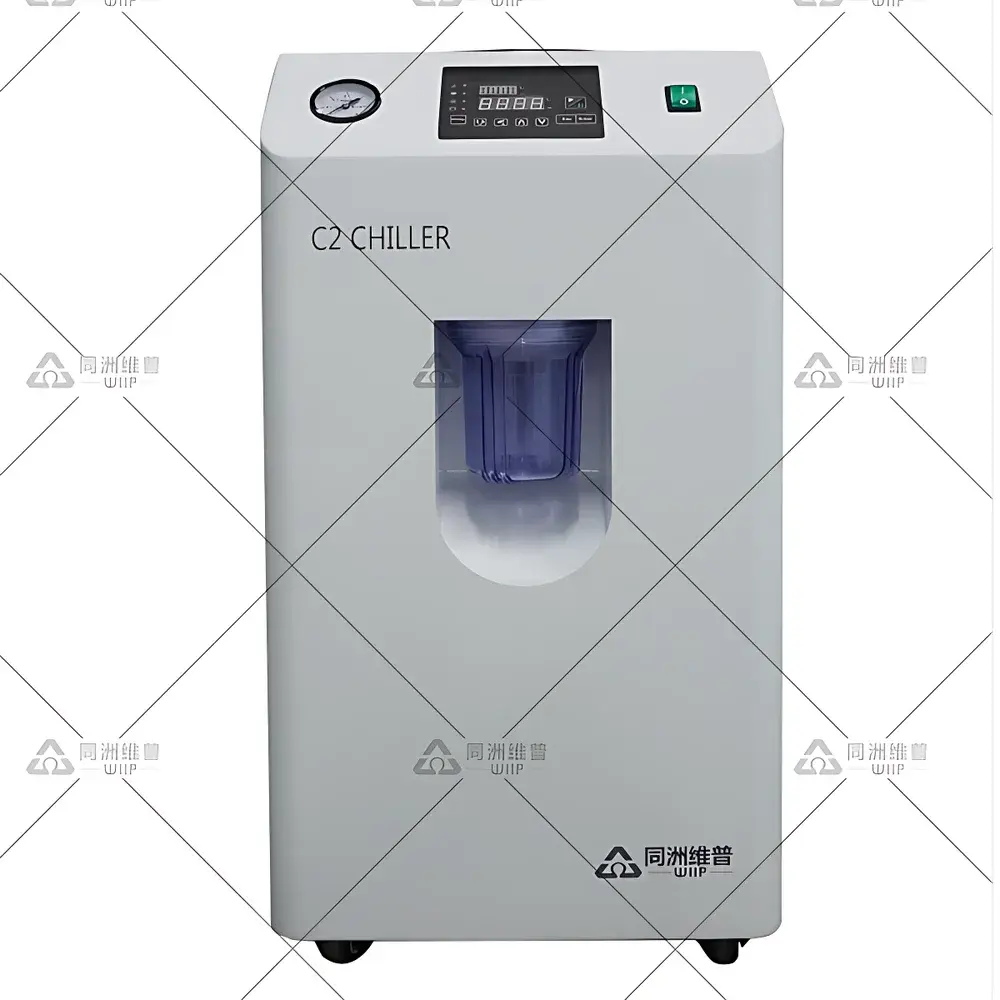
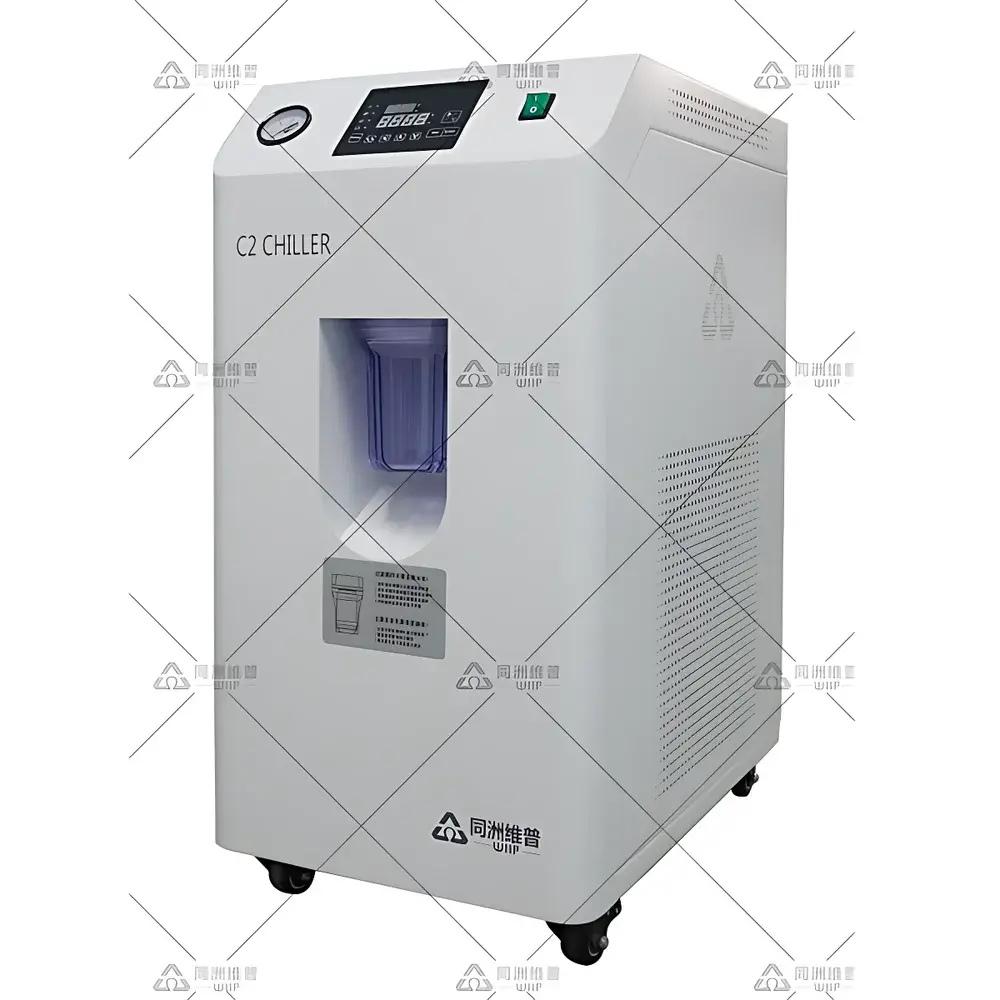
Tongzhou Weipu C2 Compact Vertical Circulating Chiller
| Brand | Tongzhou Weipu |
|---|---|
| Origin | Beijing, China |
| Manufacturer Type | Direct Manufacturer |
| Instrument Type | Integrated Circulating Chiller |
| Cooling Method | Water-Cooled |
| Temperature Control Range | 5 °C to 35 °C |
| Cooling Capacity | 1600 W |
| Temperature Stability | ±0.1 °C |
| Reservoir Volume | 20 L |
| Operating Principle | Phase-Change Refrigeration |
Overview
The Tongzhou Weipu C2 Compact Vertical Circulating Chiller is an integrated, water-cooled refrigeration system engineered for stable, continuous thermal management of sensitive laboratory instrumentation. Utilizing a closed-loop phase-change refrigeration cycle—comprising compressor, condenser, expansion device, and evaporator—the C2 delivers precise temperature regulation across its operational range of 5 °C to 35 °C. Its vertical footprint minimizes benchtop space requirements while maintaining structural rigidity and acoustic dampening suitable for shared analytical laboratories. Designed specifically for coupling with high-heat-load instruments, the chiller ensures consistent coolant delivery at controlled flow rates and thermal gradients, mitigating thermal drift in optical, spectroscopic, and vacuum-based systems.
Key Features
- Integrated vertical architecture with reinforced stainless-steel reservoir (20 L capacity) and corrosion-resistant internal piping for long-term coolant integrity
- Phase-change refrigeration system featuring hermetic scroll compressor and copper-aluminum microchannel condenser for high thermodynamic efficiency and low maintenance
- Precision temperature control via PID-regulated digital thermostat, achieving ±0.1 °C stability under steady-state load conditions
- Water-cooled condensation circuit compatible with facility-supplied cooling water (recommended inlet: 10–25 °C, max 35 °C), reducing ambient heat rejection and enabling installation in temperature-controlled rooms
- Programmable setpoint memory with real-time display of bath temperature, outlet temperature, and system pressure diagnostics
- Over-temperature, low-flow, and compressor overcurrent protection circuits compliant with IEC 61000-6-2/6-4 electromagnetic compatibility standards
Sample Compatibility & Compliance
The C2 chiller is designed for integration with a broad class of laboratory instruments requiring external coolant circulation—including atomic absorption spectrometers (AAS), inductively coupled plasma optical emission spectrometers (ICP-OES), scanning electron microscopes (SEM), gloveboxes with inert gas purge systems, plasma etchers, direct-reading optical emission spectrometers (OES), and Kjeldahl nitrogen analyzers. Its flow rate and pressure profile meet OEM specifications for most major instrument manufacturers’ auxiliary cooling ports. The unit complies with GB/T 19001–2016 (ISO 9001:2015 equivalent) quality management requirements and conforms to electrical safety standards per GB 4793.1–2018 (IEC 61010-1). While not certified for medical or pharmaceutical GMP production environments, its design supports GLP-aligned operation when paired with validated calibration protocols and audit-trail-capable external data loggers.
Software & Data Management
The C2 operates via a standalone embedded controller with no proprietary software dependency. All operational parameters—including setpoint, actual bath temperature, outlet temperature, runtime hours, and fault codes—are accessible via the front-panel LCD interface. For traceable monitoring, analog 4–20 mA output signals are provided for temperature and compressor status, enabling integration into building management systems (BMS) or centralized lab monitoring platforms. Optional RS485 Modbus RTU communication allows remote readout of real-time values and alarm states when connected to SCADA or LIMS-compatible gateways. Data logging requires external hardware; however, the chiller’s deterministic thermal response and repeatable setpoint recovery support ISO/IEC 17025-compliant uncertainty budgets when used within defined environmental and maintenance intervals.
Applications
- Stabilizing graphite furnace and flame atomizers in AAS systems to prevent spectral baseline shift and improve detection limit reproducibility
- Maintaining constant plasma torch coolant temperature in ICP-OES to ensure signal stability and reduce matrix effect variability
- Controlling stage and detector temperatures in SEM systems during high-resolution imaging to minimize thermal expansion artifacts
- Regulating internal atmosphere temperature in argon- or nitrogen-purged gloveboxes used for air-sensitive synthesis and battery material handling
- Providing consistent coolant supply to RF generators and matching networks in reactive ion etching (RIE) tools to sustain process repeatability
- Supporting digestion block temperature uniformity in automated Kjeldahl analyzers where exothermic reactions require active heat dissipation
FAQ
What is the recommended coolant type for the C2 chiller?
Deionized water or a 30% propylene glycol/water mixture is recommended. Ethylene glycol is not advised due to potential degradation of internal elastomeric seals.
Can the C2 operate continuously at 5 °C ambient temperature?
Yes—the chiller’s condenser is rated for inlet water temperatures as low as 10 °C, making it suitable for use in climate-controlled labs with chilled water infrastructure.
Is the C2 compatible with instruments requiring 0.5–2.0 bar pressure at the coolant inlet?
Yes—its integrated centrifugal pump delivers adjustable flow up to 12 L/min with a maximum head pressure of 2.5 bar, fully covering standard OEM coolant interface requirements.
Does the unit include a built-in filtration system?
It features a 50-µm stainless-steel mesh pre-filter at the reservoir inlet; users should install inline particulate filters (e.g., 5–10 µm) upstream when connecting to instruments with narrow coolant channels.
How often does the refrigerant charge require verification?
Under normal operation and leak-free installation, refrigerant integrity is verified during annual preventive maintenance; no routine recharging is specified per manufacturer guidelines.



