
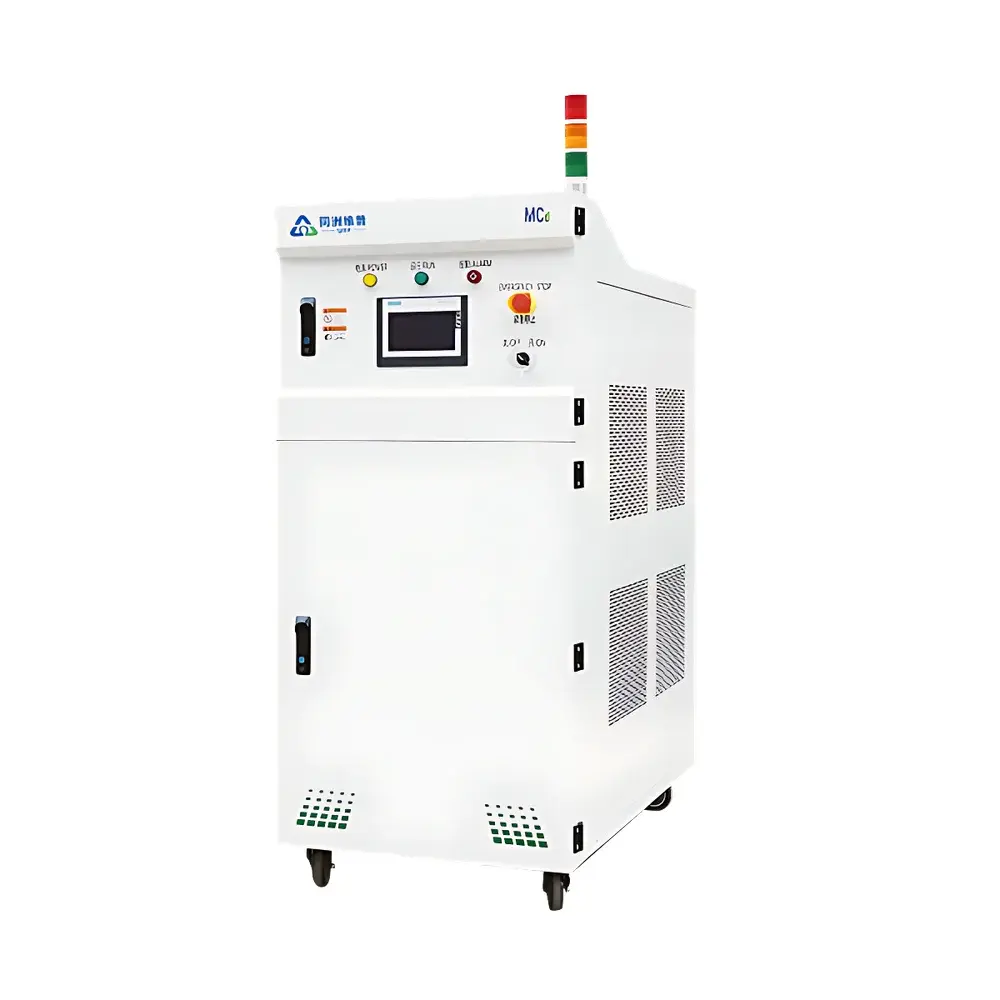
Tongzhou Weipu MCd Dual-System EV Test Temperature Control Unit
| Brand | Tongzhou Weipu |
|---|---|
| Origin | Beijing, China |
| Manufacturer Type | Direct Manufacturer |
| Product Category | Domestic |
| Model | MCd |
| Instrument Type | Integrated Circulating Chiller |
| Temperature Control Range | −40 °C to +95 °C |
| Cooling Capacity | 2.5 kW to 25 kW |
| Temperature Stability | ±0.1 °C |
| Flow Rate | 0.1–30 L/min (adjustable, dual-channel independent control) |
| Cooling Method | Dual-mode — air-cooled and water-cooled options available |
| Channel Independence | Fully isolated dual-circuit architecture |
Overview
The Tongzhou Weipu MCd Dual-System EV Test Temperature Control Unit is an integrated, high-precision circulating chiller engineered specifically for electric vehicle (EV) powertrain validation and battery system testing in laboratory and pilot-line environments. It operates on a dual-loop thermofluid architecture—each channel featuring independent refrigeration circuits, PID-controlled temperature regulation, and dynamically adjustable flow delivery. Unlike conventional single-circuit chillers, the MCd employs two physically separated cooling paths with no thermal or hydraulic cross-talk, enabling simultaneous yet distinct thermal conditioning of multiple test units—such as a battery module under low-temperature charge cycling while an inverter is subjected to high-temperature thermal stress testing. Its operational principle relies on vapor-compression refrigeration combined with precision fluid dynamics control, delivering stable thermal setpoints across a wide range (−40 °C to +95 °C) with reproducible stability of ±0.1 °C under steady-state conditions. The unit supports both air-cooled and water-cooled condenser configurations, allowing flexible integration into varying facility infrastructures—including cleanrooms, climatic chambers, and automated test benches.
Key Features
- Dual-Independent Thermal Loops: Two fully isolated refrigeration systems share a common chassis but operate with separate compressors, expansion valves, and heat exchangers—eliminating thermal crosstalk and enabling concurrent multi-device testing at divergent setpoints.
- Wide Operational Range: Achieves stable temperature control from −40 °C (using low-GWP R-513A/R-1234yf blended refrigerant) up to +95 °C (via electric heating augmentation), supporting cold-soak, hot-soak, and rapid thermal transient protocols per ISO 16750-4 and GB/T 31467.3.
- Intelligent Flow Management: Dual-channel flow rates independently adjustable from 0.1 to 30 L/min, with real-time pressure monitoring (0–6 bar range) and automatic compensation for variable backpressure encountered during EV battery coolant loop testing.
- Robust Industrial Architecture: Stainless steel fluid reservoirs, corrosion-resistant nickel-plated copper piping, IP54-rated electrical enclosure, and vibration-damped compressor mounts ensure long-term reliability in 24/7 test cell operation.
- Modular Cooling Interface: Standardized quick-connect fittings (DIN 2353, 1/2″–3/4″ BSP) compatible with common EV coolant formulations (e.g., ethylene glycol/water blends, organic acid technology coolants) and non-reactive toward aluminum, copper, and stainless steel components.
Sample Compatibility & Compliance
The MCd is designed for direct integration with EV subsystems requiring precise thermal boundary conditions—including lithium-ion battery modules (pouch, prismatic, cylindrical), traction inverters, onboard chargers (OBC), and e-motors. Its dual-loop configuration satisfies the divergent thermal demands of coupled electrothermal testing—for instance, maintaining −20 °C at the battery inlet while delivering +85 °C to the motor stator cooling jacket. All wetted materials comply with ASTM D1384 (coolant compatibility) and ISO 6743-12 (refrigeration lubricant classification). The unit meets CE marking requirements (2014/30/EU EMC Directive, 2014/68/EU PED for pressure equipment where applicable), and its control firmware adheres to IEC 61508 SIL2 functional safety principles for critical thermal interlock logic. Optional documentation packages support GLP/GMP audit readiness, including factory calibration certificates traceable to NIM (National Institute of Metrology, China) standards.
Software & Data Management
The MCd integrates with Tongzhou Weipu’s TCS-Link™ control suite via Ethernet (TCP/IP) or RS485 Modbus RTU. The software provides synchronized logging of dual-channel temperature, flow rate, pressure, compressor run time, and refrigerant saturation data at user-defined intervals (100 ms to 10 s resolution). All parameter changes are timestamped and attributed with operator ID, satisfying FDA 21 CFR Part 11 requirements when paired with optional electronic signature and audit trail modules. Historical datasets export natively to CSV, MATLAB (.mat), and HDF5 formats—enabling direct ingestion into MATLAB/Simulink thermal models or Python-based statistical process control (SPC) pipelines. Remote monitoring and alarm forwarding (SMTP/SNMP) are supported without reliance on cloud services, preserving data sovereignty in regulated R&D environments.
Applications
- Dynamic thermal validation of EV battery packs per UN GTR 20 and ISO 12405-4 accelerated life testing protocols.
- Thermal management system (TMS) co-simulation with hardware-in-the-loop (HIL) platforms such as dSPACE SCALEXIO or NI VeriStand.
- Pre-conditioning of battery cells prior to electrochemical impedance spectroscopy (EIS) or differential voltage analysis (DVA).
- Steady-state thermal resistance mapping of power electronics under controlled junction temperature conditions.
- Calibration support for infrared thermography systems requiring reference-grade surface temperature uniformity.
FAQ
Does the MCd support both heating and cooling within the same channel?
Yes—each channel features independent refrigeration and electric heating elements, enabling seamless transition between cooling and heating modes without external bypass valves or auxiliary heaters.
Can the two channels operate at extreme opposite temperatures simultaneously (e.g., −40 °C and +95 °C)?
Yes—the dual-system architecture allows full-range independent setpoint control; however, maximum cooling capacity at extreme low temperatures decreases per compressor performance curves, as specified in the technical datasheet.
Is the MCd compatible with automotive-grade glycol-water coolant mixtures?
Yes—it is validated for continuous operation with 50/50 ethylene glycol/water solutions and extended-life organic acid technology (OAT) coolants meeting ASTM D3306 and JIS K2234 specifications.
What safety interlocks are built into the system?
Standard interlocks include high-pressure cut-off, low-flow shutoff, overtemperature shutdown, refrigerant leak detection (optional), and emergency power-off (EPO) interface compliant with IEC 60204-1.
Is remote firmware update capability available?
Firmware updates are performed locally via USB or Ethernet using signed binary packages; no OTA (over-the-air) functionality is implemented to maintain air-gapped security in certified test laboratories.



