
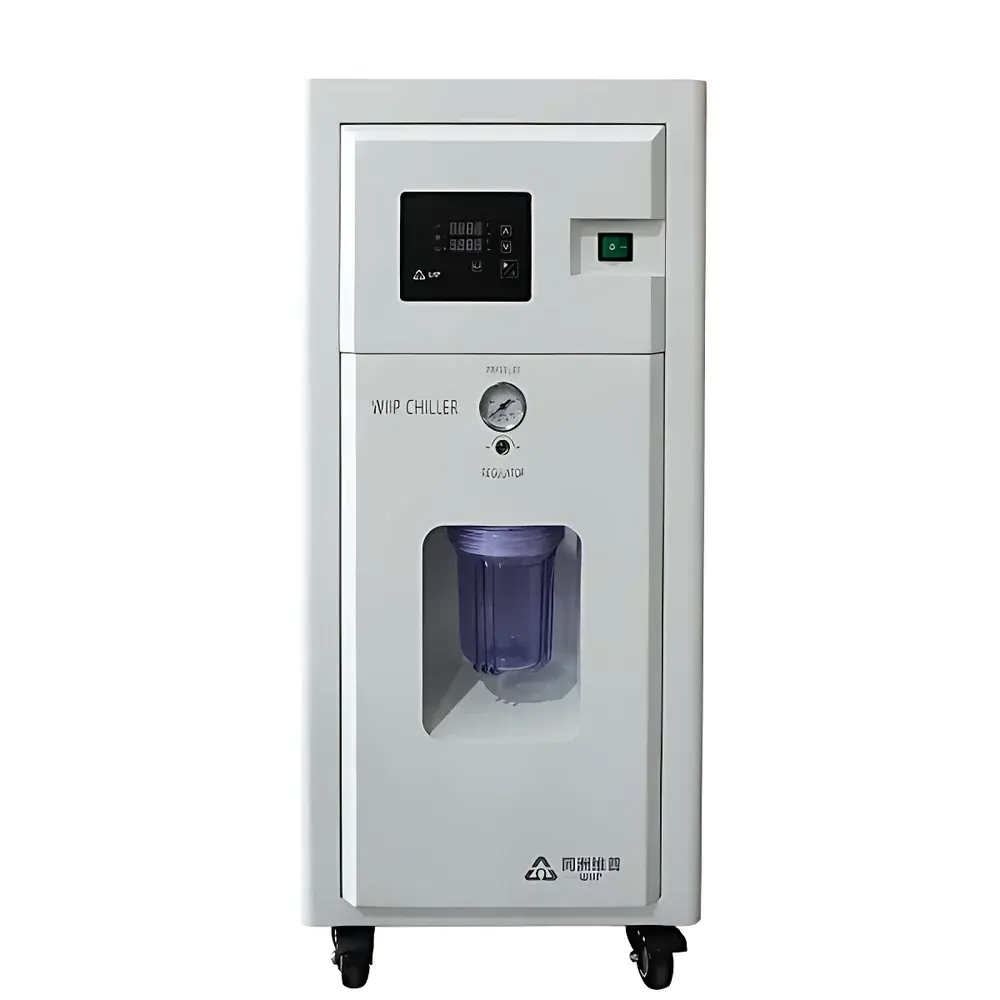
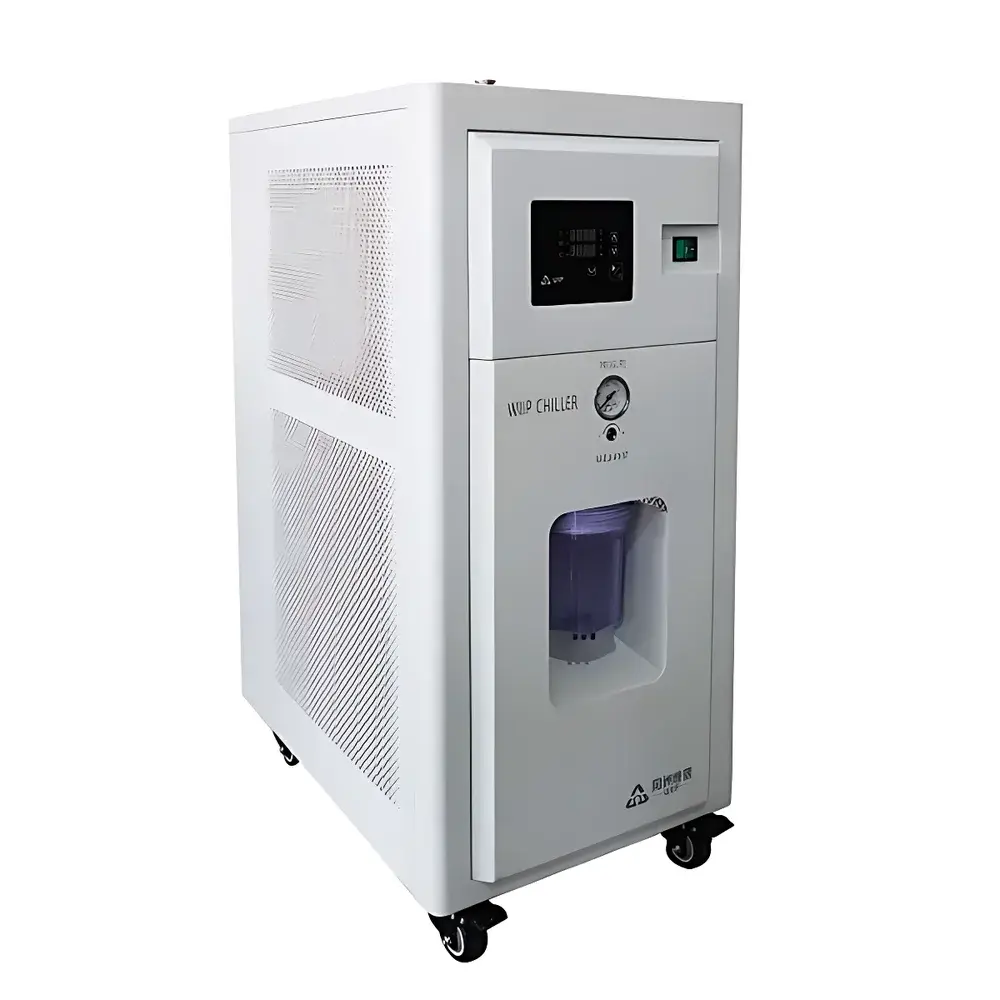
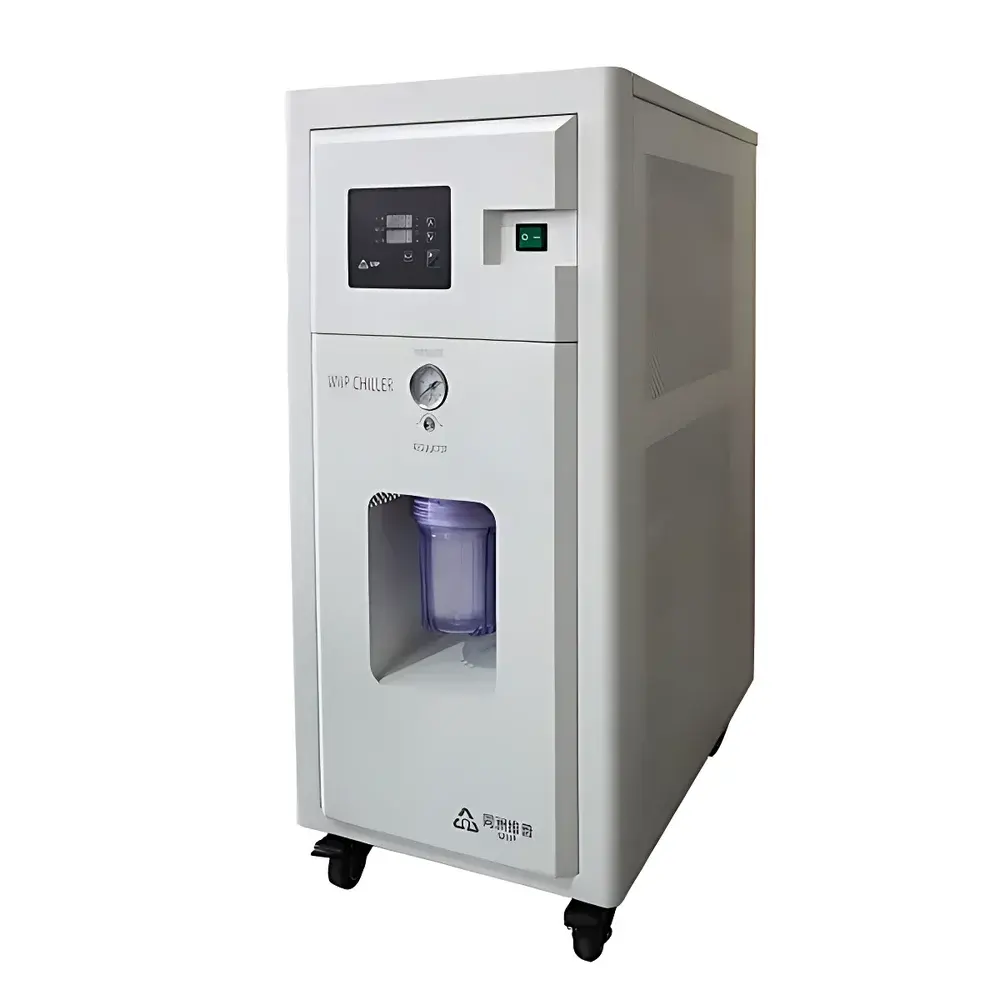
Tongzhou Weipu H2 Series Integrated Circulating Chiller for Agilent ICP-OES Systems
| Brand | Tongzhou Weipu |
|---|---|
| Origin | Beijing, China |
| Manufacturer Type | Direct Manufacturer |
| Regional Classification | Domestic (China) |
| Model | H2 for Agilent ICP-OES |
| Instrument Type | Integrated Circulating Chiller |
| Cooling Method | Water-Cooled |
| Temperature Control Range | −40 °C to 95 °C |
| Refrigeration Capacity | 900 W to 6400 W |
| Temperature Stability | ±0.1 °C to ±1.0 °C |
| Circulating Pump Pressure | 1.5 bar to 4.3 bar |
| Circulating Pump Flow Rate | 10 L/min to 50 L/min |
| Reservoir Volume | 2.5 L to 46 L |
| Operating Principle | Phase-Change Refrigeration |
Overview
The Tongzhou Weipu H2 Series Integrated Circulating Chiller is an engineered thermal management solution specifically designed to meet the stringent cooling demands of high-precision analytical instrumentation—including Agilent ICP-OES systems, ICP-MS, AAS spectrometers, SEMs, plasma etchers, and laser-based laboratory equipment. Unlike generic chillers, the H2 series implements a closed-loop phase-change refrigeration architecture optimized for stable, low-noise, and contamination-free heat extraction. Its core function is to maintain instrument heat exchangers—such as plasma torch interfaces, detector housings, and RF generator cooling jackets—at precisely regulated temperatures, thereby ensuring spectral stability, signal-to-noise ratio consistency, and long-term calibration integrity. The chiller operates across an exceptionally wide temperature span (−40 °C to +95 °C), enabling both cryogenic stabilization and high-temperature process cooling in a single platform. This operational flexibility supports not only routine elemental analysis but also method development requiring thermal ramping or multi-step temperature protocols.
Key Features
- Integrated vertical chassis design minimizing laboratory footprint while maximizing internal serviceability and airflow efficiency.
- Low-RPM, large-diameter axial fans delivering acoustic performance ≤52 dB(A) at 1 m—critical for quiet operation in shared analytical labs and ISO Class 5–7 cleanroom-adjacent environments.
- Dual-stage filtration system including particulate pre-filter and activated carbon/softening cartridge, preventing scale formation and protecting sensitive instrument coolant passages from corrosion or biofilm accumulation.
- Real-time monitoring suite with redundant sensors for reservoir level, inlet/outlet temperature differential, refrigerant pressure, flow rate, and electrical load—each triggering configurable relay alarms or Modbus TCP alerts.
- CE-marked construction compliant with EN 61000-6-3 (EMC emission) and EN 61000-6-2 (immunity), supporting global deployment with auto-sensing 100–240 V AC, 50/60 Hz input and optional 208 V three-phase configurations.
- Environmentally responsible refrigerant charge using R-410A (GWP = 2088) or R-32 (GWP = 675) variants—both compliant with EU F-Gas Regulation (EU) No 517/2014 and aligned with laboratory sustainability reporting frameworks.
Sample Compatibility & Compliance
The H2 chiller is validated for continuous duty-cycle integration with Agilent 5100/5800/5900 ICP-OES platforms, where thermal drift in the plasma interface region directly impacts nebulizer efficiency, ion transmission, and background continuum intensity. It meets ASTM E2912–22 requirements for thermal stability in analytical instrumentation support systems and supports GLP/GMP-compliant operation through audit-trail-capable event logging (optional). All fluid-contact materials—including EPDM seals, 316 stainless steel reservoirs, and PTFE-lined tubing paths—conform to USP Class VI biocompatibility standards and are certified non-leaching per ISO 10993-5. Optional IQ/OQ documentation packages are available for regulated pharmaceutical, clinical, and contract research laboratories subject to FDA 21 CFR Part 11 and Annex 11 requirements.
Software & Data Management
The embedded controller features a 4.3-inch capacitive touchscreen HMI with multilingual UI (English, German, French, Chinese), real-time trend graphs for temperature, flow, and power consumption, and configurable setpoint profiles with up to 16 segments. Local data logging stores 30 days of 1-second-interval measurements internally; export is supported via USB 2.0 or Ethernet (Modbus TCP/RTU, BACnet MS/TP). For enterprise integration, optional OPC UA server firmware enables seamless connection to LabVantage, STARLIMS, or Thermo Fisher SampleManager LIMS platforms. All configuration changes, alarm events, and manual overrides are time-stamped and user-ID logged—supporting ALCOA+ data integrity principles when paired with network-authenticated access control.
Applications
- Stabilizing plasma torch and RF coil temperatures in Agilent ICP-OES systems to reduce spectral line broadening and improve detection limits for trace metal analysis (e.g., Pb, Cd, As in environmental water per EPA Method 200.8).
- Cooling high-power diode lasers (e.g., 532 nm/1064 nm Raman excitation sources) where ±0.2 °C stability prevents wavelength drift and maintains diffraction-limited focus.
- Thermal conditioning of glovebox antechambers and inert-atmosphere reactors during catalytic material synthesis, where precise exotherm control ensures reproducible crystallinity and particle size distribution.
- Supporting automated Kjeldahl digestion units by maintaining condenser jacket temperatures below 15 °C to maximize ammonia recovery efficiency (>99.2% per AOAC 984.27).
- Enabling extended-duration SEM imaging sessions through active cooling of field-emission gun assemblies, reducing thermal lensing effects and improving beam coherence.
FAQ
What is the recommended coolant mixture for use with the H2 chiller in Agilent ICP-OES applications?
Deionized water with 15–25% v/v inhibited glycol (propylene glycol-based, non-phosphate, non-amine) is recommended to prevent microbial growth and aluminum corrosion in Agilent’s integrated cooling manifolds.
Does the H2 chiller support remote start/stop and setpoint adjustment via Ethernet?
Yes—via Modbus TCP register mapping or optional OPC UA server add-on, enabling integration into centralized building management systems (BMS) or laboratory automation controllers.
How often should the water filter cartridge be replaced under continuous ICP-OES operation?
Every 6 months under standard lab water quality (conductivity 0.1 ppm silica.
Is the H2 chiller compatible with Agilent’s SmartConnect diagnostic interface?
Not natively—but its analog 4–20 mA temperature output and digital alarm relays can be wired to Agilent’s external monitoring port for basic status mirroring in ICPOES diagnostics software.
Can the H2 operate unattended for 72-hour ICP-OES batch runs?
Yes—its dual-level float switch, low-flow cutoff, and dry-run protection circuitry ensure fail-safe operation; continuous logging confirms thermal stability compliance throughout extended sequences.



