
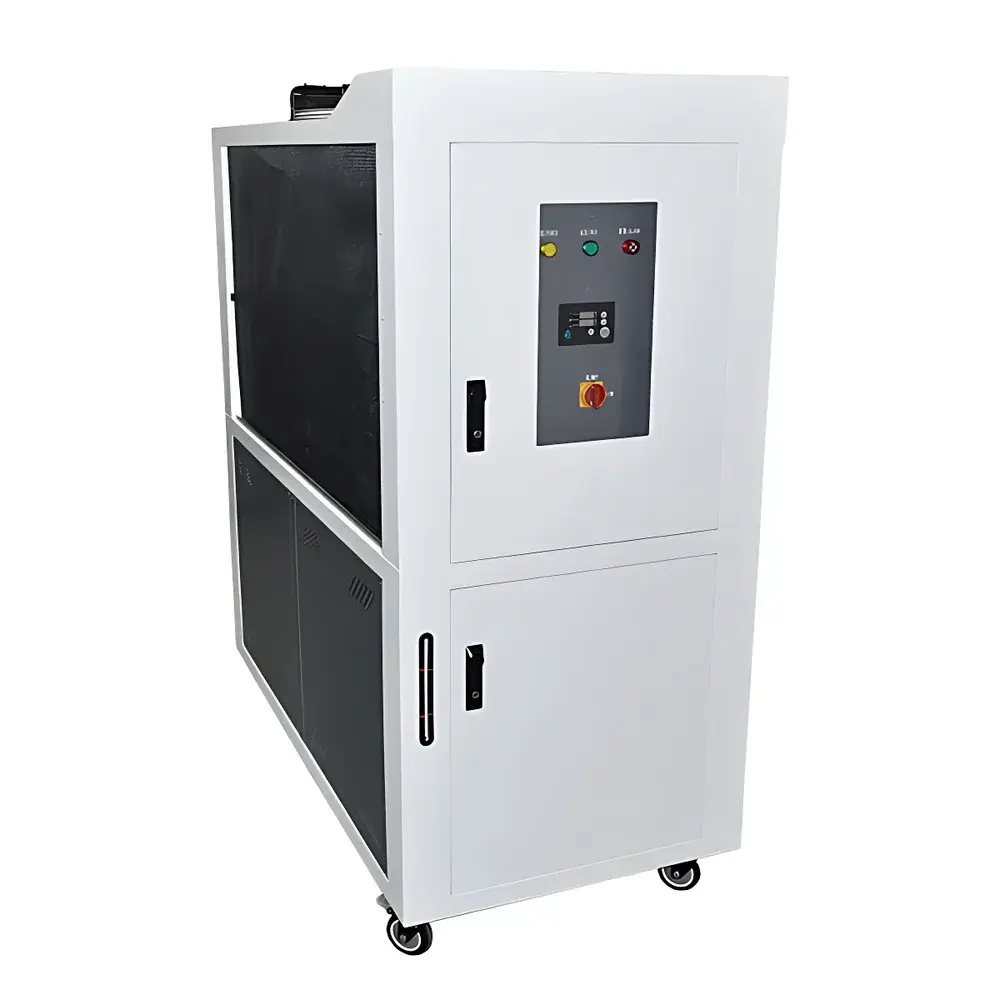
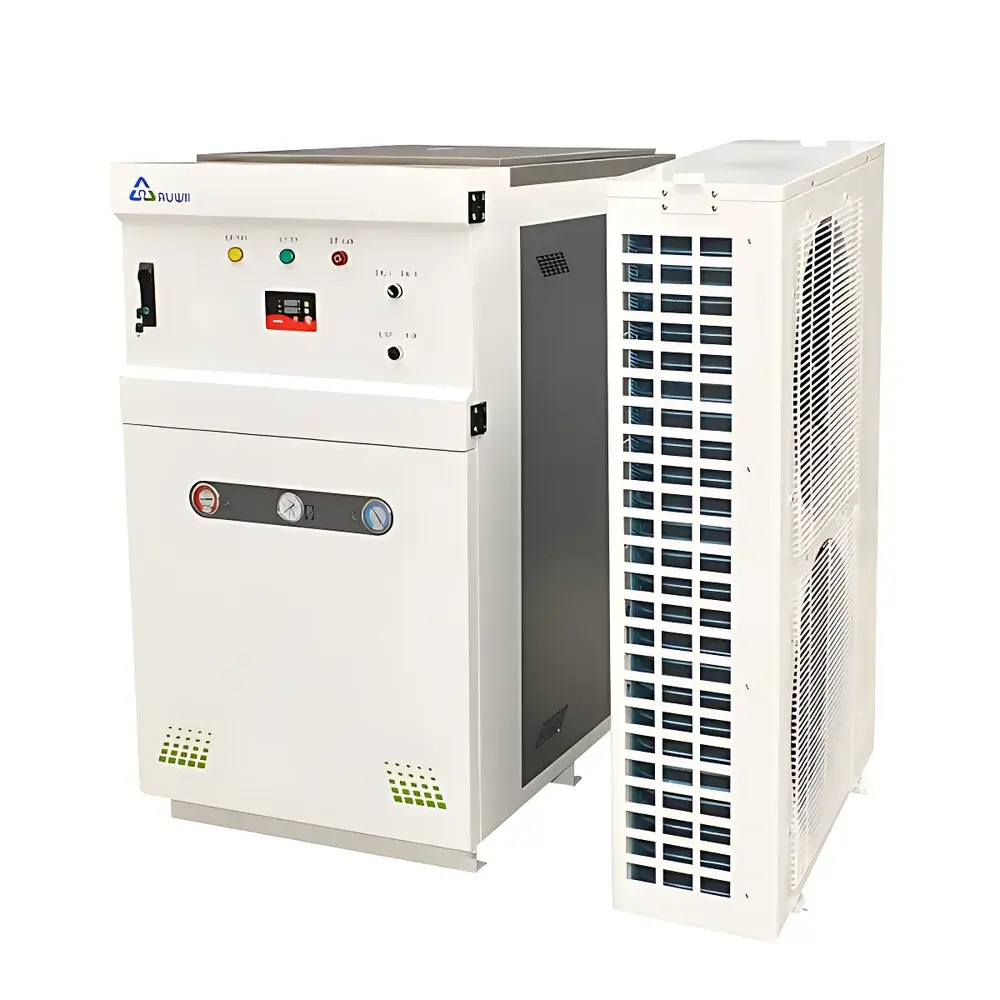
Tongzhou Weipu AR Series Air-Cooled Circulating Chiller
| Brand | Tongzhou Weipu |
|---|---|
| Origin | Beijing, China |
| Manufacturer Type | Direct Manufacturer |
| Instrument Type | Integrated Air-Cooled Circulating Chiller |
| Cooling Method | Air-Cooled |
| Temperature Control Range | 5–35 °C |
| Temperature Stability | ±1 °C |
| Refrigeration Capacity | 18–190 kW @25 °C |
| Circulating Pump Flow Rate | 1–32 m³/h |
| Circulating Pump Head | 19–55 m |
| Reservoir Volume | 150–900 L |
| Operating Principle | Compressor-Based Vapor-Compression Refrigeration |
Overview
The Tongzhou Weipu AR Series Air-Cooled Circulating Chiller is an engineered thermal management solution designed for stable, continuous cooling of laboratory and industrial equipment requiring precise temperature control. Built upon a vapor-compression refrigeration cycle, the system utilizes R410A or R134a refrigerant (model-dependent) and features hermetic scroll or semi-hermetic piston compressors—selected for reliability under sustained duty cycles. Unlike water-cooled chillers, the AR series eliminates dependency on municipal cooling towers or process water loops; instead, it dissipates heat directly to ambient air via high-efficiency finned-tube condensers with hydrophilic blue-coated aluminum fins. This air-cooled architecture enables installation in standard indoor environments without dedicated mechanical rooms or external water infrastructure—making it especially suitable for analytical instrumentation (e.g., ICP-MS, NMR precooling circuits), laser systems, plasma etchers, and high-power LED test benches where compact footprint and operational autonomy are critical.
Key Features
- Integrated single-unit design with front-accessible control panel, real-time LED display, and intuitive parameter navigation for setpoint adjustment, mode selection, and status monitoring.
- Dual control modes: “Setpoint Temperature Mode” for fixed-point operation and “Ambient Tracking Mode” for dynamic compensation against ambient fluctuations—enhancing energy efficiency in variable-load environments.
- Industrial-grade components including Schneider or Siemens contactors, Danfoss or Carel controllers, and Grundfos or Lowara circulation pumps—ensuring long-term stability and MTBF exceeding 25,000 hours.
- Comprehensive protection suite: high/low pressure cut-off, compressor overheat detection, phase loss & reverse-phase monitoring, flow sensor interlock, and reservoir low-level alarm—all with fault-code-based diagnostics displayed on the HMI.
- Optional configurations include dual-circuit redundancy, sequential start-up logic for multi-chiller arrays, particulate filtration (5–25 µm), and deionized water compatibility packages with EPDM or Viton-sealed wetted parts.
Sample Compatibility & Compliance
The AR chiller is compatible with a broad spectrum of heat-generating laboratory and production equipment—including spectrometers, mass spectrometry sources, X-ray diffraction (XRD) generators, vacuum pump jackets, and semiconductor wafer probers. Its stainless steel (SUS304) reservoir and PVC/PVDF-lined internal piping meet ISO 8573-1 Class 3 purity requirements for non-corrosive coolant loops. While not certified to UL 61010-1 or CE Machinery Directive out-of-the-box, the unit can be configured with CE-marked electrical cabinets and documented conformity assessment packages upon request. All models comply with GB/T 18430.1–2016 (Chinese national standard for liquid chillers) and support GLP/GMP-aligned operational logging when integrated with optional RS485 Modbus RTU or Ethernet/IP interfaces.
Software & Data Management
Standard firmware supports local data logging (temperature, pressure, runtime, alarms) with 30-day circular memory and export via USB flash drive. Optional Tongzhou Weipu T-Chill Connect software enables remote monitoring and configuration through a secure web interface (HTTPS/TLS 1.2), supporting up to 32 concurrent chiller nodes per server instance. Audit trails—including user login history, parameter changes, and alarm acknowledgments—are time-stamped and exportable in CSV format, satisfying basic FDA 21 CFR Part 11 requirements for electronic records when deployed with validated Windows Server environments. SNMP v3 integration is available for enterprise IT infrastructure synchronization.
Applications
- Laboratory instrumentation cooling: sustaining thermal equilibrium for FTIR detectors, HPLC column ovens, and electrophoresis power supplies operating at 5–35 °C.
- Materials testing: maintaining constant bath temperatures during tensile testers, rheometers, and environmental stress screening chambers.
- Electronics manufacturing: stabilizing solder paste reflow profiles and cooling pick-and-place machine vacuum nozzles.
- Research-scale bioreactors: providing auxiliary jacket cooling capacity for temperature-sensitive mammalian cell culture processes.
- Optical metrology: minimizing thermal drift in interferometric alignment systems and laser cavity mounts.
FAQ
What is the maximum allowable coolant conductivity for AR-series chillers?**
For standard configurations with carbon steel or copper components, coolant conductivity should remain below 100 µS/cm. For deionized water applications, optional stainless steel + EPDM fluid paths support conductivities down to 0.1 µS/cm.
Can the AR chiller operate continuously at 5 °C ambient temperature?**
Yes—the AR series includes low-ambient operation kits (compressor crankcase heaters, variable-speed condenser fans, and enhanced oil return circuits) enabling stable performance down to –10 °C outdoor ambient, verified per GB/T 10870–2014 testing protocols.
Is remote start/stop functionality supported?**
All AR models provide dry-contact (Form C) remote I/O terminals for external PLC integration, including run enable, alarm reset, and fault status outputs—fully compatible with common industrial control architectures.
What maintenance intervals are recommended?**
Compressor oil and filter driers should be replaced every 8,000 operating hours or 24 months (whichever occurs first); condenser fins require quarterly inspection and cleaning; reservoir coolant quality should be verified semiannually using ASTM D1121 pH and conductivity test methods.
Does the chiller support glycol-water mixtures?**
Yes—up to 30% propylene glycol by volume is supported with corresponding derating of refrigeration capacity (typically 3–5% per 10% glycol addition) and recalibration of flow sensor output per ISO 5167 standards.



