
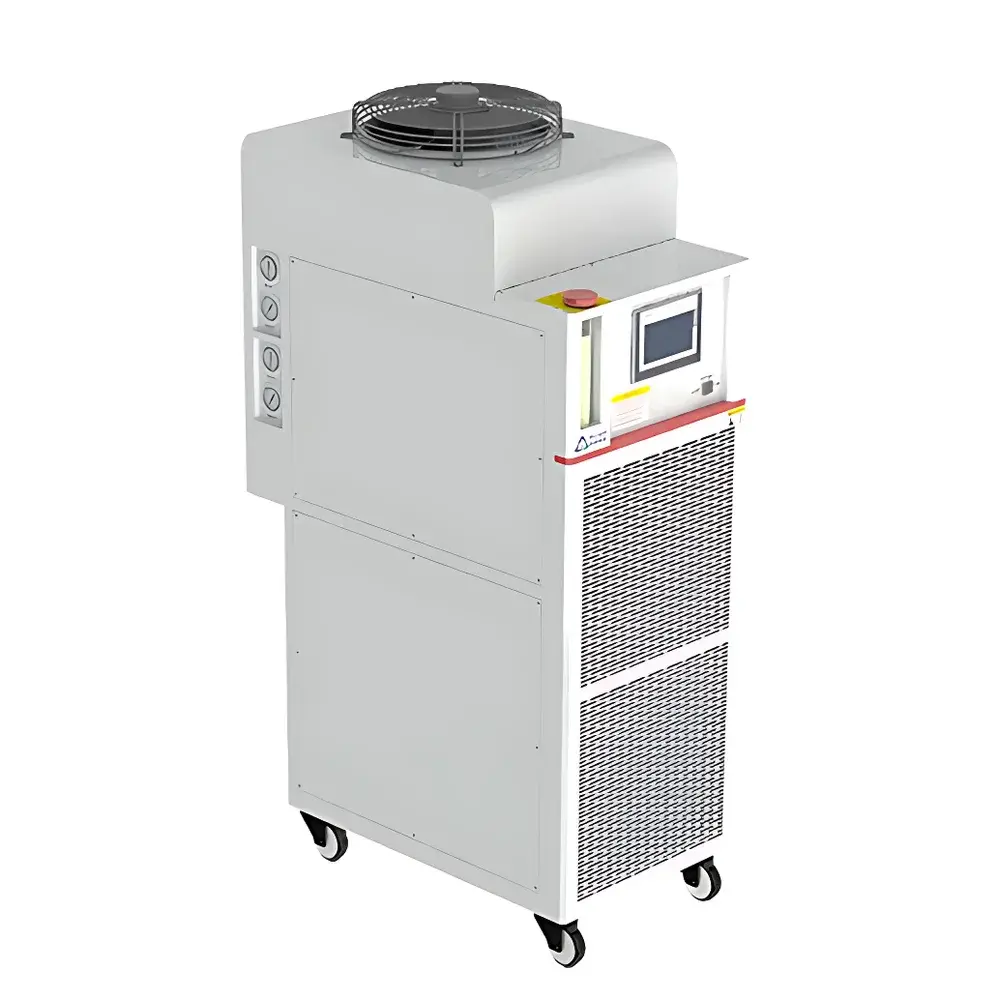
Tongzhou Weipu TL5000 Series Low-Temperature Circulating Chiller
| Brand | Tongzhou Weipu |
|---|---|
| Origin | Tianjin, China |
| Manufacturer Type | OEM Manufacturer |
| Country of Origin | China |
| Model | TL5000 |
| Temperature Range | −45 °C to +25 °C |
| Pump Flow Rate | 20–75 L/min (up to 3.0 bar) |
| Refrigeration Capacity | 0.3–15.0 kW @ −40 °C to +20 °C |
| Control Interface | 7″ TFT LCD Touchscreen with PLC-based Logic |
| Communication Protocols | Modbus TCP (Ethernet), RS485 Modbus, External PT100 Input |
| Programmable Steps | 100-step ramp/soak profiles |
| Cooling Method | Air-Cooled (F) or Water-Cooled (W) Configurations |
| Certifications | CE-compliant architecture |
| Dimensions (W×D×H) | 55×100×145 cm to 85×160×190 cm (model-dependent) |
Overview
The Tongzhou Weipu TL5000 Series Low-Temperature Circulating Chiller is an engineered thermal management system designed for precise, stable, and repeatable temperature control in demanding laboratory and pilot-scale industrial applications. Operating within a validated range of −45 °C to +25 °C, the TL5000 series employs a dual-stage vapor compression refrigeration cycle with optimized cascade architecture to achieve deep sub-zero performance without cryogenic fluids. Its core function is to circulate thermally stable heat-transfer fluid—such as synthetic silicone or polyalkylene glycol-based media—through external process loops (e.g., jacketed reactors, condensers, analytical instrument cooling jackets, or cryogenic test chambers). Unlike single-stage chillers, the TL5000’s multi-evaporator design maintains consistent refrigerant superheat and subcooling across wide ambient and load variations, minimizing thermal lag and improving dynamic response during rapid setpoint transitions.
Key Features
- 7-inch high-resolution TFT LCD touchscreen interface with intuitive navigation, real-time graphical trend display, and multilingual UI support (English, German, French, Spanish)
- PLC-integrated control architecture supporting up to 100 programmable ramp-and-soak steps with independent slope, dwell time, and alarm threshold assignment per segment
- Dual-mode temperature regulation: internal bath sensing (PT100 Class A) and external process feedback (user-supplied PT100 input with configurable offset compensation)
- Multi-dimensional PID algorithm with adaptive gain scheduling—automatically adjusts proportional band, integral time, and derivative action based on operating temperature zone and load inertia
- Modular cooling configuration: air-cooled (TL50xxF) and water-cooled (TL50xxW) variants; optional explosion-proof (ATEX Zone 2 / IECEx compliant) enclosures available upon request
- Robust fluid handling system featuring stainless-steel flexible hoses, pressure-rated quick-connect fittings (M30×1.5, M38×1.5, G1), and customizable insulation options—including aerogel-enhanced composite wraps for −100 °C service compatibility
- Comprehensive I/O interface: dry-contact alarm outputs (NO/NC), analog 4–20 mA output for remote monitoring, Ethernet-based Modbus TCP server, and isolated RS485 Modbus RTU port for SCADA integration
Sample Compatibility & Compliance
The TL5000 series is compatible with a broad spectrum of thermally sensitive processes requiring stable low-temperature operation, including but not limited to: protein precipitation in biopharmaceutical purification, cryo-milling of polymer composites, low-temperature NMR probe cooling, vacuum distillation condensation, and accelerated stability testing per ICH Q1A(R3). All units are constructed using FDA-compliant wetted materials (316L stainless steel, EPDM/FKM seals) and conform to electromagnetic compatibility standards EN 61326-1 and safety standard EN 61010-1. The control firmware supports audit trail logging and user-access-level permissions—enabling alignment with 21 CFR Part 11 requirements when deployed in regulated GxP environments. Optional validation documentation packages (DQ/IQ/OQ templates) are provided for IQ/OQ execution under GLP or GMP conditions.
Software & Data Management
Data integrity and traceability are ensured through embedded non-volatile memory that logs timestamped operational parameters—including bath temperature, outlet temperature, compressor run time, refrigerant pressure, and alarm history—at user-defined intervals (1 s to 60 min). Raw data exports via USB mass storage (CSV format) include column headers compliant with LIMS ingestion standards. For networked deployment, the built-in Modbus TCP server enables direct integration with LabVantage, STARLIMS, or custom MES platforms. Remote diagnostics and firmware updates are supported over secure TLS-enabled HTTP endpoints. All configuration changes generate immutable log entries with operator ID, timestamp, and parameter delta—satisfying ALCOA+ principles for electronic records.
Applications
- Biopharmaceutical cold chain validation: maintaining −40 °C to −20 °C during lyophilization cycle development and formulation stability studies
- Materials science: controlled crystallization of organic semiconductors, low-temperature tensile testing of elastomers, and cryogenic fatigue analysis of aerospace alloys
- Chemical synthesis: exothermic Grignard reaction quenching, low-T Diels–Alder kinetics profiling, and selective catalyst deactivation at sub-ambient temperatures
- Analytical instrumentation: continuous cooling of FTIR detectors, GC oven pre-chilling, and HPLC column ovens requiring extended low-T hold capability
- Environmental simulation: chamber conditioning for automotive component cold soak testing per ISO 16750-4 and SAE J2334
FAQ
What heat transfer fluids are recommended for use with the TL5000 series?
Synthetic fluids such as AUSI-05 (−80 °C to 220 °C), AUSI-10 (−60 °C to 250 °C), or AU-280 (−90 °C to 150 °C) are validated for compatibility. Fluid selection must consider flash point, pour point, thermal stability, and viscosity index relative to the target operating range.
Can the TL5000 be integrated into a central building management system (BMS)?
Yes—via Modbus TCP over Ethernet or RS485 Modbus RTU, enabling read/write access to setpoints, status registers, and alarm states for BACnet/IP or Niagara Framework interoperability.
Is external PT100 calibration traceable to NIST standards?
The unit accepts externally calibrated PT100 sensors; however, factory calibration certificates (traceable to CNAS-accredited labs) are supplied with each system. Field recalibration requires a certified reference thermometer and documented procedure per ISO/IEC 17025.
What maintenance intervals are recommended for long-term reliability?
Compressor oil analysis every 2,000 operating hours; refrigerant circuit leak check annually; heat exchanger cleaning (air/water side) semiannually; touchscreen firmware update verification quarterly.
Does the TL5000 support fail-safe shutdown during power interruption?
Yes—integrated UPS-ready logic retains last valid setpoint and initiates controlled cooldown ramp upon AC recovery; battery-backed RAM preserves program sequences and event logs for ≥72 hours.



