
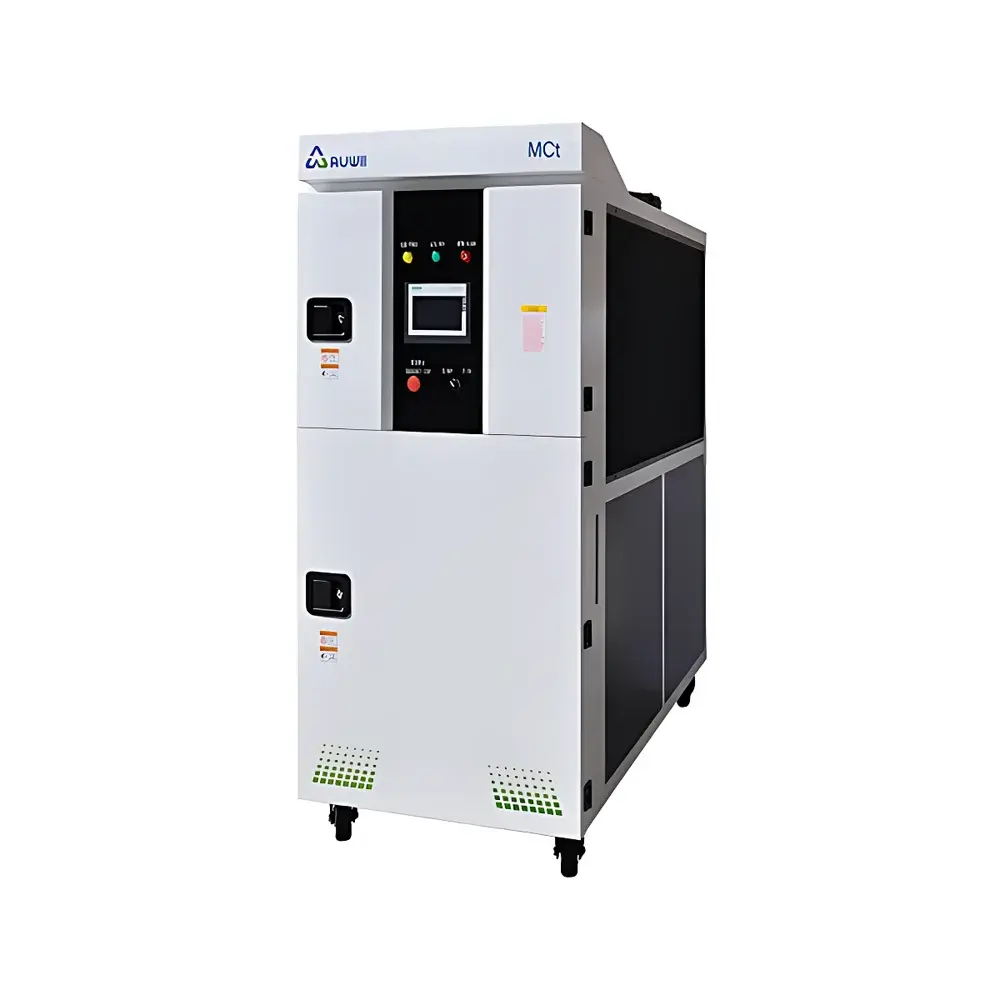
Tongzhou Weipu MCT Series Integrated Circulating Chiller for EV Motor & Powertrain Thermal Testing
| Brand | Tongzhou Weipu |
|---|---|
| Origin | Beijing, China |
| Manufacturer Type | Direct Manufacturer |
| Regional Classification | Domestic (China) |
| Model | MCT |
| Instrument Type | Integrated Circulating Chiller |
| Cooling Method | Water-Cooled |
| Temperature Control Range | −20 °C to 120 °C |
| Refrigeration Capacity | 22–45 kW |
| Temperature Stability | ±0.5 °C |
| Circulating Pump Pressure | 0–300 kPa |
| Circulating Pump Flow Rate | 2.0–20 L/min |
| Reservoir Volume | 100–150 L |
| Operating Mode | Continuous Duty |
Overview
The Tongzhou Weipu MCT Series is an integrated circulating chiller engineered specifically for thermal management in electric vehicle (EV) powertrain testing environments. Designed to meet the demanding requirements of motor, inverter, and battery pack validation—particularly during dynamic load cycling, endurance testing, and new product development—the system implements a dual-stage refrigeration architecture combined with phase-change thermal storage (cold-accumulation) technology. This enables rapid temperature ramping (up to 15 °C/min under specified conditions), stable thermal hold across wide operating windows, and precise decoupling of temperature and flow control loops. Unlike conventional chillers relying solely on compressor modulation, the MCT integrates insulated cold reservoirs that absorb transient thermal loads—reducing compressor cycling, improving energy efficiency, and extending component service life. Its structural design prioritizes laboratory integration: compact footprint, low-noise operation (<65 dB(A) at 1 m), and IP54-rated electrical enclosures compliant with IEC 60529 for controlled lab environments.
Key Features
- Wide operational temperature range: −20 °C to +120 °C, with optional extended-range variants supporting −40 °C to +120 °C using specialized refrigerant blends and low-temperature heat exchangers
- Three programmable flow configurations: 2–20 L/min, 4–40 L/min, and 4–60 L/min, each with volumetric flow control accuracy better than ±0.2 L/min (verified per ISO 5167)
- Intelligent return-fluid recovery system: automatic nitrogen-assisted purging and residual liquid reclamation from DUT cooling channels, minimizing fluid loss and cross-contamination risks
- Modular internal architecture: refrigeration, fluid conditioning, and control subsystems are physically isolated and independently serviceable—facilitating field upgrades such as additional sensor inputs or CAN FD protocol expansion
- Integrated leak containment sump: stainless-steel secondary containment tray with level-sensing alarm, meeting ISO 13849-1 Category 3 functional safety requirements for fluid-handling equipment
- Multi-protocol industrial communications: native support for RS-485 (Modbus RTU), CAN 2.0B (SAE J1939 compatible), and TCP/IP Ethernet (with configurable DHCP/Static IP and SNMP v3 monitoring)
Sample Compatibility & Compliance
The MCT Series is compatible with standard EV testbench interfaces—including SAE J1772-compliant coolant manifolds, DIN 2353 hydraulic couplings, and ISO 8503-2 surface-finish specifications for wetted components. All fluid-contact materials comply with USP Class VI biocompatibility standards and ASTM D1271 for glycol-based heat transfer fluids. The system meets CE marking requirements under the EU Machinery Directive 2006/42/EC and Electromagnetic Compatibility Directive 2014/30/EU. For regulated laboratories, firmware supports audit-trail logging (per FDA 21 CFR Part 11 Annex 11 principles), time-stamped parameter changes, and user-role-based access control (admin/operator/viewer). Calibration traceability follows ISO/IEC 17025 via NIM-certified reference instruments in China.
Software & Data Management
Equipped with embedded Linux-based controller running real-time OS (RTOS), the MCT provides local HMI via 7-inch capacitive touchscreen with multi-language UI (English, German, Chinese). Remote supervision is enabled through web-based SCADA interface (HTTPS/TLS 1.2 encrypted) supporting OPC UA server functionality. All process data—including temperature setpoint deviations, pump power consumption, refrigerant saturation pressures, and leak detection events—are timestamped and stored internally (16 GB eMMC) for ≥12 months at 1-second resolution. Export formats include CSV, PDF reports (with digital signature), and direct integration into LabVIEW, MATLAB, or Siemens Desigo CC via RESTful API endpoints. Firmware updates are performed via signed package verification to ensure integrity and prevent unauthorized modification.
Applications
- Dynamic thermal validation of permanent magnet synchronous motors (PMSM) and induction motors under ISO 19453-3 duty cycles
- Controller junction temperature mapping during high-frequency switching (e.g., SiC inverter testing per JEDEC JESD22-A108)
- Thermal shock and cycle fatigue testing of battery modules per UN ECE R100 and GB/T 31467.3
- Calorimetric efficiency measurement of power electronics stacks using differential flow calorimetry (ASTM D1171)
- Environmental stress screening (ESS) of traction inverters per MIL-STD-810H Method 502.7
- Support for Hardware-in-the-Loop (HIL) test benches requiring synchronized thermal actuation and CAN bus telemetry
FAQ
What is the maximum allowable coolant conductivity for continuous operation?
The system is rated for aqueous glycol solutions with conductivity ≤ 150 µS/cm at 25 °C. Higher values may trigger conductivity alarms and require filtration or fluid replacement.
Does the MCT support external PID cascade control from a master test controller?
Yes—via analog 0–10 V or 4–20 mA input terminals, enabling seamless integration into third-party test sequencers (e.g., dSPACE SCALEXIO or NI Veristand).
How is refrigerant charge integrity verified during preventive maintenance?
Built-in pressure transducers, subcooling sensors, and compressor current monitoring enable automated refrigerant charge diagnostics; results are logged and exportable per ASHRAE Guideline 3-2021.
Can the unit operate unattended for 72-hour endurance tests?
Yes—continuous-duty rating, redundant level sensors, dry-run protection, and remote alarm notification (email/SMS via optional gateway) ensure safe long-duration operation.
Is firmware validation documentation available for GxP-regulated labs?
IQ/OQ protocols, traceability matrices, and 21 CFR Part 11 compliance statements are provided upon request and validated against NIST-traceable metrology standards.



