
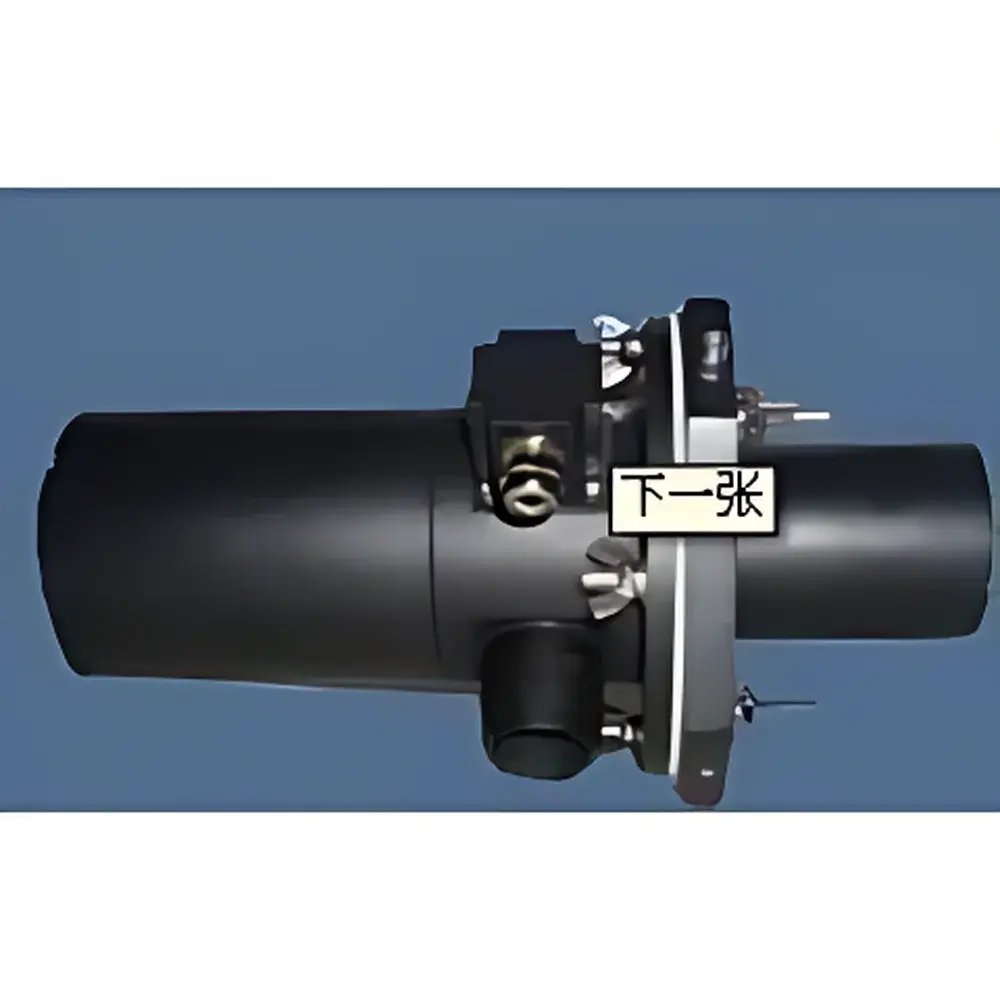
English Product Name
| Origin | Beijing, China |
|---|---|
| Manufacturer Type | Authorized Distributor |
| Domestic Production | Yes |
| Model | MODEL2030 |
| Price | USD 3,950 (FOB) |
| Measurement Principle | Laser Backscatter Photometry |
| Explosion-Proof Rating | Ex d IIB T4 Gb |
| Measurement Range | 0.01–5000 mg/m³ (standard) |
| Resolution | 0.01 mg/m³ |
| Accuracy | ±1% of reading |
| Relative Error | ±2% FS |
| Operating Temperature | −40 °C to +65 °C |
| Humidity Range | 0–100% RH (non-condensing) |
| Max. Flue Gas Temperature | 300 °C (custom high-temp probe available) |
| Output Signal | 4–20 mA (max. load 500 Ω) |
| Power Supply | DC 16–24 V ±10% |
| Power Consumption | ≤3 W (typical), ≤5 W (max.) |
| Dimensions | 160 × 250 mm (H × D) |
| Weight | 4 kg |
| Flue Diameter Compatibility | 1–15 m |
| Minimum Detectable Concentration | 2 mg/m³ |
| Installation | Single-ended, tool-free mounting |
Overview
The MODEL2030 Laser Backscatter In-Situ Dust Monitor is an industrial-grade particulate matter (PM) analyzer engineered for continuous, real-time measurement of suspended dust concentration in flue gas streams from coal-fired power plants, steel mills, cement kilns, and other high-temperature emission sources. It operates on the principle of laser backscatter photometry — a robust optical technique where a collimated near-infrared laser beam (typically 780–850 nm) is directed into the flue gas; scattered light intensity from suspended particles is detected at an angle close to 180° (i.e., backscatter geometry). This configuration eliminates sensitivity to refractive index gradients caused by thermal stratification or mechanical vibration — common challenges in large-diameter, high-velocity ducts. Unlike transmissometers or forward-scatter systems, the MODEL2030 requires no optical alignment, zero-path-length calibration drift compensation, or dual-sensor synchronization. Its single-ended, insertion-type design enables rapid deployment directly through a standard flange port, minimizing downtime during CEMS integration or retrofit projects.
Key Features
- In-situ measurement with no sample extraction, heating, or dilution — preserves true particle size distribution and avoids condensation artifacts.
- Explosion-proof housing rated Ex d IIB T4 Gb, certified for Zone 1 hazardous areas per IEC 60079-0/1/11 standards.
- Tool-free mechanical installation: all mounting hardware integrates into the probe body; field setup completed in ≤10 minutes using only one screwdriver.
- Low-power architecture (<3 W typical) supports solar-battery hybrid CEMS configurations and reduces thermal loading in insulated duct penetrations.
- Wide dynamic range: configurable linear span from 0.01–200 mg/m³ (low-range precision mode) to 0–10 g/m³ (high-concentration mode), validated per ISO 12103-1 A2 test dust calibration protocols.
- Environmental resilience: operational down to −40 °C ambient and up to 65 °C cabinet temperature; humidity tolerance up to 100% RH non-condensing.
- Standard 4–20 mA analog output compliant with IEC 61000-6-2/4 EMC immunity and NAMUR NE43 fault signaling.
Sample Compatibility & Compliance
The MODEL2030 is validated for use with flue gases containing fly ash, limestone slurry carryover, catalyst fines, and metal oxide particulates typical of FGD scrubber bypass, ESP outlet, and baghouse inlet applications. It meets EN 15267-3 (QAL1 certification readiness), aligns with EPA Method 9 and ASTM D6216 for opacity-correlated PM estimation, and supports compliance reporting under EU Directive 2010/75/EU (IED) and China’s GB 13223–2011. The probe’s stainless-steel wetted parts (316L) resist corrosion from SO₂, NOₓ, and chloride-laden exhausts. For installations exceeding 300 °C flue gas temperature, high-temperature variants with active air-purge cooling and sapphire window optics are available under custom engineering order (CEP). All units undergo factory verification against traceable NIST-traceable PSL (polystyrene latex) aerosol standards and are supplied with calibration certificates per ISO/IEC 17025 requirements.
Software & Data Management
While the MODEL2030 operates as a standalone analog transmitter, it integrates natively into distributed CEMS architectures via Modbus RTU (RS-485 optional) or HART 7.0 digital overlay. Its 4–20 mA output maps linearly to user-defined concentration ranges and includes diagnostic flags (e.g., lens contamination alert, signal saturation, power fault) encoded as NAMUR-compliant current limits (3.8 mA / 20.5 mA). When deployed in multi-point networks, up to 16 units can share a single data acquisition frontend using time-synchronized polling. Firmware supports remote parameter adjustment (span, zero, damping time) via HART communicator or web-enabled gateway — all changes logged with timestamp, operator ID, and pre/post values to satisfy FDA 21 CFR Part 11 and ISO/IEC 17025 audit trail requirements. No proprietary software is required for basic operation; configuration files adhere to OPC UA Information Model conventions for interoperability with Siemens Desigo, Honeywell Experion, and Yokogawa CENTUM VP.
Applications
- Continuous monitoring of electrostatic precipitator (ESP) and fabric filter (baghouse) performance in coal-fired power stations.
- Real-time feedback control of limestone injection rate in dry sorbent injection (DSI) desulfurization systems.
- Stack compliance verification for PM10/PM2.5 reporting under national emission standards (e.g., US EPA 40 CFR Part 60, Subpart Db; China’s “Ultra-Low Emission” policy).
- Process optimization in clinker cooler exhausts, raw mill vents, and secondary combustion chambers of waste-to-energy plants.
- Leak detection and filter integrity testing in pneumatic conveying lines and cyclone separator outlets.
FAQ
Does the MODEL2030 require periodic optical cleaning or manual alignment?
No. The probe features an integrated air-purge collar (optional compressed air or instrument air supply) that maintains lens clarity under heavy dust loading. Its backscatter geometry eliminates alignment sensitivity — no collimation adjustments are ever needed after initial installation.
Can it be installed in round ducts larger than 10 meters in diameter?
Yes. The standard probe supports duct diameters from 1 m to 15 m. For ultra-large stacks (>12 m), a custom-length probe with reinforced support arm and extended signal cable is available upon engineering review.
Is the 4–20 mA output intrinsically safe for use in Zone 0 areas?
The base unit is rated for Zone 1 (Ex d IIB T4 Gb). For Zone 0 deployment, an approved intrinsic safety barrier (e.g., Pepperl+Fuchs KFD2-STC4-EX1) must be installed in the signal loop — full system certification documentation is provided upon request.
How is calibration traceability maintained over time?
Each unit ships with a factory calibration certificate referencing NIST-traceable PSL aerosols. Field verification uses portable reference scatterometers (e.g., TSI AM510 with PM2.5 correction curve) per ISO 29463 Annex B guidelines. Annual recalibration is recommended and supported by accredited third-party labs.







