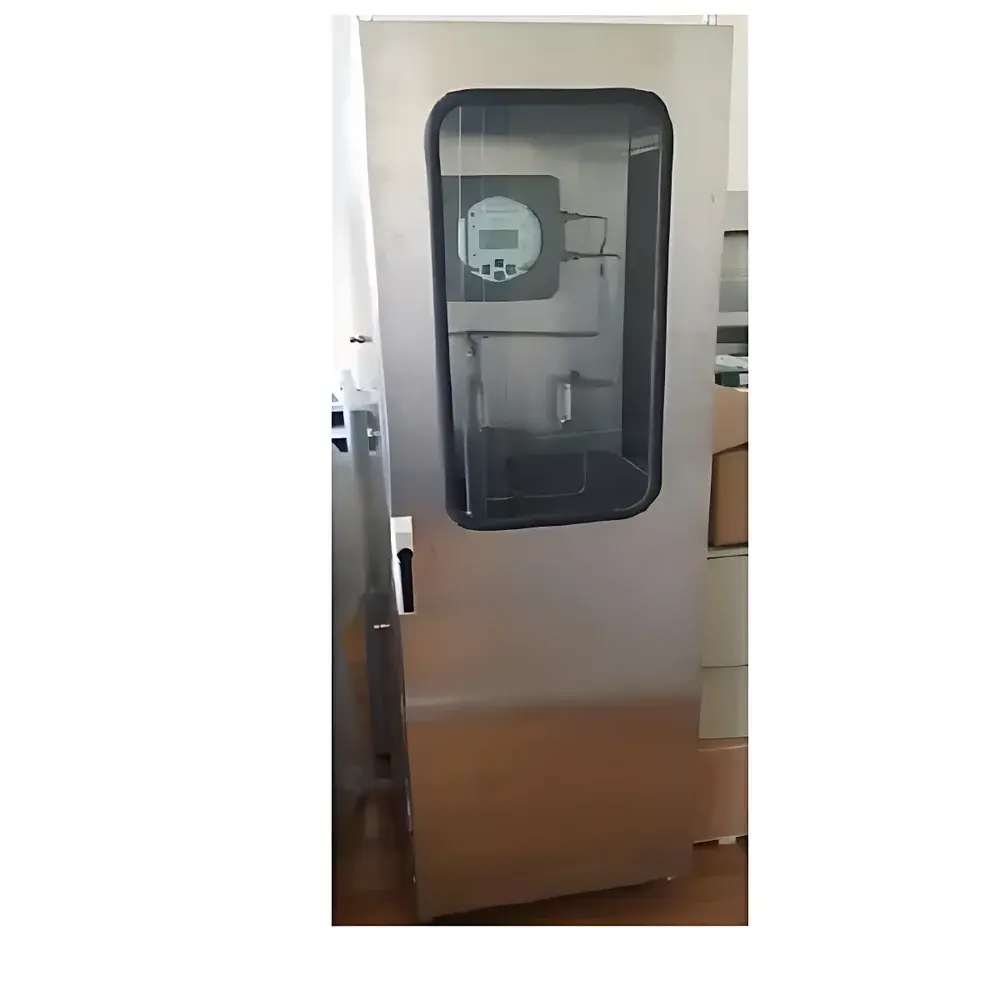
QXT-3000 Hydrogen Purity Monitoring System for Generator Cooling
| Key | Origin: Italy |
|---|---|
| Manufacturer Type | Authorized Distributor |
| Origin Category | Imported |
| Model | QXT-3000 |
| Pricing | Available Upon Request |
| Sensor Core | ADEV 8866TR Explosion-Proof Thermal Conductivity Analyzer |
| Measurement Principle | Dual-Chamber Thermal Conductivity Differential Detection |
| H₂-in-Air Range | 85–100% vol |
| H₂-in-CO₂ Range | 0–100% vol |
| CO₂-in-Air Range | 0–100% vol |
| Accuracy | ±1% FS |
| Repeatability | ≤0.3% FS |
| Linearity Error | ≤1% FS |
| Response Time (t₆₀) | H₂ <13 s, CO₂ <23 s |
| Response Time (t₉₀) | H₂ <24 s, CO₂ <45 s |
| Zero Drift | ≤1% FS/week |
| Sample Flow Rate | 100 mL/min – 2 L/min |
| Sample Inlet | 1/4" or 6 mm compression fitting |
| Analog Outputs | Four isolated 4–20 mA channels |
| Digital Interface | RS232 / RS485 |
| Power Supply | Sensor: 24–30 VDC |
| Transmitter | 115 VAC ±10% or 220 VAC ±20%, 50 ±0.5 Hz, 150 VA |
| Enclosure Rating | IP66 |
| Explosion Protection | ATEX 94/9/EC (EN 60079-0, -1), IECEx, CSA Class I, Div 1, Groups B, C, D, T6 |
| Hazardous Area Classification | Zone 1 / Zone 2 |
Overview
The QXT-3000 Hydrogen Purity Monitoring System is a certified industrial-grade analyzer engineered for continuous, real-time monitoring of hydrogen purity in turbine generator cooling circuits. It integrates the ADEV 8866TR explosion-proof thermal conductivity sensor — a dual-chamber, reference-compensated design that exploits the significantly higher thermal conductivity of hydrogen (≈7 times that of air and ≈16 times that of CO₂) to deliver high-reproducibility measurements under dynamic process conditions. Unlike optical or electrochemical methods, thermal conductivity detection offers inherent stability in inert gas matrices, zero consumables, and immunity to catalyst poisoning — critical advantages in sealed hydrogen-cooled generators where gas composition shifts must be detected with minimal lag and maximum reliability. The system supports three independent measurement configurations: H₂-in-air (85–100%), H₂-in-CO₂ (0–100%), and CO₂-in-air (0–100%), enabling seamless transition between purging, commissioning, and steady-state operation phases.
Key Features
- ATEX-certified EEx d II C T6 explosion-proof enclosure rated for Zone 1 and Zone 2 hazardous areas, compliant with EN 60079-1 and IEC 60079-0 standards
- Dual-chamber thermal conductivity detector with active reference compensation, minimizing drift from ambient temperature fluctuations and pressure transients
- Fast response kinetics: t₉₀ ≤ 24 s for H₂ and ≤ 45 s for CO₂ — optimized for rapid detection of air ingress or CO₂ leakage during generator purge cycles
- Four independently configurable 4–20 mA analog outputs, each assignable to a specific gas channel or diagnostic parameter (e.g., flow status, sensor health)
- RS232/RS485 serial interface supporting Modbus RTU protocol for integration into DCS, SCADA, or PLC-based control architectures
- Wide sample flow tolerance (100 mL/min to 2 L/min) with integrated flow regulation and visual flow indication, compatible with standard 1/4″ Swagelok® or 6 mm compression fittings
- Zero drift ≤1% FS per week — validated under continuous operation at 25°C ambient and 1 bar(g) sample pressure, meeting long-term stability requirements for unattended monitoring
Sample Compatibility & Compliance
The QXT-3000 is specifically validated for use with dry, non-corrosive, particle-free hydrogen, carbon dioxide, and air mixtures typical of generator seal oil systems and closed-loop cooling circuits. It excludes applications involving condensable vapors, reactive gases (e.g., Cl₂, NH₃), or particulate-laden streams without upstream filtration (≥1 µm absolute). The analyzer conforms to ISO 8573-1:2010 Class 4 for compressed gas cleanliness and meets the mechanical integrity requirements of IEEE Std 1132–2002 (Guide for Hydrogen Gas Monitoring in Turbine Generators). Its ATEX 94/9/EC and CSA certifications ensure compliance with EU Machinery Directive 2006/42/EC and North American hazardous location regulations (NFPA 70, Article 500). Documentation includes full traceable calibration certificates aligned with ISO/IEC 17025-accredited practices.
Software & Data Management
While the QXT-3000 operates as a standalone hardware analyzer, its digital interface enables seamless data acquisition via third-party historian platforms (e.g., OSIsoft PI, Emerson DeltaV, Siemens Desigo CC). The RS485 port supports multi-drop configuration (up to 32 units per bus) with configurable baud rates (9.6–115.2 kbps) and parity settings. All analog outputs include HART-compatible digital superimposition for remote configuration and diagnostics. Audit trails for calibration events, range changes, and alarm acknowledgments are retained locally for ≥30 days and can be exported via serial dump. The system supports GLP/GMP-aligned operation when deployed with external validation protocols — including electronic signature capability and 21 CFR Part 11-compliant data logging when interfaced with validated software suites.
Applications
- Real-time hydrogen purity verification in hydrogen-cooled synchronous generators (IEEE C50.13-2020)
- CO₂ blanket monitoring during generator maintenance and nitrogen/hydrogen exchange procedures
- Air ingress detection during seal oil system failure or flange leakage events
- Automated interlock signaling for hydrogen replenishment valves and purge vent controls
- Compliance reporting for NERC PRC-005-6 (Generator Protection Reliability) and ISO 50001 energy management audits
- Integration into predictive maintenance programs via trend analysis of zero-point stability and response decay over time
FAQ
What calibration gases are required for field verification?
Certified binary mixtures traceable to NIST or PTB standards: 90.0% H₂/10.0% N₂ (for H₂-in-air span), 50.0% H₂/50.0% CO₂ (for H₂-in-CO₂ linearity), and 5.0% CO₂/95.0% N₂ (for CO₂-in-air zero/span).
Can the QXT-3000 operate with wet sample gas?
No — moisture condensation will impair thermal conductivity measurement accuracy and accelerate sensor degradation. Sample gas must be dried to ≤−20°C dew point prior to inlet using a coalescing filter and refrigerated dryer.
Is remote firmware update supported?
Firmware updates require physical access and connection via RS232 using ADEV’s proprietary configuration utility; no over-the-air or web-based update capability is provided.
How is sensor contamination diagnosed?
Gradual increase in zero drift (>1.5% FS/week), asymmetric response times between H₂ and CO₂ channels, or deviation >±2% FS from calibrated reference values under stable flow/temperature conditions indicate potential contamination.
Does the system support SIL2 functional safety certification?
The QXT-3000 itself is not SIL2-certified; however, it may be incorporated into a SIL2 loop when combined with certified logic solvers and redundant architecture per IEC 61511, subject to full LOPA and SIS design review.
Related Products