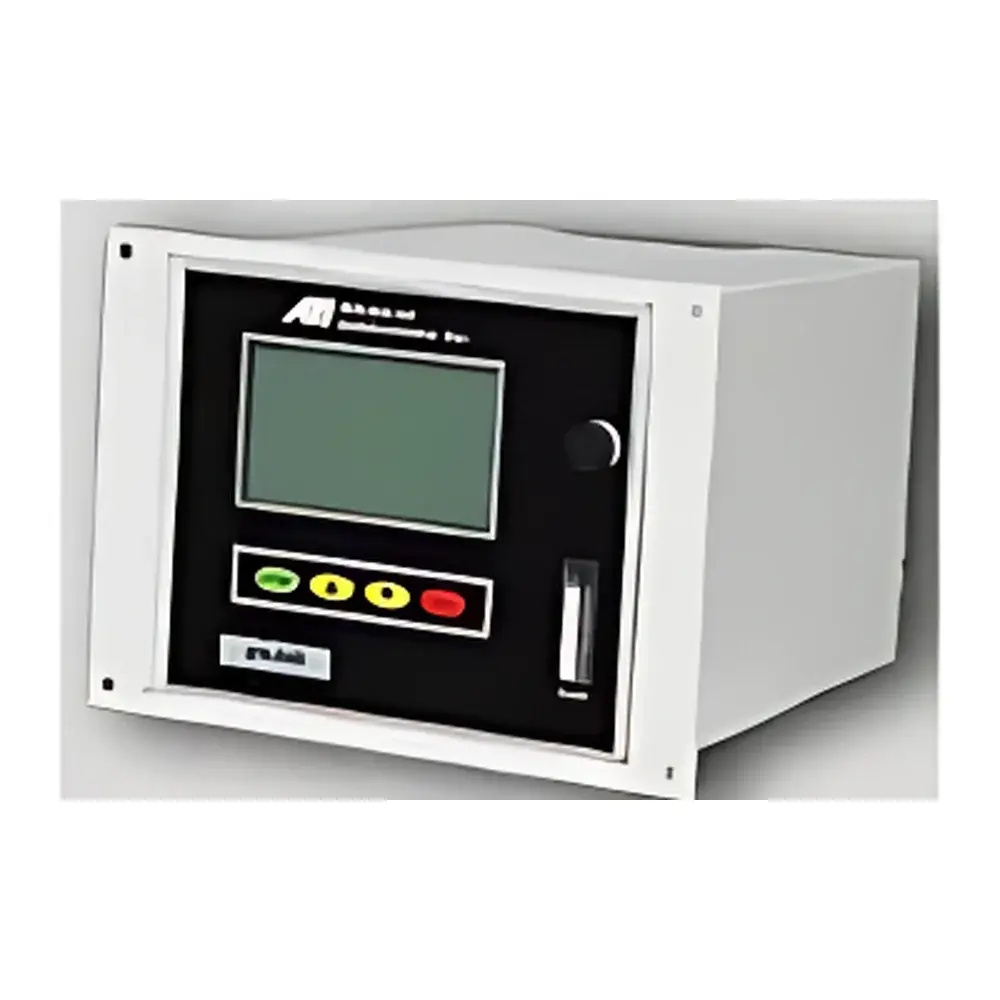
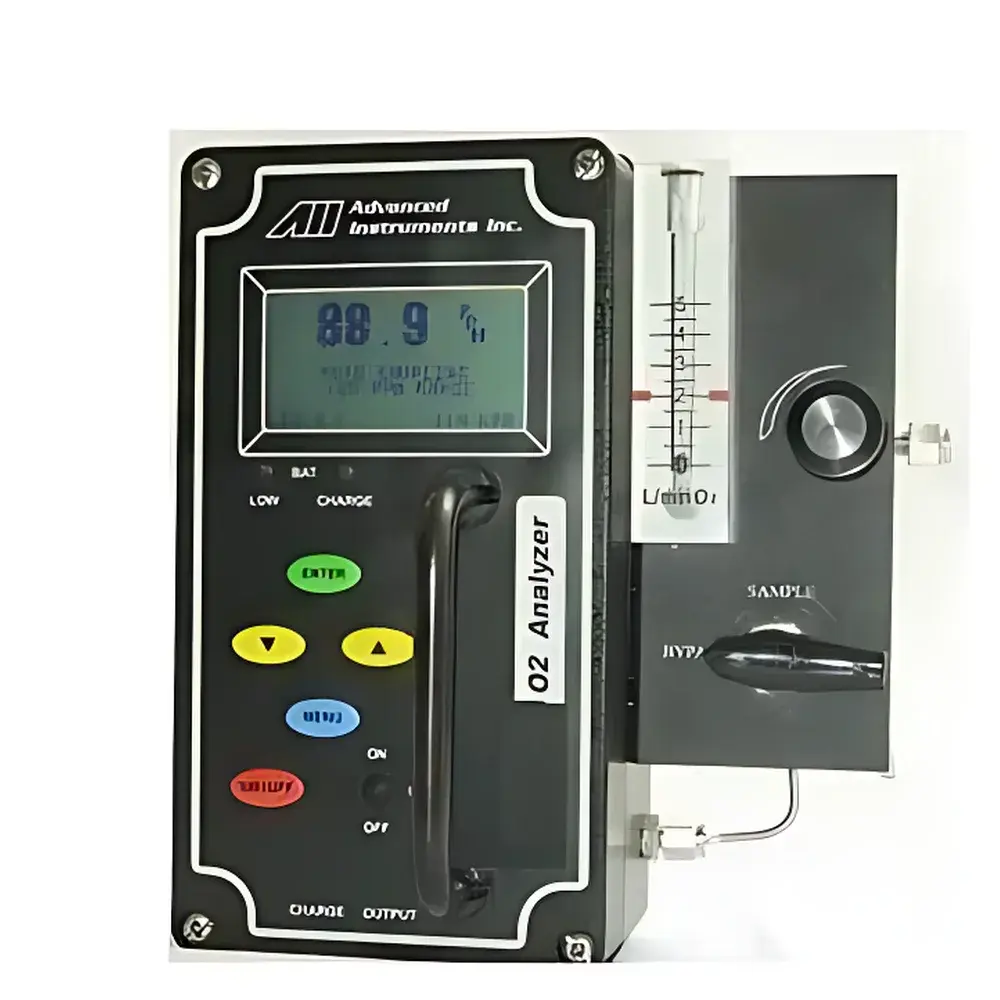
AII GPR-3100 Online Oxygen Analyzer
| Brand | AII |
|---|---|
| Origin | USA |
| Model | GPR-3100 |
| Measurement Principle | Electrochemical Fuel Cell |
| Full Scale Range | 0–100% O₂ |
| Selectable Sub-Ranges | 50–100%, 80–100%, 90–100% O₂ |
| Accuracy | < ±1% FS |
| Linearity | > 0.995 |
| Response Time (T₉₀) | 13 s |
| Sensitivity | 0.1% RD |
| Operating Temperature | 5–45 °C |
| Inlet Pressure | 5–30 psig |
| Outlet Pressure | Ambient |
| Sample Flow Rate | 1–3 SCFH (recommended: 2 SCFH) |
| Temperature & Barometric Pressure Compensation | Yes |
| Output Signals | 0–1 V analog, isolated 4–20 mA |
| Display Resolution | 0.01% O₂ |
| Enclosure Type | Aluminum panel-mount housing |
| Certifications | CE, ISO 9001 |
| Compliance | Designed for general-purpose industrial use per IEC 61000-6-2/6-4 and EN 61326-1 |
Overview
The AII GPR-3100 Online Oxygen Analyzer is an industrial-grade electrochemical analyzer engineered for continuous, real-time monitoring of oxygen concentration in inert, reducing, and mixed gas streams—including helium, hydrogen, nitrogen, argon, and synthetic process gases. Utilizing a proprietary, long-life fuel cell sensor (GPR-11-120-OP), the instrument operates on the principle of galvanic oxygen reduction, generating a current proportional to partial pressure of O₂ without requiring external bias voltage or consumable electrolytes. Its robust architecture supports unattended operation in ambient-controlled plant environments, delivering high reproducibility and drift stability over extended deployment cycles. Unlike paramagnetic or zirconia-based analyzers, the GPR-3100 avoids thermal drift, magnetic interference, or ceramic aging—making it especially suited for applications where maintenance access is limited and calibration frequency must be minimized.
Key Features
- Self-contained electrochemical fuel cell sensor with 24-month nominal service life and zero routine maintenance requirements
- Four programmable measurement ranges (0–100%, 50–100%, 80–100%, 90–100% O₂) selectable via intuitive front-panel menu navigation
- Integrated temperature and barometric pressure compensation algorithms to correct for environmental fluctuations and ensure consistent %O₂ accuracy across varying site altitudes and seasonal conditions
- Dual adjustable relay outputs for configurable high/low O₂ alarms, plus dedicated diagnostics for low sensor signal, power failure, and internal system fault detection
- Front-panel waterproof membrane keypad with LCD display showing real-time O₂ reading (0.01% resolution), ambient temperature, and local atmospheric pressure
- Isolated 4–20 mA analog output and RS-232 serial interface for integration into DCS, PLC, or SCADA systems—supporting Modbus RTU protocol upon firmware configuration
- Modular sampling interface: 1/8″ Swagelok inlet and 1/4″ Swagelok outlet; optional heated sample line and sensor guard available for dew-point-sensitive or condensable gas streams
Sample Compatibility & Compliance
The GPR-3100 is validated for use with non-corrosive, non-condensing gas matrices including high-purity inert gases (N₂, Ar, He), hydrogen-rich reformate streams, and binary or ternary mixtures where oxygen is a trace or major constituent. It is not suitable for oxidizing halogenated gases, chlorine, or high-humidity samples (>80% RH) without upstream drying. The analyzer complies with CE marking directives (EMC Directive 2014/30/EU, Low Voltage Directive 2014/35/EU) and is manufactured under an ISO 9001-certified quality management system. While not intrinsically safe or explosion-proof, its panel-mount aluminum enclosure meets NEMA 1 specifications and may be installed within Class 1, Division 2 hazardous locations when deployed behind approved barrier systems per NEC Article 500.
Software & Data Management
Local configuration and diagnostics are managed entirely through the embedded menu-driven interface—no PC software required for basic operation. For advanced data logging and remote supervision, the RS-232 port enables ASCII command-based interrogation of live readings, alarm status, sensor health metrics, and calibration history. When interfaced with third-party historian systems (e.g., Ignition SCADA, Siemens Desigo CC), the GPR-3100 supports timestamped data export at user-defined intervals (1–60 second resolution). Audit trails—including date/time-stamped calibration events and parameter changes—are retained in non-volatile memory and accessible via serial query, satisfying foundational GLP/GMP documentation expectations for process validation records.
Applications
- Control of blanketing atmospheres in heat-treating furnaces, annealing lines, and metal powder sintering systems
- Monitoring O₂ ingress in nitrogen-purged transformer oil storage tanks and high-voltage switchgear enclosures
- Verification of inertization efficacy during pharmaceutical lyophilizer chamber evacuation and backfill cycles
- Continuous verification of oxygen depletion in modified atmosphere packaging (MAP) gas mixing panels
- Leak detection support in vacuum gloveboxes and semiconductor process tool purge loops
- Quality assurance in cryogenic air separation unit (ASU) product stream analysis (e.g., liquid nitrogen or argon off-gas)
FAQ
What calibration gas is recommended for routine span verification?
A certified 80% O₂ in N₂ standard gas (±1% uncertainty) is recommended for span calibration; zero calibration is performed automatically using ambient air or certified zero gas (e.g., 99.999% N₂).
Can the GPR-3100 operate in elevated ambient temperatures above 45°C?
No—the specified operating range is strictly 5–45°C. Prolonged exposure beyond 45°C accelerates sensor electrolyte evaporation and degrades long-term baseline stability.
Is pressure compensation automatic or manually configured?
Barometric pressure compensation is fully automatic via an integrated absolute pressure transducer; inlet pressure compensation requires manual entry of static line pressure during setup.
Does the instrument support FDA 21 CFR Part 11 compliance?
While the GPR-3100 does not include electronic signature or role-based access control natively, its audit-trail-capable serial interface allows integration with validated Part 11-compliant data acquisition platforms.
What is the expected sensor lifetime under typical industrial conditions?
The GPR-11-120-OP sensor has a rated functional life of 24 months from date of manufacture when operated continuously within specification—no recalibration or refurbishment is required during this period.