
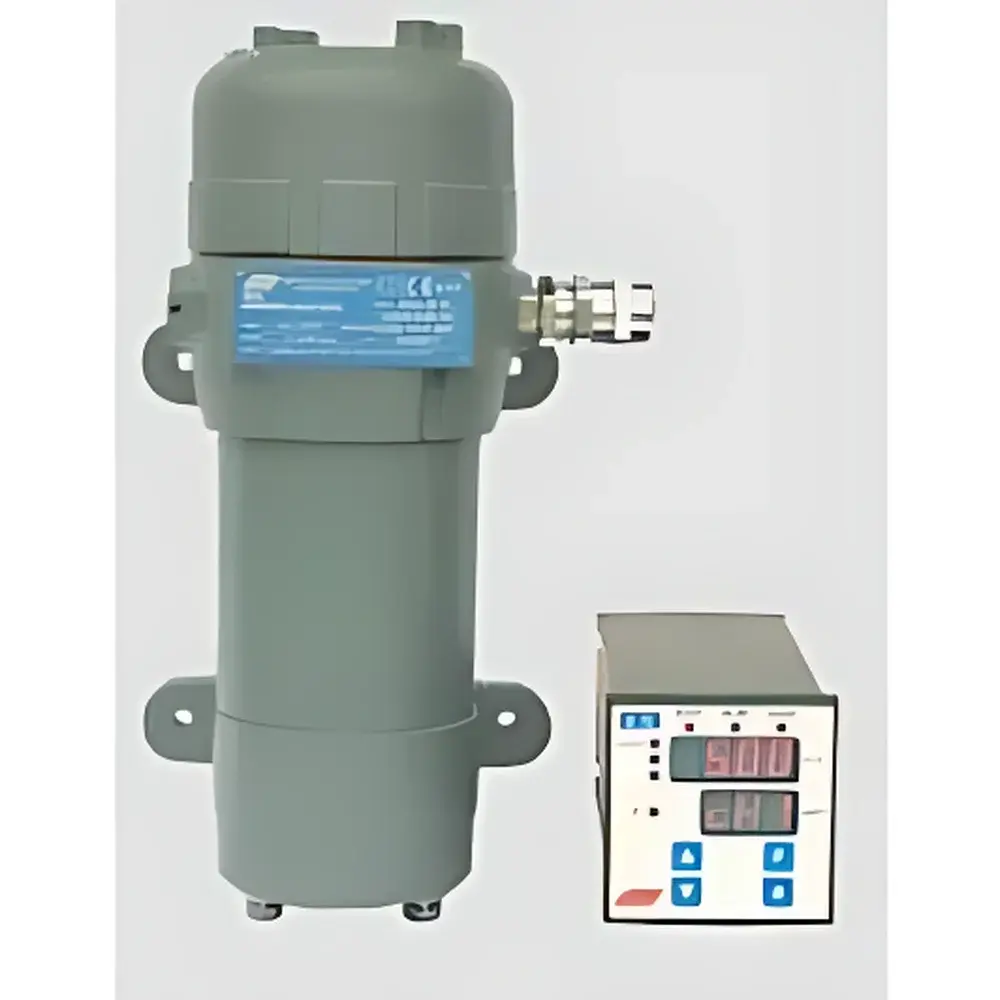
ADEV 8866 Thermal Conductivity Argon Purity Analyzer
| Origin | Italy |
|---|---|
| Manufacturer Type | Authorized Distributor |
| Origin Category | Imported |
| Model | 8866 |
| Price | USD 12,200 (FOB) |
Overview
The ADEV 8866 Thermal Conductivity Argon Purity Analyzer is a high-stability, intrinsically robust online gas analyzer engineered for continuous, real-time measurement of argon concentration in industrial process streams—particularly where ultra-high purity monitoring is critical to operational safety and product integrity. Based on the fundamental principle of thermal conductivity differential detection, the instrument compares the thermal dissipation characteristics of the sample gas against a known reference (typically high-purity nitrogen or air), enabling precise quantification of argon content across multi-component gas matrices. Its design adheres to the physical limitations and calibration stability requirements inherent to thermal conductivity (TC) sensing—making it especially suitable for binary or quasi-binary mixtures where argon is the major constituent (e.g., Ar/N₂, Ar/CO₂, Ar/He) and where interference from condensables, corrosives, or reactive species is negligible. Unlike optical or electrochemical methods, TC-based analysis requires no consumables, exhibits long-term baseline stability, and delivers deterministic output under steady-state flow conditions—key advantages for air separation units (ASUs), semiconductor inerting loops, and superconducting magnet cooling systems.
Key Features
- Intrinsically safe, explosion-proof construction certified to ATEX Directive 94/9/EC (Category 2G, Zone 1, II C T6) and CSA C/US Class I, Division 1, Groups B, C, D
- IP66-rated enclosure for outdoor and harsh industrial environments including steel mills, chemical plants, and nuclear auxiliary systems
- Multi-range programmable measurement capability: configurable spans from 0–1% up to 98–100% Ar, with dedicated factory-calibrated modes for Ar-in-N₂, Ar-in-CO₂, and Ar-in-He applications
- Response time optimized for process control: t₆₀ < 13 s for H₂; t₉₀ < 24 s for Ar in N₂ background; full-scale stabilization within 40 s (99% response)
- High metrological fidelity: ±1% FS accuracy, ≤0.3% FS repeatability, and linearity error ≤1% FS over full operating temperature range (0–50°C ambient)
- Dual power architecture: sensor module operates on 24–30 VDC; main electronics support universal AC input (115 VAC ±10% or 220 VAC ±20%, 50 Hz ±0.5 Hz, 150 VA)
- Flexible connectivity: four isolated 4–20 mA analog outputs (HART-compatible), plus RS232/RS485 serial interface for Modbus RTU integration into DCS/SCADA platforms
Sample Compatibility & Compliance
The ADEV 8866 is validated for use with dry, non-corrosive, non-condensing gas streams containing argon as the analyte of interest. It is routinely deployed in air separation facilities for final-product argon purity verification (≥99.998% Ar), in semiconductor fab tool purging lines, and in MRI magnet cryogenic systems where helium–argon blends require compositional verification prior to injection. The analyzer complies with IEC 60079-0 (Explosive Atmospheres – General Requirements), IEC 60079-1 (Flameproof Enclosure “d”), and EN 61326-1 (EMC for Industrial Environments). Its zero-point drift specification (≤1% FS per week) meets GLP-aligned maintenance intervals for unattended operation in ISO 17025-accredited laboratories and GMP-compliant gas production facilities. Calibration traceability follows NIST-traceable standards per ISO/IEC 17025:2017 clause 6.6.
Software & Data Management
While the 8866 operates as a standalone field instrument with local LCD display and push-button configuration, its RS485 interface enables seamless integration with third-party data historians and asset management systems. Configuration parameters—including span selection, damping factor, alarm thresholds, and analog output mapping—are stored in non-volatile memory and retain settings during power cycling. The device supports audit-trail-capable parameter logging when connected to a host system compliant with FDA 21 CFR Part 11 requirements (electronic signatures, change history, and user access controls implemented at the supervisory layer). No proprietary software is required for basic commissioning; however, ADEV provides optional Windows-based PC utility (8866 ConfigTool v3.2) for advanced diagnostics, zero/span validation reports, and firmware updates.
Applications
- Air separation plant (ASP) argon column overhead purity monitoring and final product certification
- Semiconductor manufacturing: inert purge gas verification for ALD/CVD chamber backfilling and wafer handling environments
- Nuclear power generation: argon blanket purity assurance in spent fuel pool cover gas systems
- Superconducting magnet cooling circuits: Ar/He mixture composition control for thermal stability optimization
- Specialty gas blending stations: QC verification of certified argon standards (e.g., ISO 8573-1 Class 1 compressed air replacement gases)
- Hydrogen production facilities: co-monitoring of argon impurities in PEM electrolyzer off-gas streams
FAQ
What gas interferences affect argon measurement accuracy on the 8866?
Thermal conductivity analyzers are sensitive to all permanent gases present in the sample stream. Accuracy assumes stable background composition. Significant deviations in N₂, CO₂, O₂, or He concentrations outside the calibrated matrix will introduce cross-sensitivity errors. For mixed-background applications, multi-point matrix calibration is recommended.
Can the 8866 measure argon in humid or particulate-laden streams?
No. Sample gas must be filtered to ≤0.1 µm and dried to a dew point ≤ −20°C to prevent thermal mass loading on the sensor element and condensation-induced drift.
Is field calibration possible without external gas standards?
Zero calibration may be performed using certified zero-grade nitrogen (99.999% N₂); span calibration requires certified argon-in-nitrogen standard gas at the target measurement range (e.g., 99.5% Ar / 0.5% N₂).
Does the analyzer support SIL2 functional safety certification?
The base 8866 unit is not SIL-certified; however, it may be integrated into SIL2 loops when paired with certified safety relays and configured per IEC 61511 guidelines for low-demand mode operation.
What maintenance schedule is recommended for continuous operation?
Sensor element inspection every 12 months; filter replacement every 6 months in typical industrial environments; annual full calibration verification using traceable standards.







