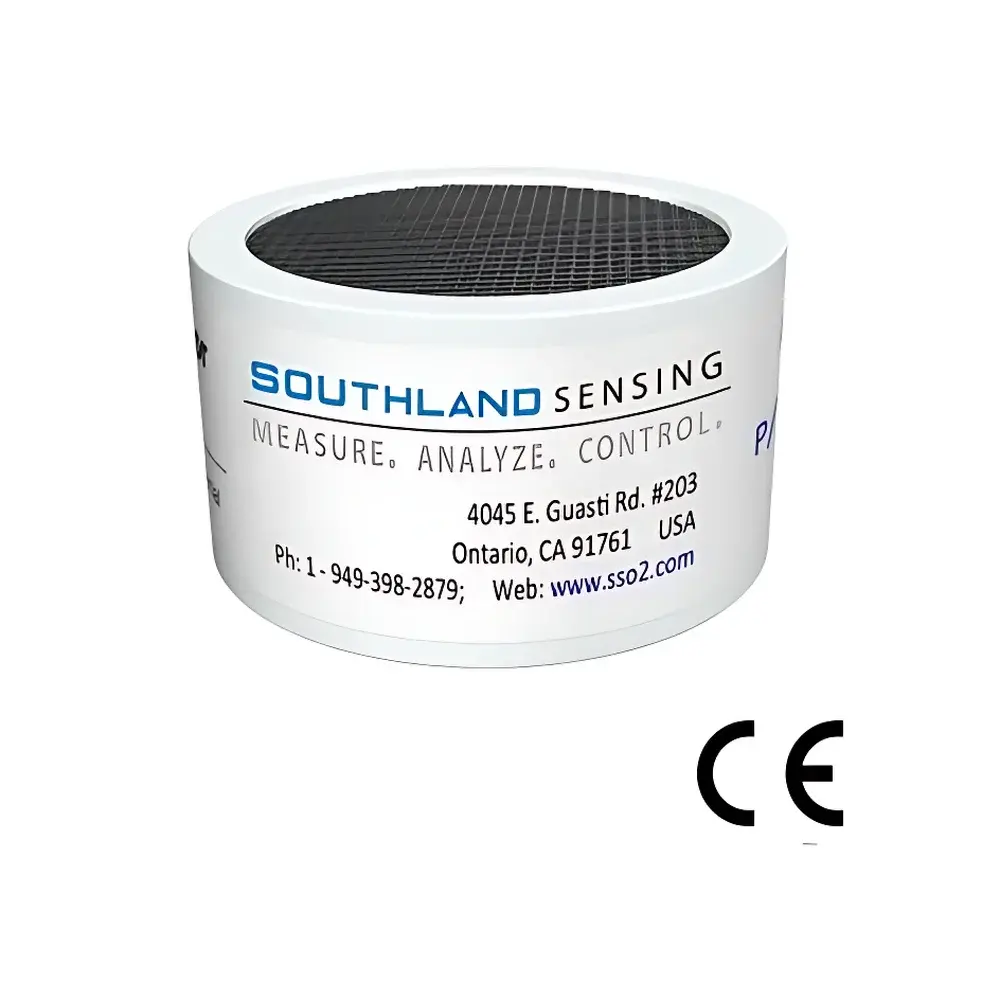
Southland Sensing TO2-1L PPM-Level Electrochemical Oxygen Sensor
| Origin | USA |
|---|---|
| Manufacturer Type | Authorized Distributor |
| Origin Category | Imported |
| Model | TO2-1L |
| Price Range | USD 1–9,999 |
Overview
The Southland Sensing TO2-1L is a high-stability, electrochemical fuel-cell-based oxygen sensor engineered for trace-level and percent-range oxygen measurement in industrial process gas streams. Unlike paramagnetic or zirconia-based analyzers, the TO2-1L employs a solid polymer electrolyte (SPE) fuel cell architecture that generates a linear current output (285–590 µA) proportional to oxygen partial pressure—enabling direct, drift-free quantification across six decades of concentration: from 0.01 ppm to 25% O₂. Its operation relies on the electrochemical reduction of O₂ at the cathode, with electrons flowing through an external circuit and protons migrating via the membrane—eliminating the need for external power, calibration gases, or consumable electrolytes. Designed for continuous online monitoring in demanding environments—including inert gas purification loops, semiconductor purge lines, hydrogen generation systems, and high-purity nitrogen production—the TO2-1L delivers long-term baseline stability and intrinsic safety in non-explosive atmospheres.
Key Features
- Fuel-cell sensing principle with zero-power operation and no internal battery or heater required
- Multi-range auto-switching capability: 0–1 ppm, 0–10 ppm, 0–100 ppm, 0–1000 ppm, 0–1%, and 0–25% O₂—configured via external signal conditioning or host controller logic
- T90 response time ≤13 seconds across all ranges, validated per ISO 14644-3 cleanroom instrumentation protocols
- Full-scale accuracy ±1% F.S. and repeatability ±0.5% F.S., traceable to NIST-traceable calibration standards
- Temperature coefficient compensated at 2.54%/°C (typical), with integrated thermal reference for analog output correction
- Two programmable SPDT alarm relays (dry contact, 250 VAC/5 A) supporting fail-safe shutdown or vent activation
- Large backlit LCD display with real-time concentration, unit toggle (ppm/%), status icons, and relay activation indicators
- PCB-mountable design with center-foil cathode (negative) and outer-foil anode (positive); compatible with standard 0.1″ pitch headers
Sample Compatibility & Compliance
The TO2-1L is validated for use in dry or humidified process streams containing N₂, Ar, He, H₂, CH₄, CO₂, and other non-corrosive, non-reactive carrier gases. It is not suitable for use in oxidizing halogenated compounds, SO₂, Cl₂, or condensing vapors. The sensor operates within 0–50°C ambient temperature and 0–100% RH (non-condensing) conditions; storage temperature range is 0–45°C. It complies with IEC 61000-6-2 (EMC immunity) and IEC 61000-6-4 (EMC emissions) standards. While not intrinsically safe certified, it meets UL 61010-1 requirements for laboratory and industrial measurement equipment. For GMP/GLP-regulated environments, the sensor supports audit-ready documentation packages including calibration certificates, material declarations (RoHS/REACH), and manufacturing lot traceability.
Software & Data Management
The TO2-1L outputs a raw microampere current signal compatible with standard 4–20 mA transmitters, PLC analog inputs, or dedicated signal conditioners (e.g., Southland’s SC-100 series). When integrated into a full analyzer system, it supports Modbus RTU over RS-485 for remote configuration and diagnostics. Data logging, alarm history, and calibration event tracking are managed via host SCADA or DCS platforms compliant with ISA-88 and ISA-95 frameworks. For regulated industries, optional firmware enables 21 CFR Part 11-compliant electronic signatures, user access levels, and immutable audit trails when deployed with validated software stacks.
Applications
- On-line purity verification in nitrogen and argon generators (ISO 8573-1 Class 1–2 compressed air/gas quality)
- Oxygen leak detection in semiconductor fab nitrogen blanketing lines (ASTM F2257-03)
- Process control of hydrogen production units (PEM electrolyzer off-gas monitoring)
- Residual oxygen analysis in aerospace-grade inerting systems (MIL-STD-889D)
- Quality assurance in heat-treating furnace atmospheres (AMS 2750E pyrometry support)
- Monitoring of glovebox and dry room inert environments (IEC 60079-26 for equipment protection levels)
- Research applications requiring low-drift, low-maintenance trace O₂ detection in catalysis and materials synthesis
FAQ
What is the expected service life under continuous operation?
Typical operational lifetime is 20–25 months at 23°C and <10 ppm O₂ exposure; lifespan scales inversely with ambient O₂ concentration and temperature.
Does the TO2-1L require periodic calibration?
Zero calibration is not required; span calibration is recommended every 6 months using certified NIST-traceable gas standards (e.g., 100 ppm O₂ in N₂).
Can the sensor be used in hydrogen-rich environments?
Yes—fuel-cell design ensures stable performance in H₂ up to 100%, provided gas stream contains no catalyst poisons (e.g., CO >10 ppm, H₂S >1 ppb).
Is condensation permissible in the sample stream?
No—condensation will permanently damage the SPE membrane; use inline desiccants or heated sample lines if dew point exceeds 5°C.
How is temperature compensation implemented?
Internal thermistor provides real-time temperature feedback to external signal conditioners; factory-compensated coefficients are embedded in SC-100 and compatible OEM modules.
Related Products