
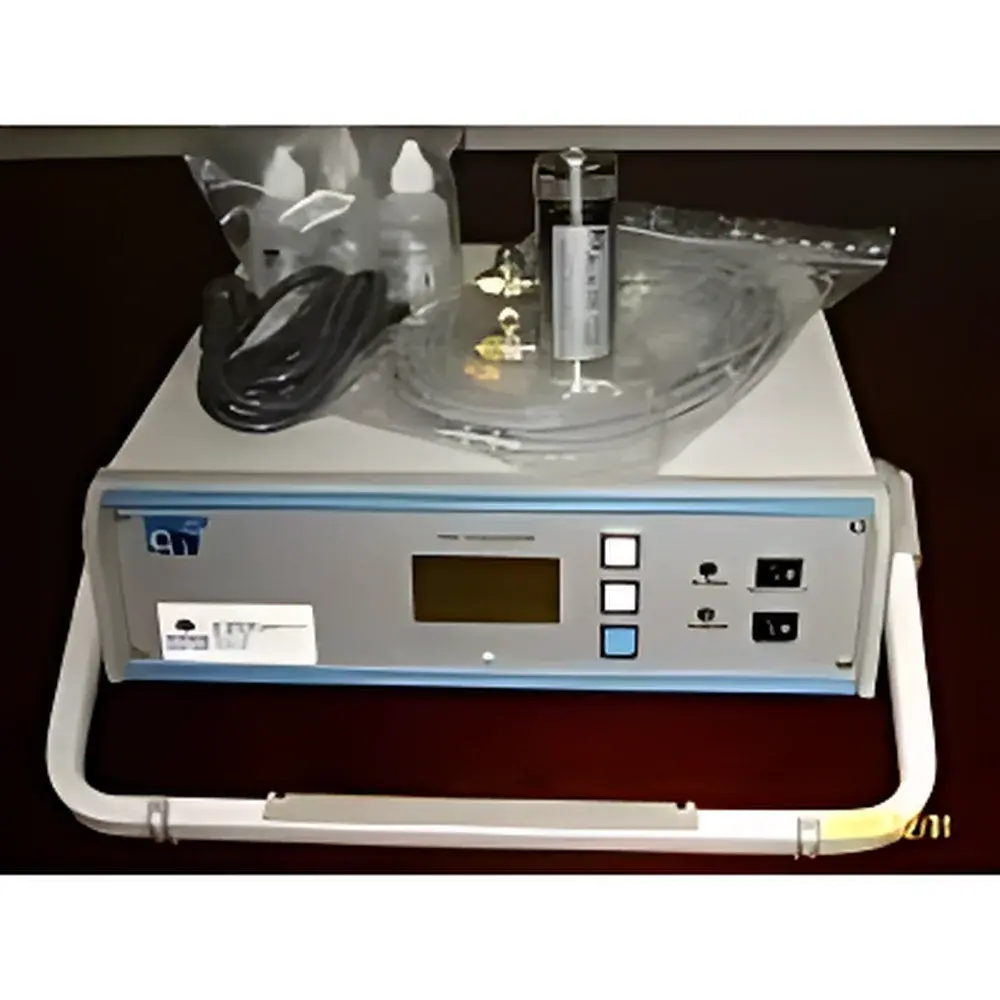
CMC TMA-210-P-ZB Portable Electrolytic Dew Point Analyzer
| Origin | Germany |
|---|---|
| Manufacturer Type | Authorized Distributor |
| Origin Category | Imported |
| Model | TMA-210-P-ZB |
| Product Type | Portable Dew Point Analyzer |
| Measurement Principle | Phosphorus Pentoxide (P₂O₅) Electrolytic Method |
| Operating Temperature Range | −5 to 50 °C |
| Accuracy | ±1 % of full scale |
| Repeatability | ±0.01 % of full scale |
| Measurement Range | 0–10 / 100 / 1000 / 2500 ppmᵥ (auto-ranging) |
| Sensitivity | 0.1 % of full scale |
| Response Time (T₉₀) | < 1 s |
| T₅₀ Response | < 8 s |
| Sample Flow Rate | 20 NL/h |
| Recommended Sample Pressure | 0.1–0.5 barg |
| Sample Temperature | 5–150 °C |
| Ambient Temperature | 5–65 °C |
| Display | Multifunctional High-Resolution LCD |
| Analog Output | 4–20 mA |
| Standard Cable Length | 3 m (up to 300 m optional) |
| Dimensions (Portable Version) | 363 mm (W) × 115 mm (H) × 377 mm (D) |
Overview
The CMC TMA-210-P-ZB is a portable, high-stability electrolytic dew point analyzer engineered for trace moisture measurement in aggressive and reactive process gases. It employs the internationally recognized phosphorus pentoxide (P₂O₅) electrolytic principle—where water vapor in the sample gas is quantitatively decomposed via electrochemical reaction at a P₂O₅-coated sensor cell. This absolute measurement method eliminates the need for periodic recalibration under stable operating conditions and ensures long-term measurement integrity without drift. The core sensor consists of a fused-silica cylindrical body with two parallel electrodes (typically platinum or rhodium), coated with a thin, hygroscopic layer of phosphoric acid (H₃PO₄). Upon application of a DC voltage, water molecules are electrolyzed into hydrogen and oxygen; the resulting anhydrous P₂O₅ continuously absorbs moisture from the sample stream until dynamic equilibrium is reached. The magnitude of the electrolysis current is directly proportional to the water concentration, enabling linear, stoichiometric quantification in parts-per-trillion (ppt) to parts-per-million (ppm) ranges. Designed specifically for demanding industrial environments, the TMA-210-P-ZB delivers metrologically traceable results compliant with ISO 8573-1 (compressed air purity classes), ASTM D6673 (moisture in gaseous hydrocarbons), and IEC 61000-4 electromagnetic compatibility standards.
Key Features
- True absolute measurement principle—no zero/span drift over time; no calibration gas required for routine operation
- P₂O₅ sensor with regenerable electrode membrane—electrochemical regeneration restores baseline sensitivity without sensor replacement
- Auto-ranging measurement across four selectable spans: 0–10, 0–100, 0–1000, and 0–2500 ppmᵥ
- Sub-second T₉₀ response (<1 s) and rapid T₅₀ (<8 s) ensure real-time monitoring of moisture transients in purge lines or reactor feeds
- Full microprocessor-based control architecture with built-in self-diagnostic routines per NAMUR NE 43 guidelines
- Rugged portable enclosure (IP65-rated) with integrated battery option for field deployment in chlorine, HCl, SO₂, H₂S, and other corrosive gas streams
- Wide sample temperature tolerance (5–150 °C) and pressure adaptability (0.1–0.5 barg) support direct-in-line installation without external conditioning
Sample Compatibility & Compliance
The TMA-210-P-ZB is validated for use with inert gases (He, Ar, Kr, Xe, N₂), diatomic gases (H₂, O₂, D₂, F₂), oxidizing species (O₃), halogenated compounds (SF₆, Freons), hydrocarbons (CH₄, C₂H₂, natural gas), and highly corrosive process streams including chlorine (Cl₂), hydrogen chloride (HCl), sulfur dioxide (SO₂), and hydrogen sulfide (H₂S). It excludes only those gases known to chemically attack P₂O₅ or phosphoric acid layers (e.g., strong reducing agents such as NH₃ under high humidity, or alkali vapors). All configurations meet CE marking requirements and conform to EN 61326-1 (EMC for laboratory equipment) and EN 61010-1 (safety for electrical equipment). Data logging and audit trails comply with GLP/GMP documentation expectations when paired with optional RS-232/RS-485 interfaces and timestamped output.
Software & Data Management
The analyzer operates standalone with local LCD display and front-panel navigation, but supports digital integration via optional serial communication modules. Raw analog 4–20 mA output is fully isolated and linearized across all ranges. Optional firmware upgrades enable Modbus RTU protocol for SCADA connectivity. Internal memory stores up to 32,000 timestamped readings (sample time, moisture value, sensor status, temperature/pressure flags) with configurable sampling intervals (1 s to 1 h). Exportable CSV files facilitate post-acquisition trend analysis in Excel or LIMS platforms. For regulated environments, optional 21 CFR Part 11-compliant software packages provide electronic signatures, user access levels, and immutable audit logs—fully supporting FDA-reviewed validation protocols.
Applications
- Moisture verification in chlorine and HCl delivery systems for semiconductor etching and PVC production
- In-line monitoring of SF₆ purity in high-voltage switchgear maintenance
- Quality assurance of dry air and nitrogen purge gases used in lithium-ion battery electrode drying
- Trace H₂O detection in hydrogen fuel cell feed streams (ISO 8573-8 Class 1 compliance)
- Process gas certification in pharmaceutical inerting applications (e.g., lyophilization, granulation)
- Field verification of desiccant dryer performance in petrochemical refineries and LNG facilities
FAQ
Is the P₂O₅ sensor affected by condensable hydrocarbons or particulates?
Yes—oil mist, silicone vapors, or aerosols can coat the electrode surface and impair electrolysis efficiency. A heated particulate filter (optional) and coalescing pre-filter are recommended for contaminated streams.
Can the instrument measure below 0 ppmᵥ (sub-ppb level)?
No—the TMA-210-P-ZB’s lower detection limit is 0.1 ppmᵥ (100 ppb) under optimal conditions. For sub-ppb work, consider the TMA-202-P-ZB variant with enhanced signal-to-noise electronics.
Does the analyzer require carrier gas or zero-air purge?
No—unlike tunable diode laser or capacitance-based analyzers, the P₂O₅ cell operates on the sample gas itself; no auxiliary purge is needed.
How often must the sensor be regenerated?
Regeneration frequency depends on cumulative moisture exposure. Under typical Cl₂ service (≤10 ppmᵥ), regeneration intervals exceed 6 months. The unit alerts users automatically when regeneration is advised.
Is explosion-proof certification available?
The standard TMA-210-P-ZB is not ATEX/IECEx certified. For hazardous area use, consult CMC for the intrinsically safe TMA-210-Ex-P-ZB variant (certified to ATEX II 2G Ex ib IIB T4 Gb).




