
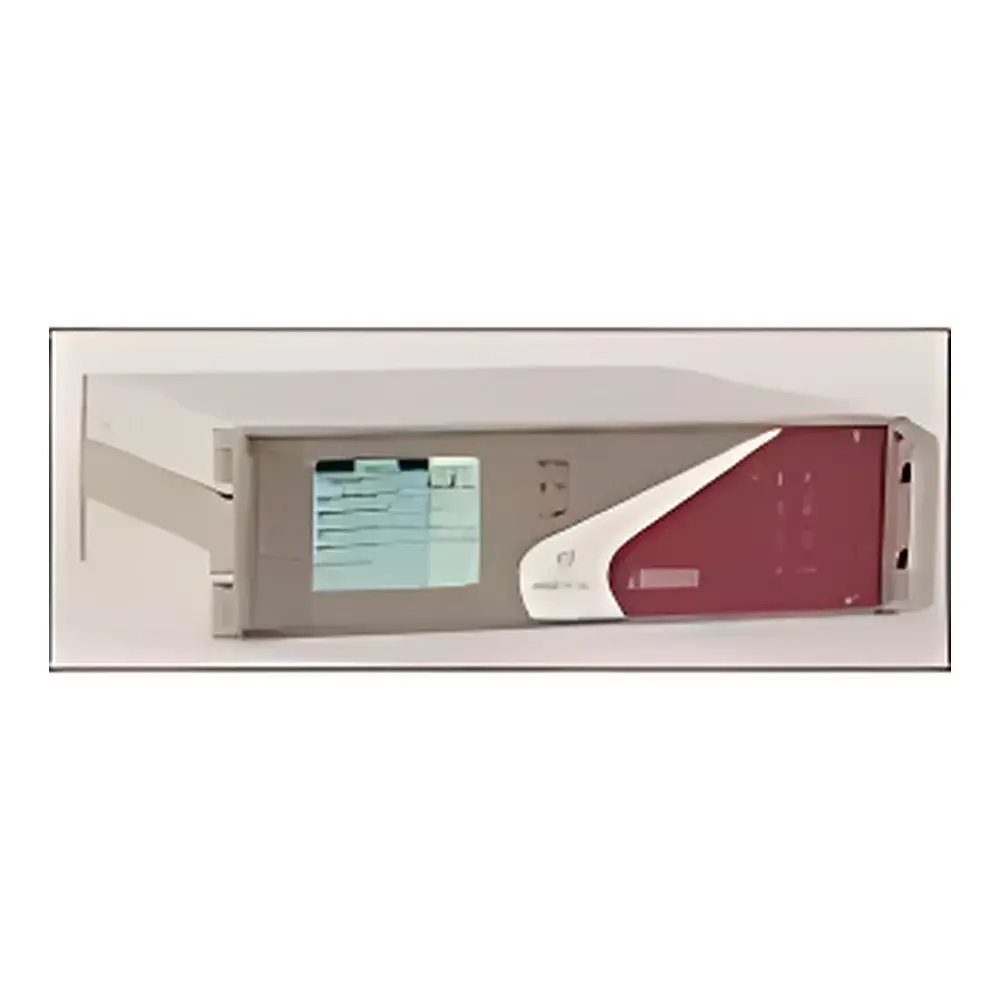
LD8000 Plasma Emission Spectroscopy Analyzer for Trace Nitrogen in Argon
| Key | Origin: Italy |
|---|---|
| Manufacturer Type | Authorized Distributor |
| Origin Category | Imported |
| Model | LD8000 |
| Price | USD 24,500 (FOB) |
| Detection Principle | Plasma Emission Spectroscopy (PES) |
| Range Options | 0–1 ppm (10 ppb resolution) |
| Repeatability | <1% FS |
| Accuracy | ±1% FS |
| Sample Flow | 15–200 sccm |
| Flow Accuracy | ±1% FS (0–200 sccm) |
| Operating Pressure | 4–100 PSIG (28–689 kPAG), optional down to 1 PSIG (7 kPAG) |
| Operating Temperature | 10–45 °C |
| Power | 115/220 VAC, 50–60 Hz |
| Max Power Consumption | 40 W |
| Drift | <±1% over 24 h |
| Weight | 13 kg (29 lbs) |
| Display | 5.6″ TFT Touchscreen LCD |
| Outputs | 4–20 mA (isolated), LAN/Web interface, 3-channel analog range output, system status output, calibration output |
| Communication | RS-232/422/485, Profibus optional |
| Gas Connections | 1/8″ Swagelok (sample, vent, span gas) |
| Calibration Gases | Zero: LDP1000 getter-purified Ar |
| Span | 8.0–9.5 ppm N₂ in Ar |
Overview
The LD8000 Plasma Emission Spectroscopy Analyzer is a high-stability, laboratory-grade trace nitrogen analyzer engineered specifically for quantitative measurement of nitrogen impurities in ultra-high-purity argon (and helium) carrier gases. It employs low-power, stabilized direct-current plasma emission spectroscopy (PES) — a non-destructive, element-specific optical detection method — to monitor the characteristic atomic emission line of nitrogen at 120.0 nm in the vacuum ultraviolet (VUV) spectrum. Unlike chemiluminescence or thermal conductivity detectors, PES eliminates cross-sensitivity to oxygen, hydrogen, hydrocarbons, or moisture, delivering unambiguous nitrogen selectivity without chemical conversion or catalytic interference. The instrument’s sealed optical path, temperature-controlled plasma source, and getter-based zero-gas purification system collectively minimize baseline drift and contamination-induced signal degradation — critical for applications demanding long-term stability in semiconductor-grade gas certification, cryogenic process monitoring, and high-purity metal inerting environments.
Key Features
- Plasma emission spectroscopy detection with inherent elemental specificity for nitrogen — no spectral overlap with O₂, H₂, CO, or H₂O under controlled argon matrix conditions
- Triple-range measurement architecture: 0–1 ppm (10 ppb resolution), 0–10 ppm (0.1 ppm resolution), and 0–100 ppm (1 ppm resolution); extended ranges available upon request
- Microprocessor-controlled auto-ranging and manual span selection with guided, safety-locked calibration sequence compliant with ISO/IEC 17025 internal verification protocols
- Integrated 5.6″ high-brightness TFT touchscreen interface supporting multilingual UI (English, German, Japanese), real-time trend logging, and on-device alarm history storage (≥1,000 events)
- Dual-stage gas handling: LDP1000 getter cartridge for zero-gas generation (N₂ < 50 ppt) and precision mass-flow-controlled sample introduction (15–200 sccm, ±1% FS accuracy)
- Comprehensive digital and analog I/O: Isolated 4–20 mA output (calibration reference), three programmable analog range outputs, discrete system status output, and Ethernet-enabled remote access via embedded web server (HTTP/HTTPS)
Sample Compatibility & Compliance
The LD8000 is validated for continuous analysis of argon and helium matrices containing ≤100 ppm nitrogen. It complies with ASTM D6349–22 (Standard Test Method for Determination of Nitrogen in High-Purity Argon by Emission Spectrometry), ISO 8573-7:2019 (Compressed air — Part 7: Particle content), and supports GLP/GMP data integrity requirements through time-stamped audit trails, user-access levels (admin/operator), and non-erasable calibration logs. All wetted materials — including Swagelok 1/8″ stainless-steel fittings, electropolished 316L flow paths, and VUV-grade fused silica optics — meet SEMI F57 purity standards for semiconductor process gas instrumentation. Optional pressure regulation modules enable stable operation from 1 PSIG (7 kPAG) minimum — essential for low-pressure cryogenic transfer lines and glovebox integration.
Software & Data Management
Firmware v3.2 includes embedded data logging (1-second sampling, 30-day buffer), configurable alarm thresholds (up to 3 user-defined setpoints with latching/non-latching behavior), and CSV export via USB or LAN. The analyzer supports FDA 21 CFR Part 11-compliant operation when deployed with validated third-party SCADA platforms (e.g., Ignition SCADA, Siemens Desigo CC). Raw spectral intensity values, normalized emission ratios, and diagnostic parameters (plasma voltage, optical gain, flow sensor output) are accessible via Modbus TCP or ASCII serial protocol. All calibration events generate immutable records containing operator ID, timestamp, zero/span gas lot numbers, and deviation metrics — satisfying ISO/IEC 17025 clause 7.7.1 for measurement traceability.
Applications
- Final quality verification of electronic-grade argon (ASTM D6349 Class 1, SEMI F22) prior to cylinder filling or bulk delivery
- In-line monitoring of nitrogen breakthrough in argon purification skids using copper-based getters or cryo-adsorption beds
- Leak detection validation in ultra-high-vacuum (UHV) systems where residual N₂ serves as a tracer for air ingress
- Process gas certification for aluminum casting, titanium welding, and additive manufacturing (AM) powder atomization furnaces
- Reference standard generation in metrology labs performing inter-laboratory comparison studies per ILAC-P10
FAQ
What detection limit can be achieved in pure argon using the LD8000?
The instrument achieves a proven method detection limit (MDL) of 8 ppb (3σ) for nitrogen in argon when operated in the 0–1 ppm range with optimized integration time and background subtraction.
Is helium compatible as a carrier gas?
Yes — the plasma emission response is identical in He and Ar matrices; no hardware or firmware modification is required. Calibration gases must match the sample matrix (e.g., N₂-in-He standards for He applications).
How often does the plasma source require maintenance?
Under continuous operation at nominal power, the DC plasma electrode assembly maintains stable performance for ≥18 months; routine inspection is recommended every 6 months per preventive maintenance schedule.
Can the LD8000 interface with a distributed control system (DCS)?
Yes — native Modbus TCP support enables seamless integration with Emerson DeltaV, Honeywell Experion, and Yokogawa CENTUM VP DCS platforms without gateway hardware.
Does the analyzer support automated zeroing during unattended operation?
No — zero calibration requires physical connection of the LDP1000 getter-purified gas stream; however, scheduled automatic span checks (with user-provided span gas) are fully supported via timer-based sequences.
Related Products






