
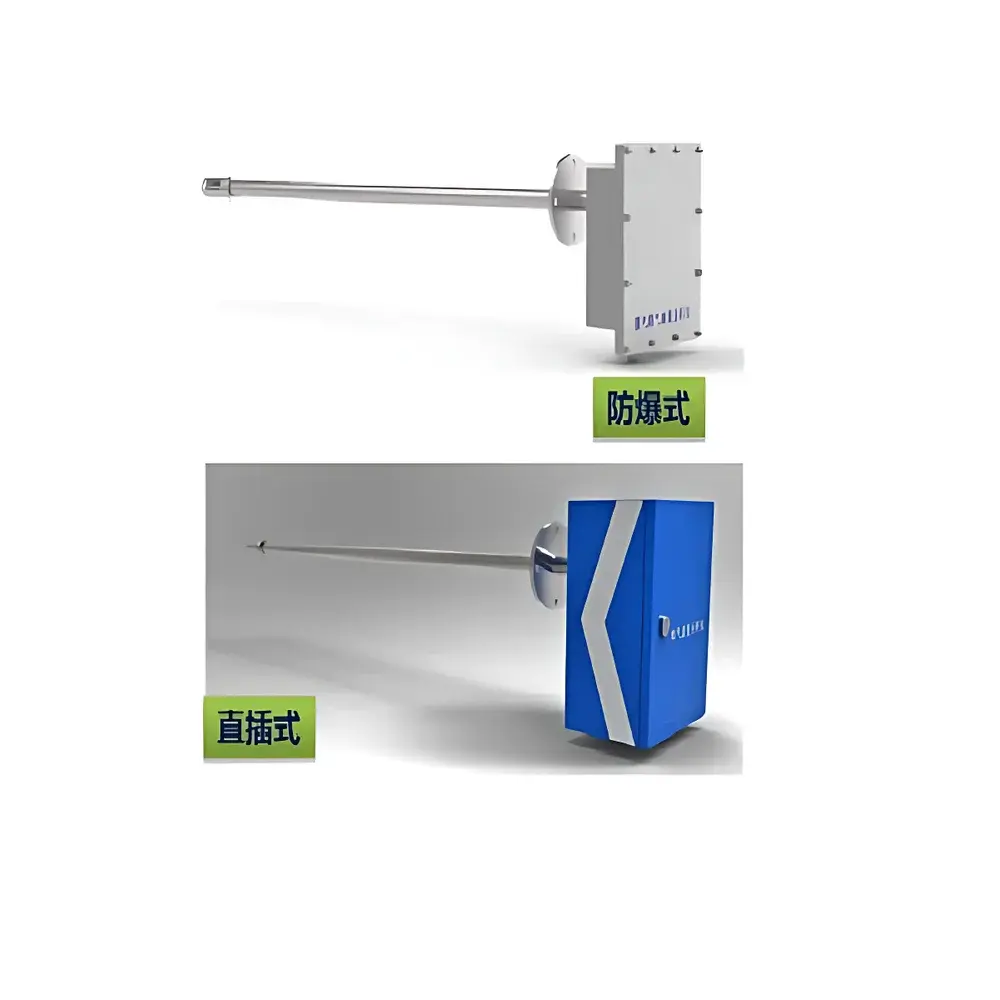
ML-60 TDLAS-Based In-Situ Laser Gas Analyzer
| Origin | Beijing, China |
|---|---|
| Manufacturer Type | Authorized Distributor |
| Origin Category | Domestic (China) |
| Model | ML-60 |
| Pricing | Available Upon Request |
| Humidity Range | 0–10 %vol |
| Humidity Accuracy | ±1 %vol |
| Temperature Range | −80 to +350 °C |
| Temperature Accuracy | ±0.2 °C |
| Display | LED LCD showing %vol H₂O, ppmv H₂O, RH%, and temperature |
| Sampling Method | Insertion-type probe |
| Sample Pressure | 0.2–10 bar (adjustable) |
| Sample Flow Rate | 1–3 L/min |
| Sample Line Material | Electropolished 316L Stainless Steel |
| Sensor Mount Thread | 0.750-16 UNF-2A |
| Optical Cell Connection | Swagelok® 6 mm or 1/4″ compression fitting |
| Operating Temperature | −20 to +60 °C (electronics), −60 to +250 °C (probe) |
| Storage Temperature | −10 to +50 °C |
| Ambient Humidity | ≤90 %RH, non-condensing |
| Optical Interface | FC/APC fiber connector |
| Communication | RS-485 (Modbus RTU) |
| Analog Output | 4–20 mA (isolated, configurable per parameter) |
| Power Supply | DC 24 V ±10 % or AC 220 V ±15 %, 50/60 Hz |
| Power Consumption | ~4 W |
Overview
The ML-60 is an in-situ, tunable diode laser absorption spectroscopy (TDLAS)-based gas analyzer engineered for continuous, real-time monitoring of water vapor concentration in industrial process streams. Unlike extractive systems requiring sample conditioning, the ML-60 employs direct optical path measurement across a heated, corrosion-resistant probe inserted into the process duct or pipe. Its core measurement principle relies on wavelength-scanned near-infrared (NIR) laser absorption at a specific rotational-vibrational transition of H₂O (typically near 1368 nm or 1877 nm), enabling selective, interference-free quantification even in complex matrices containing CO₂, SO₂, NOₓ, hydrocarbons, or particulates. Designed for fixed-location deployment in demanding thermal and chemical environments—including cement kilns, syngas lines, flare stacks, biogas upgrading units, and semiconductor purge gas loops—the ML-60 delivers high reproducibility and long-term stability without calibration drift induced by pressure or temperature fluctuations, thanks to built-in multi-point temperature compensation and pressure normalization algorithms.
Key Features
- In-situ TDLAS architecture eliminates sampling system complexity, reducing maintenance intervals and eliminating condensation-related errors.
- High-temperature probe rated to +250 °C (operational) with optional ceramic-coated variants for transient exposure up to +350 °C.
- Electropolished 316L stainless steel wetted parts ensure compatibility with aggressive gases (e.g., HCl, Cl₂, NH₃) and high-dust applications (>10 g/m³).
- Dual-range humidity detection: 0–10 %vol (primary range) with ±1 %vol accuracy; extended low-concentration mode supports ppmv-level resolution down to 10 ppmv (calculated from %vol and temperature/pressure inputs).
- Integrated temperature sensor (±0.2 °C accuracy) co-located within the optical path enables real-time thermodynamic correction of absorption line strength and broadening.
- Configurable 4–20 mA output channels support simultaneous transmission of moisture %vol, ppmv, RH%, and probe temperature—each independently scalable and linearized.
- RS-485 interface compliant with Modbus RTU protocol for integration into DCS, SCADA, or PLC systems; supports remote firmware updates and diagnostic logging.
Sample Compatibility & Compliance
The ML-60 is validated for use with non-explosive, non-radioactive process gases meeting Class II, Division 2 hazardous area requirements when installed with appropriate conduit seals and junction boxes. It complies with electromagnetic compatibility standards IEC 61326-1 (industrial environment) and safety standard IEC 61010-1. While not intrinsically safe certified out-of-the-box, it may be deployed in Zone 2/Class I Div 2 areas using barrier-isolated analog outputs and fiber-optic signal transmission. The analyzer supports traceability per ISO/IEC 17025 when operated with documented calibration procedures and certified reference gases (e.g., NIST-traceable H₂O-in-N₂ standards). Data integrity meets GLP/GMP-aligned practices through timestamped internal event logging and write-protected configuration memory.
Software & Data Management
Local configuration and diagnostics are performed via the front-panel LED display and membrane keypad. For advanced commissioning and trending, the optional PC-based ML-Config Suite provides graphical spectral visualization, baseline correction tools, alarm threshold setup, and CSV export of time-stamped measurement logs (including raw absorbance, fitted peak area, temperature, pressure, and diagnostic flags). All configuration changes are logged with user ID and timestamp. The device stores ≥30 days of 1-minute averaged data internally (non-volatile memory), supporting audit-ready retrieval during FDA 21 CFR Part 11-compliant deployments when paired with validated third-party data acquisition software.
Applications
- Moisture monitoring in natural gas dehydration units and LNG liquefaction trains to prevent hydrate formation and corrosion.
- Real-time H₂O control in hydrogen production (PEM electrolyzer feed gas) and fuel cell reformate streams.
- Process optimization in fluid catalytic cracking (FCC) regenerators and waste-to-energy boiler flue gas recirculation loops.
- Quality assurance in pharmaceutical lyophilization chamber purge gas and sterile barrier system integrity testing.
- Environmental compliance reporting for stack emissions (e.g., EPA Method 303 for moisture in incinerator exhaust).
FAQ
Is the ML-60 suitable for measuring moisture in corrosive acid gas streams?
Yes—when equipped with electropolished 316L probe housing and Swagelok® 6 mm fittings, it is routinely deployed in H₂S-rich sour gas, chlorinated off-gas, and sulfuric acid plant tail gas applications.
Does the analyzer require periodic span calibration with certified gas standards?
No—TDLAS is a fundamental spectroscopic technique; zero calibration is sufficient for long-term stability. Optional span verification using traceable moisture standards is recommended annually for regulatory reporting.
Can the ML-60 operate unattended for extended periods in outdoor enclosures?
Yes—its wide operating temperature range (−20 to +60 °C for electronics) and sealed IP66-rated enclosure enable deployment in instrument shelters without active climate control, provided ambient humidity remains below 90 %RH non-condensing.
What is the minimum detectable moisture level in ppmv mode?
Under optimal conditions (stable temperature/pressure, clean optical path), the effective lower limit of quantitation is approximately 10 ppmv H₂O, derived from the 0–10 %vol primary range and thermodynamic conversion.
Is fiber optic cable length between probe and analyzer limited?
Standard FC/APC patch cables support distances up to 500 m without signal degradation; for longer runs, single-mode fiber with appropriate launch conditions maintains spectral fidelity.







