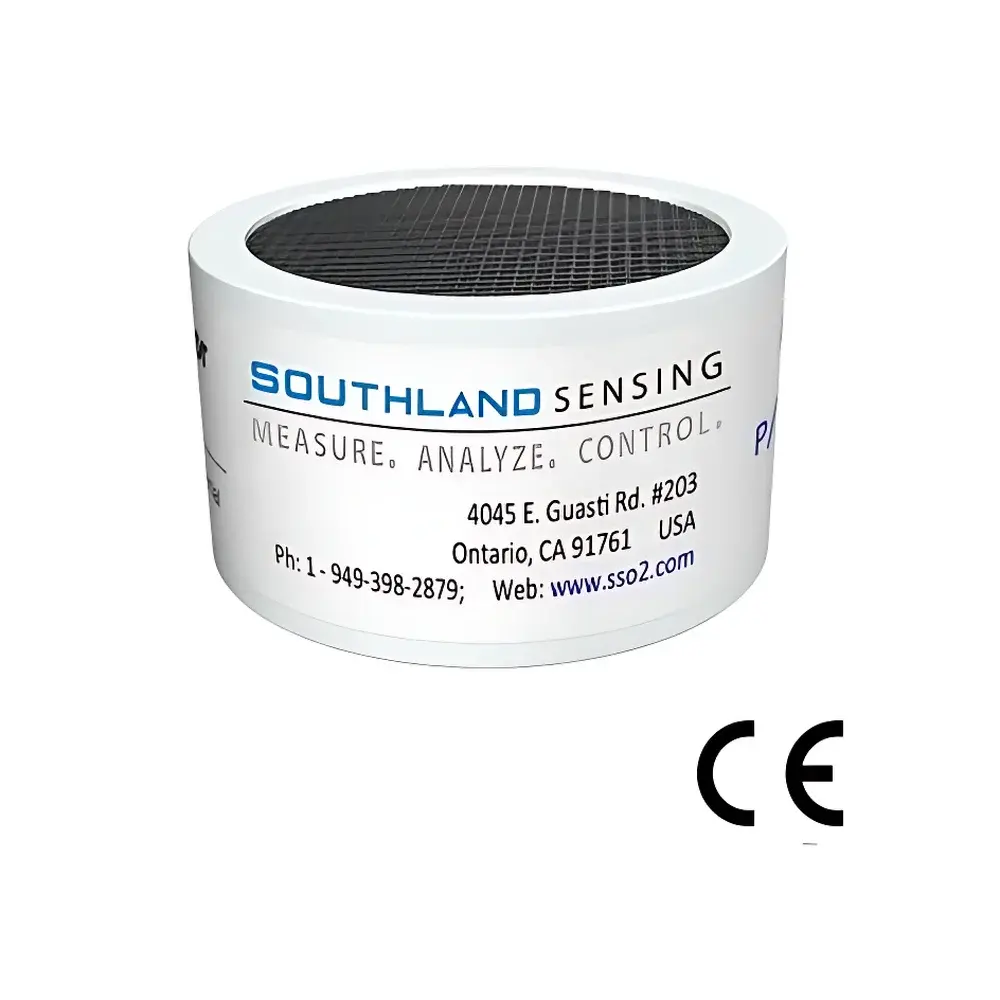
Southland Sensing TO2-133-T PPM-Level Electrochemical Oxygen Sensor
| Origin | USA |
|---|---|
| Manufacturer Type | Authorized Distributor |
| Origin Category | Imported |
| Model | TO2-133-T |
| Output Signal | 285–590 µA (linear vs. O₂ concentration) |
| Measurement Ranges | 0–1 ppm / 0–10 ppm / 0–100 ppm / 0–1000 ppm / 0–1% / 0–25% O₂ (auto-ranging) |
| Response Time (T₉₀) | ≤13 s |
| Full-Scale Accuracy | ±1% FS |
| Repeatability | ±0.5% FS |
| Temperature Coefficient | 2.54%/°C |
| Operating Temp. | 0–50°C |
| Storage Temp. | 0–45°C |
| Recommended Flow Rate | 0.5–5 SCFH |
| Humidity Range | 0–100% RH (non-condensing) |
| Expected Service Life | 20–25 months (under typical operating conditions) |
| Warranty | 12 months |
| Electrical Interface | PCB-mounted, center foil (cathode), outer foil (anode) |
Overview
The Southland Sensing TO2-133-T is a high-stability, electrochemical oxygen sensor engineered for trace-level and percent-range oxygen detection in demanding industrial process environments. Based on proprietary micro-fuel cell technology, the sensor operates without external power or consumable electrolytes—relying instead on ambient moisture and oxygen diffusion to generate a linear, temperature-compensated current output (285–590 µA). Its design adheres to fundamental principles of galvanic oxygen sensing: O₂ diffuses through a selective membrane, undergoes reduction at the cathode, and generates a current proportional to partial pressure—enabling precise quantification from sub-ppm (0–1 ppm) up to 25% O₂. Unlike optical or zirconia-based analyzers, the TO2-133-T delivers inherent zero-drift stability, low power requirements, and immunity to background gas interference (e.g., CO₂, N₂, H₂, CH₄, Ar), making it ideal for inert gas purity verification, blanketing gas monitoring, and high-reliability safety-critical loops.
Key Features
- Multi-range capability: Factory-configurable or user-selectable spans covering 0–1 ppm, 0–10 ppm, 0–100 ppm, 0–1000 ppm, 0–1% and 0–25% O₂—enabling single-sensor deployment across diverse applications
- True PPM-grade resolution: Optimized for ultra-low-oxygen environments with <1 ppm detection limit and ±1% full-scale accuracy across all ranges
- Integrated intelligent signal conditioning: On-board microcontroller enables auto-ranging, digital temperature compensation, and linearized analog output scaling—eliminating need for external transmitters in many OEM integrations
- Robust mechanical architecture: Hermetically sealed, PCB-mountable design with gold-plated electrodes and hydrophobic membrane—resistant to condensation, particulates, and moderate vibration
- Dual programmable alarm relays: Configurable for high/low O₂ thresholds with latching or non-latching behavior—compliant with SIL 2 functional safety requirements when used in conjunction with certified logic solvers
- Extended service life: Rated for 20–25 months of continuous operation under nominal conditions (0–50°C, 0.5–5 SCFH flow, non-condensing humidity), with 6-month shelf-life prior to activation
Sample Compatibility & Compliance
The TO2-133-T is validated for use with inert gases (N₂, Ar, He), reducing atmospheres (H₂, forming gas), hydrocarbon streams (natural gas, refinery off-gas), and mixed industrial process gases. It exhibits negligible cross-sensitivity to CO₂ (<0.1% signal deviation at 10% CO₂), CO (<0.05% at 1000 ppm), and H₂S (<0.2% at 50 ppm), ensuring reliable performance in complex matrices. The sensor complies with ASTM D6347/D6347M (Standard Test Method for Oxygen in Gases by Electrochemical Sensors), ISO 8573-3 (Compressed Air – Part 3: Determination of Oil Content), and supports GLP/GMP data integrity workflows when integrated into systems compliant with FDA 21 CFR Part 11 (electronic records/signatures). Its construction meets RoHS Directive 2011/65/EU and REACH SVHC screening criteria.
Software & Data Management
While the TO2-133-T operates as a standalone analog sensor, its linear µA output is compatible with industry-standard signal conditioners (e.g., Moore Industries, Phoenix Contact, Yokogawa UT series) and PLC analog input modules (16-bit ADC minimum recommended). When embedded in OEM analyzer platforms, the sensor’s onboard microcontroller supports Modbus RTU over RS-485 (optional firmware upgrade) for remote calibration verification, lifetime counter readout, and diagnostic status reporting (e.g., membrane saturation warning, temperature excursion flag). All configuration parameters—including range selection, alarm setpoints, and temperature compensation coefficients—are stored in non-volatile memory and survive power cycling. Audit trails for calibration events and firmware updates may be maintained per ISO/IEC 17025 requirements when paired with validated host software.
Applications
- Inert gas purity monitoring: Real-time O₂ verification in nitrogen, argon, and helium blanketing systems for semiconductor CVD/PVD chambers, pharmaceutical fluidized beds, and food packaging lines
- Hydrogen and synthesis gas quality control: Trace oxygen detection upstream of PEM electrolyzers, fuel cells, and ammonia reactors where catalyst poisoning must be avoided
- Natural gas transmission: Continuous O₂ ingress monitoring in pipeline custody transfer stations and LNG vaporizer outlets per API RP 1173 guidelines
- High-temperature process support: Integration into furnace atmosphere controllers (e.g., sintering, brazing, annealing) using optional high-temp sampling probes (up to 200°C with cooled sample line)
- Research & development: Stable reference sensor for method validation in ASTM E260, USP , and ICH Q5C oxygen stability studies
- Environmental safety: Low-oxygen hazard detection in confined space entry systems and battery energy storage enclosures
FAQ
What gases can interfere with TO2-133-T measurements?
Chlorine, ozone, and strong oxidizers (e.g., NO₂, ClO₂) will cause positive interference; sulfur dioxide and hydrogen sulfide may accelerate cathode poisoning if present above 50 ppm continuously. Halogenated refrigerants (e.g., R134a) show minimal effect below 1000 ppm.
Is field calibration required?
Zero calibration is not necessary due to inherent galvanic zero stability; span calibration using certified NIST-traceable O₂ standards (e.g., 10 ppm O₂ in N₂) is recommended every 3–6 months depending on exposure history and criticality.
Can the sensor be used in pressurized sample streams?
Yes—rated for continuous operation up to 15 psig (1 bar(g)); for higher pressures, install a pressure regulator and flow restrictor upstream to maintain specified flow rate and avoid membrane deformation.
Does humidity affect measurement accuracy?
The sensor requires ≥30% RH for optimal electrolyte hydration; operation below 10% RH may increase response time and reduce sensitivity—use a humidification bypass or Nafion dryer if sample dew point falls below 5°C.
How is sensor lifetime determined?
Service life is defined as the period until output drift exceeds ±5% of original span; accelerated aging tests confirm 20–25 months at 25°C/50% RH with 1 L/min N₂ flow—actual longevity depends on O₂ exposure history and thermal cycling profile.
Related Products