
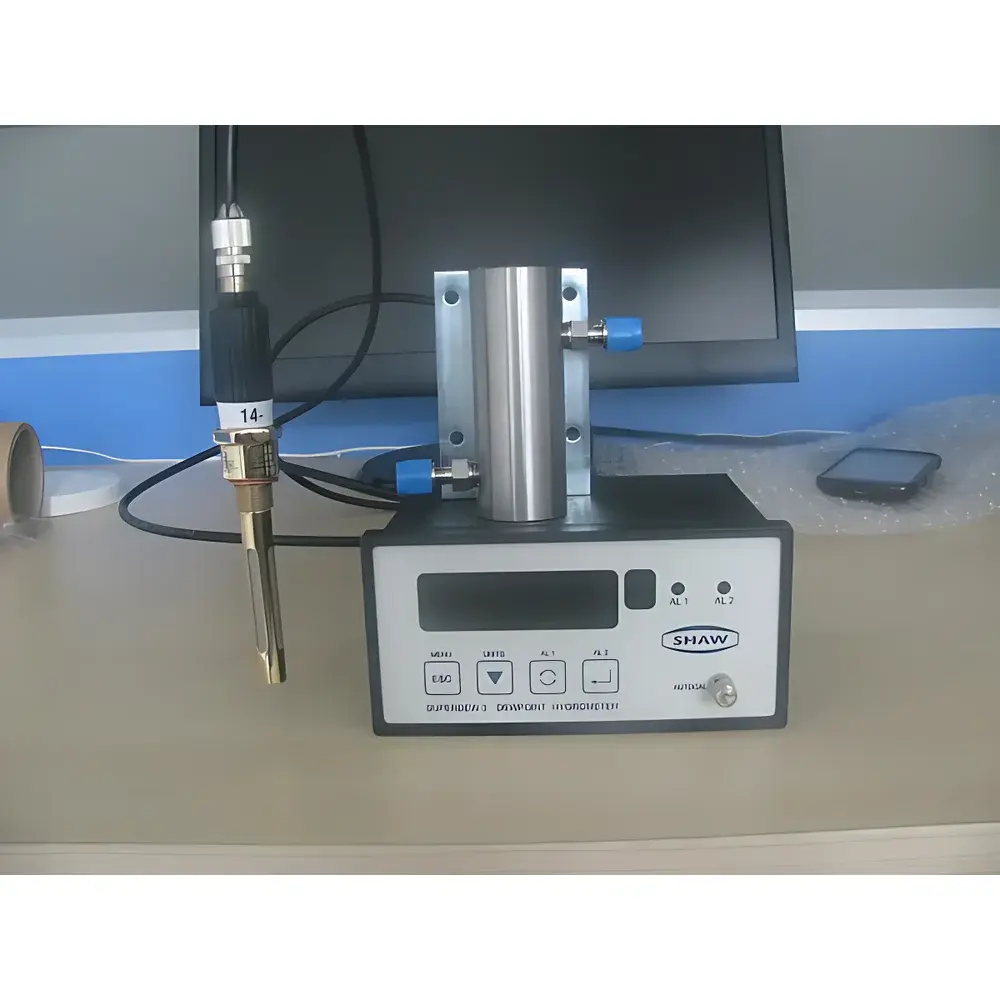
Shaw SuperDew3 Online Dew Point Meter
| Brand | Shaw |
|---|---|
| Origin | United Kingdom |
| Model | SuperDew3 |
| Type | Online Dew Point Meter |
| Measurement Principle | Capacitive Polymer Sensor |
| Operating Temperature Range | −10 °C to +50 °C |
| Accuracy | ±2 °C (at 23 °C ambient, typical for calibrated sensor in dry gas) |
| Repeatability | ±0.5 °C |
| Display Resolution | 0.1 °C |
| Output Signal | 4–20 mA (isolated, HART-compatible), 0–1 V optional |
| Alarm Outputs | Two SPDT relays (240 V AC, 3 A) |
| Power Supply | 220 V AC, 50 Hz |
| Panel Cutout | 135 mm × 66 mm × 175 mm (D) |
| Enclosure Rating | IP65 (front panel), NEMA 4X equivalent |
| Sensor Cable Length | Up to 1000 m (with shielded twisted-pair cable) |
| Sensor Pressure Rating | Up to 200 bar (burst), operational range 1–30 psi (0.07–2.1 bar) |
| Sample Flow Rate | 1–5 L/min (recommended: 1 L/min) |
| Connection | 1/4″ or 1/8″ Swagelok®-type compression fittings |
| Intrinsic Safety | Ex ia IIC T4 Ga certified (sensor head only) |
| Calibration | Automatic 1-minute ambient air self-calibration routine |
| Optional Ranges | −110 °C to −20 °C (Silver), −100 °C to 0 °C (Purple), −80 °C to 0 °C (Grey), −80 °C to −20 °C (Red), −60 °C to 0 °C (Yellow) |
| Compliance | ISO 9001:2015 certified manufacturing |
| Environmental Certification | Meets EN 61000-6-2 (EMC immunity) and EN 61000-6-3 (EMC emission) standards |
Overview
The Shaw SuperDew3 Online Dew Point Meter is an industrial-grade, continuously operating dew point analyzer engineered for high-reliability moisture monitoring in compressed air, natural gas, nitrogen, hydrogen, and other technically dry process gases. It employs a temperature-controlled, thin-film capacitive polymer sensor that responds dynamically to water vapor partial pressure—enabling direct, real-time measurement of dew point temperature (°Cdp) without the need for chilled-mirror optics or electrolytic cell regeneration. Unlike chilled-mirror instruments, the SuperDew3 delivers stable readings across rapid humidity transients and maintains metrological integrity under variable flow, pressure, and temperature conditions typical in pipeline, drying, and purification applications. Its architecture supports long-term unattended operation in demanding environments—from pharmaceutical cleanroom compressed air networks to offshore natural gas dehydration skids—where trace moisture control is critical to corrosion prevention, catalyst protection, and product quality assurance.
Key Features
- Capacitive polymer sensing element with active temperature stabilization for minimized thermal drift and improved low-dew-point stability
- Automatic 60-second ambient air calibration routine—no manual zero-gas required; eliminates dependency on calibration cylinders in routine operation
- Robust 4–20 mA analog output with HART protocol support for integration into DCS, SCADA, and PLC-based control systems
- Two independently configurable SPDT alarm relays rated at 240 V AC / 3 A, suitable for triggering desiccant tower regeneration, purge valve actuation, or safety interlocks
- Front-panel 3½-digit backlit LCD display with 0.1 °C resolution and intuitive menu navigation via membrane keypad
- Extended sensor cable capability up to 1000 m using standard shielded twisted-pair cabling—ideal for remote installation in hazardous or inaccessible locations
- Intrinsically safe sensor head (Ex ia IIC T4 Ga) certified for Zone 0/1 use; full-system ATEX/IECEx compliance achievable with certified galvanic isolators and barriers
- Modular sensor selection covering five distinct dew point ranges—from ultra-low −110 °Cdp (Silver sensor) to mid-range −60 °Cdp (Yellow)—ensuring optimal signal-to-noise ratio per application
Sample Compatibility & Compliance
The SuperDew3 is validated for continuous analysis of non-corrosive, non-condensing process gases including compressed air, instrument air, nitrogen, argon, hydrogen, helium, CO2, and natural gas (up to 10% hydrocarbon content). It is not recommended for use with aggressive halogenated solvents, ammonia, or high-concentration acidic gases (e.g., SO2, HCl), which may degrade the polymer dielectric layer over time. The instrument complies with ISO 8573-1:2010 Class 2 (≤−40 °Cdp) and Class 1 (≤−70 °Cdp) specifications when configured with appropriate sensors and installed per manufacturer guidelines. All units are manufactured under ISO 9001:2015 quality management systems and bear CE marking confirming conformity with EU Machinery Directive 2006/42/EC and EMC Directive 2014/30/EU. Traceable factory calibration certificates (NIST-traceable reference standards) are provided with each shipment.
Software & Data Management
While the SuperDew3 operates as a standalone analog transmitter, its 4–20 mA output enables seamless integration with third-party data historians and LIMS platforms. For enhanced diagnostics and configuration, Shaw provides the optional SuperView PC software (Windows-based), which connects via RS-232 or USB-to-serial adapter to access live sensor diagnostics, trend logs, calibration history, and relay status. All configuration changes—including alarm setpoints, output scaling, and auto-calibration enable/disable—are stored in non-volatile memory and survive power loss. The device supports audit trail logging for GLP/GMP environments when used with compatible SCADA systems that record timestamped parameter modifications. Although native FDA 21 CFR Part 11 compliance is not embedded, the hardware design accommodates electronic signature workflows through external validation protocols and system-level access controls.
Applications
- Compressed air quality monitoring in pharmaceutical manufacturing (ISO 8573-1 Class 2–4 compliance verification)
- Moisture control in nitrogen blanketing systems for chemical reactors and storage tanks
- Dehydration verification downstream of regenerative desiccant dryers and membrane separators
- Offshore platform natural gas dew point monitoring prior to pipeline injection
- Quality assurance in semiconductor fab gas cabinets (ultra-high-purity N2, Ar)
- Preventive maintenance of pneumatic control systems in power generation facilities
- Validation of freeze-dryer chamber purge cycles in biopharmaceutical lyophilization
FAQ
What is the recommended sample flow rate for optimal accuracy?
A consistent flow of 1 L/min is recommended to ensure laminar, representative sampling without pressure drop-induced cooling artifacts. Flow rates above 5 L/min may cause turbulence and localized condensation upstream of the sensor.
Can the SuperDew3 measure dew point in high-pressure natural gas lines?
Yes—the sensor housing is rated for continuous service up to 200 bar burst pressure. For accurate dew point reporting at elevated pressures, users must apply pressure compensation using the known absolute pressure value in post-processing or via external PLC logic.
Is the automatic air calibration valid for all sensor ranges?
The 1-minute ambient air calibration is optimized for sensors with upper range limits ≥0 °Cdp (e.g., Purple, Grey, Yellow). For ultra-low-range sensors (Silver, Red), factory calibration remains the primary reference; ambient air calibration serves only as a diagnostic sanity check.
How often should field calibration be performed?
Under stable operating conditions, annual verification against a NIST-traceable chilled mirror reference is sufficient. More frequent checks are advised after exposure to liquid water ingress, heavy particulate loading, or prolonged operation above 80% RH.
Does the SuperDew3 support digital communication protocols beyond analog output?
Standard units provide only 4–20 mA and relay outputs. HART-enabled versions are available upon request, allowing for remote configuration and diagnostic readouts via handheld communicators or asset management systems.




