
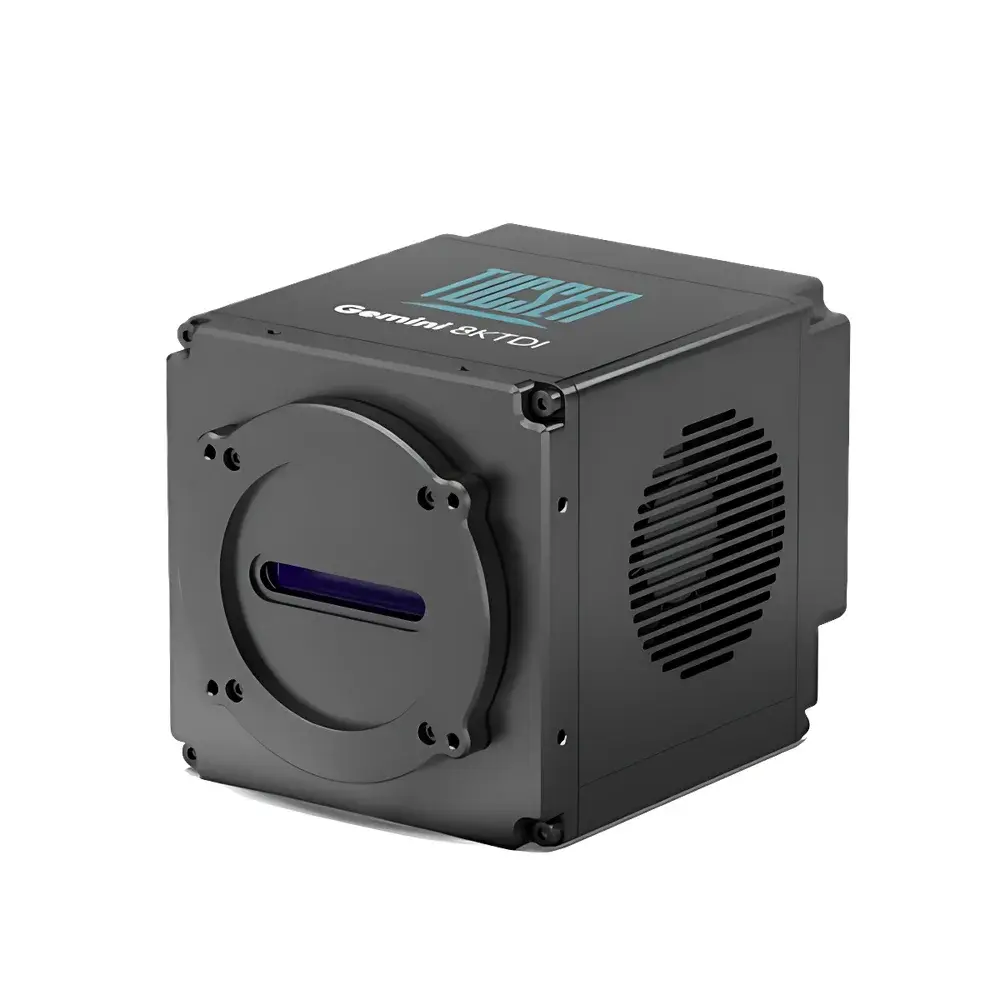
Tucsen Gemini 8KTDI Back-Illuminated sCMOS Time-Delay Integration Camera
| Brand | Tucsen |
|---|---|
| Origin | Fujian, China |
| Manufacturer Type | OEM Manufacturer |
| Model | Gemini 8KTDI |
| Image Resolution | 8028 (H) × 256 (V) |
| Pixel Size | 5 µm × 5 µm |
| Sensor Format | 41 mm diagonal |
| Readout Speed | 1 MHz @ 8K (10-bit) |
| Dynamic Range | ≥ 62.8 dB @ 10-bit ADC |
| Quantum Efficiency | ≥ 63.9% @ 266 nm, ≥ 93.4% @ 440 nm |
Overview
The Tucsen Gemini 8KTDI is a high-performance, back-illuminated sCMOS time-delay integration (TDI) camera engineered for precision industrial inspection and scientific imaging in demanding UV-to-NIR spectral regimes. Built around the Gpixel GLT5008BSI_UV sensor, it delivers exceptional quantum efficiency across a broad 180–1100 nm spectral range—particularly critical for semiconductor wafer inspection, flat-panel display (FPD) metrology, fluorescence scanning, genomics sequencing, and low-light biological imaging. Its TDI architecture enables continuous, motion-synchronized line-scan acquisition with programmable stage counts (up to 256 stages), eliminating motion blur while maintaining high signal-to-noise ratio (SNR) during high-speed conveyor-based inspection. The camera employs deep-cooled thermal stabilization (0 °C water-cooled operation) to suppress dark current and fixed-pattern noise—essential for detecting sub-2 DN gray-level variations in defect-sensitive applications such as nanoscale lithography verification or micro-crack identification on silicon wafers.
Key Features
- Back-illuminated sCMOS TDI sensor with 8028-pixel width and configurable integration stages (2–256), supporting both forward and reverse scan direction control
- UV-enhanced quantum efficiency: ≥63.9% at 266 nm and ≥93.4% at 440 nm—optimized for excimer laser-based inspection and fluorescence excitation
- 1 MHz line rate at 8K resolution using 10-bit ADC; 500 kHz at 12-bit high-dynamic-range mode—enabling flexible trade-offs between speed and quantization fidelity
- Precise active cooling: water-cooled operation stabilizes sensor temperature at 0 °C ±0.5 °C under ambient conditions (22 °C water inlet), reducing dark current to ≤1000 e⁻/p/s at 10 °C
- High charge transfer efficiency (≥0.99993) and anti-blooming protection (>50× full-well capacity), ensuring integrity of high-contrast edge features
- QSFP+ / QSFP28 100G CoaXPress-over-Fiber (CoF) interface for deterministic, low-latency data streaming—designed for seamless integration into automated optical inspection (AOI) platforms
- M72×0.75 mechanical interface with customizable optical flange options for alignment-critical optical train configurations
Sample Compatibility & Compliance
The Gemini 8KTDI is compatible with standard industrial inspection environments including cleanroom Class 100–1000, vacuum-compatible enclosures (with optional sealing), and vibration-isolated optical tables. Its spectral response supports compliance with key industry test methods: ASTM F2616 (wafer surface defect classification), ISO 10110-7 (optical component surface quality), and SEMI E142 (FPD panel inspection standards). While not inherently FDA-certified, the camera’s deterministic triggering, audit-ready metadata logging (via SamplePro SDK), and support for timestamped frame headers align with GLP/GMP documentation requirements for regulated manufacturing workflows. Firmware and driver binaries are validated for long-term stability under continuous 24/7 operation—a requirement for inline semiconductor process control systems.
Software & Data Management
Tucsen provides the cross-platform SamplePro SDK (C/C++ API) with native support for Windows 10/11 (x64), Ubuntu 20.04/22.04 (x64), and Euler OS (ARM64). The SDK includes real-time ROI configuration, multi-stage TDI gain mapping, non-uniformity correction (NUC) calibration tools, and hardware-triggered acquisition sequences with sub-microsecond jitter. All acquired frames embed embedded metadata—including exposure time, stage count, sensor temperature, and ADC bit depth—enabling traceable data lineage for quality assurance audits. Integration with third-party frameworks such as HALCON, OpenCV, and LabVIEW is supported via standardized GenICam-compliant drivers. Optional firmware updates maintain compatibility with evolving machine vision standards including GenTL 2.2 and USB3 Vision extensions.
Applications
- Semiconductor Wafer Inspection: High-throughput detection of pattern defects, particle contamination, and gate oxide pinholes using 266 nm DUV illumination
- Flat-Panel Display Metrology: Sub-pixel uniformity analysis and Mura detection on OLED/LCD panels at production-line speeds
- Fluorescence Scanning Microscopy: Wide-field TDI acquisition of labeled tissue sections and microarray slides with reduced photobleaching
- Genomic Sequencing Platforms: Synchronization with flow-cell translation for base-calling in next-generation sequencing (NGS) instruments
- UV Lithography Mask Inspection: High-fidelity imaging of chrome-on-quartz reticles with minimal photon shot noise
FAQ
What cooling methods are supported, and what is the operational temperature stability?
The Gemini 8KTDI supports both water-cooling (0 °C ±0.5 °C at 22 °C inlet water temperature) and forced-air cooling (10 °C ±1.0 °C at 22 °C ambient). Thermal regulation is maintained via closed-loop PID control with integrated thermistor feedback.
Is the camera compliant with GenICam or other machine vision interoperability standards?
Yes—the device implements GenICam v3.3-compliant XML feature descriptions and supports GenTL 2.2 transport layers via the QSFP+ interface. Trigger signaling adheres to IEEE 1588 PTPv2 for synchronized multi-camera deployments.
Can the TDI stage count be adjusted dynamically during acquisition?
Yes—stage count (2–256) and integration direction (forward/reverse) are runtime-configurable via the SDK without interrupting the acquisition stream.
What is the maximum sustained data throughput over the QSFP+ interface?
At 1 MHz line rate and 10-bit depth, the sustained payload exceeds 8.04 Gbps per channel, fully utilizing the 100G CoF bandwidth when configured in dual-channel mode.
Does the camera support hardware binning or pixel subsampling?
Yes—programmable binning modes include 1×2, 2×2, 4×4, and 8×8, enabling trade-offs between spatial resolution, frame rate, and SNR depending on application constraints.




